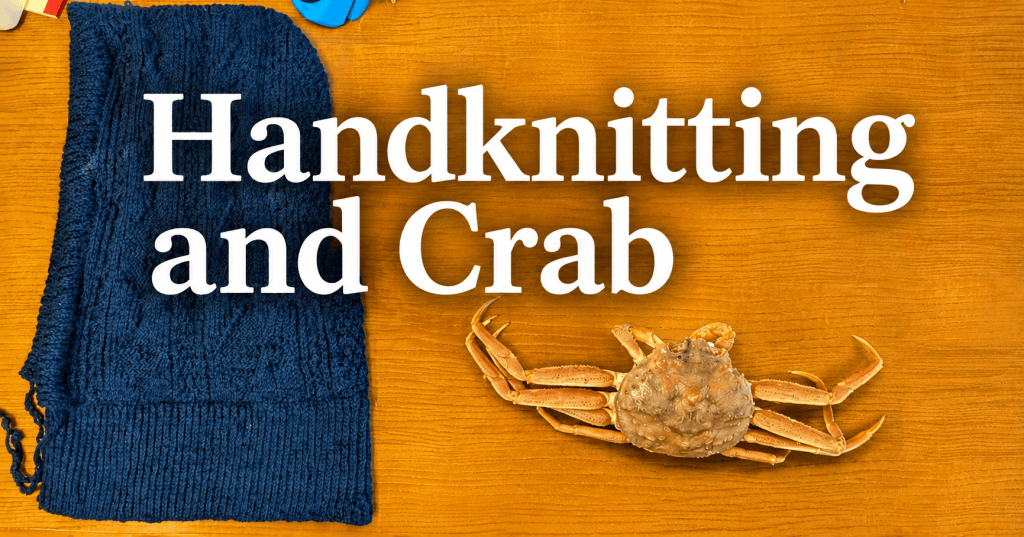
The balaclava I was knitting for my wife was almost finished. “Just a little longer.” I spread it out to show her. Without even turning her head, she said: “I want crab.” The mismatch between supply and demand was almost shocking.
My wife’s birthday was the following week. She was the one who had asked me to knit her a balaclava in the first place. But once you hit 49, apparently even the important things start slipping your mind. Then again, maybe it had never been important to begin with.
In retrospect, though, I shouldn’t have been surprised. My wife’s list of priorities went something like this: Our daughter. Herself. Alcohol. Crab. Me. The only one missing from that list was crab. For the record, I’m only on it because I made the list myself. Message received. I opened my calendar app and entered “Buy crab” on her birthday.
Crab had barged in just as I was planning to make a final push on the knitting. Would I finish in time? “Hey! Come give me a hand!” I called in our daughter for backup and had her crochet a drawstring. “I want to be able to tighten it and tie it, like on a parka.” “You mean a hoodie.” The look in her eyes, belonging to a generation raised on short-form videos, was positively pitying. Damn it. And she can barely handle decimal-point calculations. Our hip, happening fourth-grader worked that drawstring longer and longer at an astonishing rate, seemingly untouched by such adult afflictions as eye strain and presbyopia.
Beside her, I got on with the finishing touches. A balaclava is essentially a hood. To make it fit snugly over the head, you have to join the two knitted panels along the line running over the crown, like a mohawk.
It was less like knitting and more like sewing. I laid the knitted edges together, pushed a needle through, and pulled the yarn from the other side toward me, working in tiny increments of a few millimeters to make sure nothing would come undone. Whenever I managed to catch the yarn exactly where I wanted, I could feel it in my fingertips. It was a little like the satisfaction of pulling the entire digestive tract out of a shrimp in one smooth motion.
Unlike the intricate pattern knitting, which had kept me on edge for so long, this part was easy to undo and redo. There was little chance of making a mistake now, and I could finally relax. I loved this stage of knitting, when the satisfaction of finishing was practically guaranteed. Since I’d come this far, I decided to save the big reveal for her actual birthday.
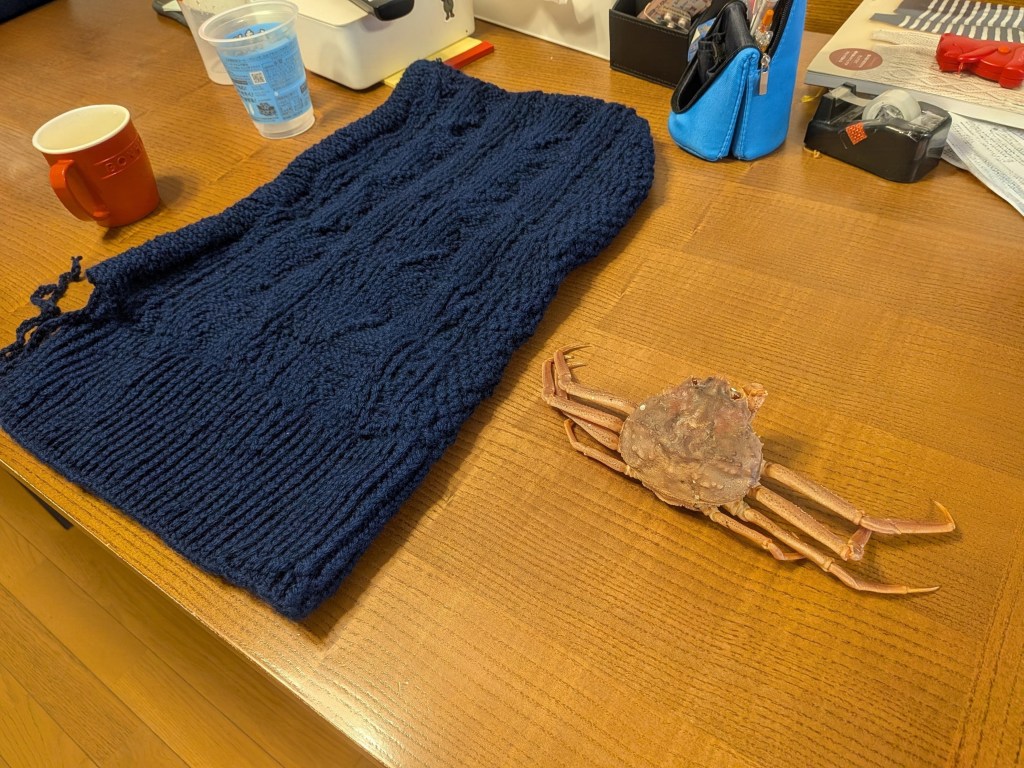
On the day itself, I took the train to a department store, only to discover one thing: since when did crab cost this much? I had developed a certain affinity for hairy crabs. Their fuzzy shells reminded me of balls of yarn, and somehow they even rhymed with the whole business of hand-knitting. But at ¥9,000 apiece, I was never going to be on friendly terms with one of those. Not in this lifetime. Oh well. It’s not as if the hair is where the flavor is. I went home with the kind of crab I could actually afford to feel attached to.
“Look what I brought home.” I called my wife over while washing the shell in the kitchen sink. “Oh! You actually got some!” It was rare for her to come anywhere near the kitchen. “Snow crab, huh? Doesn’t matter. Any crab’ll do.” While I got the steamer ready, she examined it like a marine biologist. “It’s a female! Maybe it’s got roe!” Her regional accent was getting thicker by the minute. She was getting excited. Her enthusiasm was worlds apart from anything she’d shown toward the balaclava.
I put the steamer on the heat. Twenty minutes later, I took a knife to the body and legs, releasing clouds of steam rich with the smell of crab. When I carried the platter to the table, my wife gave a little round of applause. “I could drink just from smelling that.” With the exuberance of someone who’d just won the lottery, she snapped the joints of the shell apart and sank her teeth into it like some kind of sea monster. Our daughter, meanwhile, was putting her crochet skills to work with a crab pick.
“Who knows if we’ll be able to afford crab next year.” My wife muttered this as she took a moment to catch her breath with a canned chu-hai. “Forty-nine. A year of struggles. Maybe it’ll turn into a year of tears.” She tried to disguise the weight of the situation with a lightness of words. “Never seen anyone get gloomy while eating crab.” “Don’t be stupid. Crab wins.” Without even turning to look at me, she kept picking at the meat.
My wife was a non-regular employee, and it looked increasingly likely that her contract would not be renewed at the end of the current term. Apparently, the company she worked for was ruthlessly switching its business partners. Her wages were already about as low as they could possibly go. Instead of cutting costs any further, the company had taken back her work-issued smartphone. If she wanted one, she could pay for it herself. Little by little, they were pushing her out.
“High-school graduate. Got a kid. Middle-aged woman. Three strikes against me at forty-nine. Think I’ll find another job?” She was talking a lot, but the frown on her profile suggested that the hard crab shell wasn’t the only thing making her work so hard.
“With your work experience, I’m sure there’ll be something. Age doesn’t matter that much these days.” I called out to her back while settling down on the sofa to put the final touches on the balaclava.
The hood itself was already finished. But with knitting, the real challenge begins after you think you’re done. I picked up stitches along the edges and added a neat finishing detail with a one-by-one rib.
Most knitted things are meant to be worn. Sometimes their details only really come alive in motion: catching the wind, turning your head, moving through the world. That was especially true for my petite wife.
By the time I’d threaded the drawstring our daughter had made around the opening, the balaclava somehow felt heavier in my hands.
“Okay. It’s done. Here you go. Happy birthday.” I held it out to her. She sprang to her feet as if someone had shouted, “Attention!” “Oh! You finished it! Thanks. I’ll take good care of it.” She accepted it with both hands and pulled it over her head. As she put it on, she ran her hands over the top, feeling the texture of the patterned stitches. “Damn. Hope I didn’t get crab smell on it.” Perhaps the alcohol was beginning to wear off. In the end, she kept the balaclava on until we’d polished off the crab porridge. “Ahhh, that was good. Next year, I’ll buy the crab myself.”
Unemployment was practically knocking at her door, and she was already talking about crab. Or perhaps it was precisely because unemployment was knocking that she needed crab. Either way, it seemed to have given her a much-needed boost.
Over the past few days, autumn had unmistakably come to an end in Tokyo. The air-conditioning units hadn’t been cleaned for winter yet, but my wife was wearing her balaclava around the house.
Now she was keeping her neck warm while scrolling through job listings on her phone. “Huh. There’s actually quite a lot that says no experience necessary. Don’t underestimate a commercial high-school graduate!”
A TV drama about the Hakone Ekiden, Japan’s famous university relay marathon, was playing in the background. Apparently, it had fired her up. “This thing’s warm! Maybe I’ll march right into Hello Work wearing it.” Apparently, she was getting a little too fired up.
Come winter, my wife’s list of priorities would become: The Hakone Ekiden. Our daughter. Herself. Alcohol. Crab. And just like that, I’d fallen off the list altogether. Maybe I should start a side hustle and try to earn myself a spot in the seeded ranks. Yarn isn’t getting any cheaper, after all.
I wonder what I’ll be knitting this time next year. As I imagined the possibilities, I picked up my own sweater project.


Leave a Reply