I was making dinner in the kitchen when my daughter came up behind me and poked me in the back. “Dad. I have something I’d like you to knit for me.” In her little hand was one of my knitting needles, gripped like a weapon.
It was the first time she’d ever asked me to knit something for her. But knowing my daughter, her idea of “something” rarely turned out to be something small. And the unusually polite tone was another bad sign.
“Can you make me some coasters?” “What for?” I asked, rinsing the dirt off some komatsuna greens. “We’re having this fun day at school, and I’m in charge of the prizes.” “Why don’t you knit them yourself? I’ll teach you.” “No way. I won’t finish in time.” “When do you need them?” “Tomorrow.” It was already six in the evening. My worst suspicions had been confirmed.
I glanced at the dining table where she’d been sitting moments earlier. Scissors, tape, origami paper, scraps of cardboard. It wasn’t so much a mess as the aftermath of a small-scale disaster. I’m all for giving things a try, but she had absolutely no sense of planning. Just like me. “Fine. Let me finish dinner first. Pick out the yarn colors you want.”
When I moved over to the sofa where I usually knit, I found five balls of yarn waiting for me. “Which color do you want?” “All of them.” “Excuse me?” “Five coasters.” She puffed out her cheeks with food and held up her hand, all five fingers spread wide. Dad is a soft touch. A dangerously soft touch. My daughter knew this perfectly well and had played her trump card. A flawless victory. I imagine dinner tasted especially good to someone who had just successfully unloaded a whole lot of work onto her father.
Still, coasters are pretty straightforward. Ten centimeters square should do the trick. Two or three hours for five of them, tops. I figured I’d be done by the time she finished dinner and emerged from one of her famously long, teenage-style baths. Since they were coasters, absorbency mattered. I swapped out the yarn for cotton and got my knitting needles ready.
I started knitting in the spring of last year. I’ve been at it almost every day for more than a year now, but my hands still haven’t quite found their rhythm. My stitches are uneven, and my finished pieces have a habit of losing their shape. Sometimes the needles and yarn glide together beautifully. Other times, they suddenly snag for no apparent reason. Lately, I’ve also started tripping over absolutely nothing when I walk. Maybe it’s the same phenomenon. In both cases, I can never figure out what went wrong. But then again, perhaps because of that, I’ve finally learned to make a proper gauge swatch.
Knitting has its own kind of rehearsal. You first knit a small square, usually around ten centimeters on each side, then calculate how many stitches and rows you’ll need with your particular yarn and knitting style.
This is called a gauge swatch. In the beginning, I found it tedious and skipped it whenever I could. I took up knitting to escape a job where I was constantly chasing numbers. The last thing I wanted was more calculations. Nobody was going to help me. I was knitting on my own, so why not just get started and take the shortest possible route to a finished piece? Predictably, the things I knitted that way were either too big or too small. One failure after another.
At the time, I was on leave from work, recovering from mental exhaustion. My approach to work had been much the same: rushing ahead on my own, getting nowhere, and making a mess of things.
I hated tedious tasks, but I hated failing even more. After reluctantly repeating the process enough times, the tedious part stopped feeling tedious. Maybe that’s what getting better actually looks like: getting used to things.
If anything, knitting had turned into a hobby in which I could enjoy the tedious bits. I’d also regained the ability to appreciate the luxury of having time to spend on something so seemingly pointless. My doctor had warned me: “Recovering from depression takes about three times as long as it took to develop it.” So I suppose I was making reasonably good progress. I’ve certainly come a long way. As I stacked the little square coasters, which looked rather like crackers, I found myself thinking about that.
My daughter had been glued to YouTube for a while, so I called over to her. “You can weave in the loose ends. That way you can at least claim you helped make them.” She came and sat beside me. The smell of shampoo lingered in her damp hair.
I took a tapestry needle out of my knitting box and handed it to her. “Don’t worry. It won’t stab you.” She picked up a coaster and was about to lick the loose end of yarn. “Whoa, whoa, whoa. Hold on.”
First, let me show you. This is the needle. Now, which end is the head and which is the butt? I guess the end with the hole is the butt. Anyway, you hook the yarn through that end and fold it in half. Like hanging a pair of jeans over a washing line. Yes, exactly. Then pull the needle out. See? It looks like a hairpin, right? Got it? Now pinch the folded end flat between your fingers and thread it through.
Her little fingers, round like her mother’s, tightened around the yarn until the tips turned white. “Done!” “That was fast.” Maybe small hands are better suited to delicate work. Mine, meanwhile, are starting to struggle with the fine print on medicine bottles.
“Now all you have to do is stitch the loose end into the least noticeable part of the knitting. Once it gets short enough, snip it off.” “Do you tie a knot at the end?” “Nope. You don’t need to. Once it’s woven in, it won’t come undone unless someone really goes at it.” I suddenly remembered the magician Mr. Maric had once used the friction of a cotton hand towel to perform a trick. While that memory was taking shape, I got on with heating up the iron.
I threaded the needle through the knitted fabric, pulled the yarn tight, and snipped it with scissors. There was something oddly aggressive about the whole process, and apparently it stirred something in my daughter. “What’s the point of moral education at school anyway?” A fourth-grader, already taking issue with the national curriculum. “They still have moral education classes?” “Because, like, say someone asks the class, ‘What would you do if you saw someone in trouble on the street?’” “That’s a pretty vague question.” “And everyone says, ‘I’d help them,’ right?” “Of course. What good little citizens.” “But when I said I couldn’t make all the prizes by myself, nobody helped me. So what’s the point of moral education?” A curious mixture of a tantrum and a philosophical argument. But I could see where she was coming from. “Your friends all have jobs to do as well, right? Sometimes you just have to make a plan and look after yourself. That’s how it works.” She still looked thoroughly unconvinced. Nevertheless, since the coasters were meant for other people, she carefully trimmed the loose ends down to the last millimeter.
Once I’d finished ironing them, she inspected the coasters, stretching them this way and that. “Are these okay? They won’t unravel?” “You can’t even tell where I stitched the ends in anymore, can you?” “Do you think people will be happy if they win these?” Apparently, she’d developed a sense of responsibility as my co-creator. She kept stroking the coasters with her palms, as if trying to preserve the warmth of the steam iron. I swallowed the words, “I did all the knitting, though.”
It was Thursday evening, four days later. I’d spent those four days fighting the urge to ask who’d won the coasters, whether they were a hit, and what the teacher had said. My curiosity was wearing me out. Then, as if she’d just remembered — which probably meant she’d forgotten all about it — my daughter casually filled me in. “Oh, by the way, K got one of the coasters.” K was the girl who’d knitted with me when I first took up knitting last year. “She figured out you made it. She said, ‘Your dad knitted this, didn’t he?’” Impressive. I hadn’t seen much of her lately, but she’d remembered. “And she was wiping sweat with it.” K: a rare talent whose delicate sensibilities somehow coexist with remarkably unpredictable behavior. I doubt the coaster had ever imagined it would one day be promoted to handkerchief. Good thing I’d used cotton yarn.
“Tell her we should knit together again sometime.” “I will. If she ever gets put in charge of the prizes.” There was a hint of pride in my daughter’s expression. The confidence of a former prize-committee member. Next time, perhaps I should make some Sumikko Gurashi dishcloths. I think I’ll start preparing now, just in case another desperate prize organizer comes knocking on my door.
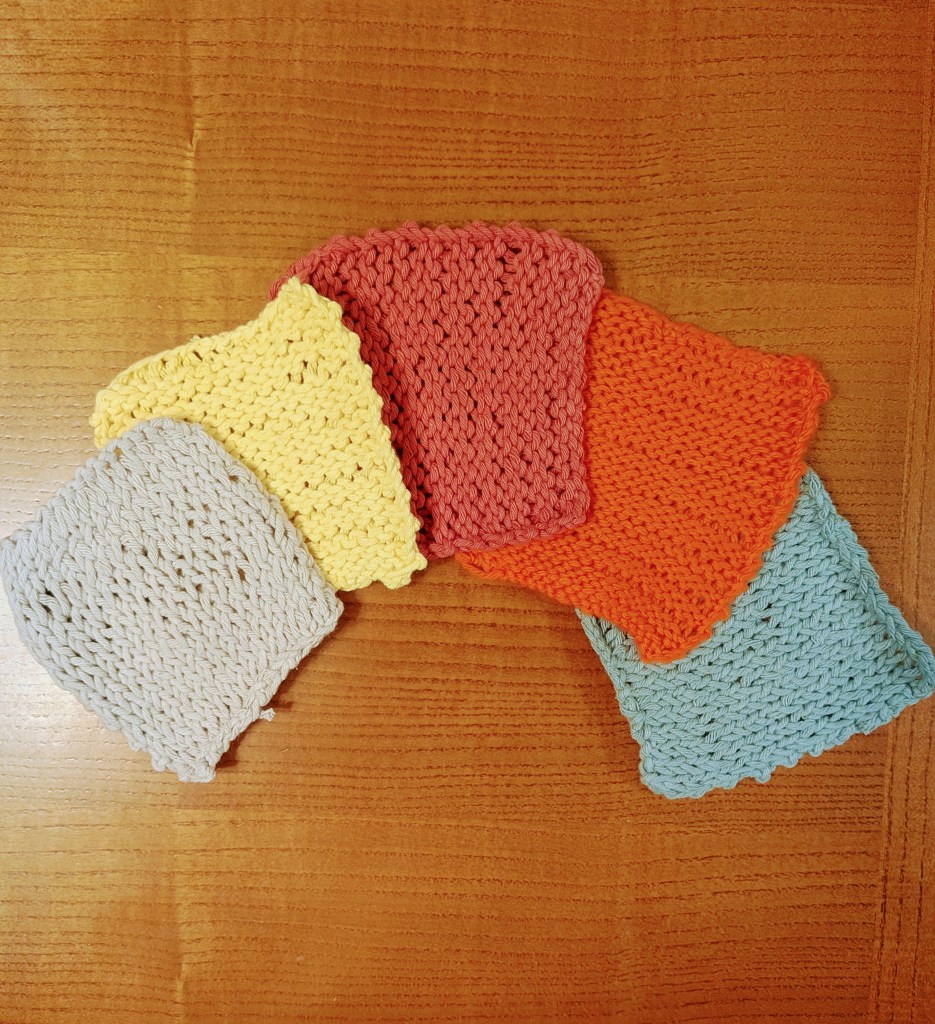
All five coasters, in their full range of colors. The light green one on the far right was later promoted to handkerchief status.


Leave a Reply