One thing I want to see with my own eyes before I die: my abs.
For me, a defined waistline is more out of reach than the Uyuni Salt Flats or the surface of the moon. My waist measures 91 cm, and my body fat percentage is 24%. My diet still hasn’t made a difference, and the first cold winds of winter have already arrived.
I wanted to knit a sweater. A simple, off-white one. This was my second attempt at making one this year. For my first, I followed a YouTube tutorial and ended up knitting it far too small. My wife took one look and said, “You look like a kagami mochi.” A traditional Japanese New Year decoration made of stacked rice cakes. I looked like I was wearing a full-body bodysuit. This time, I decided to follow a proper knitting pattern.
But every book of men’s sweaters I found in the bookstore seemed aimed at advanced knitters. The designs were elaborate, yet the books didn’t include actual charts, just a few rough notes. So I changed tack and looked for a beginner’s guide. Those, however, only offered women’s sizes. Apparently, the accepted path was for women to learn how to knit a sweater, then, once they’d mastered the craft, knit one for a man.
“There’s a man right here who knits his own sweaters!” I wanted to shout, with the conviction of a political candidate running for office as an independent.
Surely this wasn’t a problem for publishing professionals. I needed someone who actually knew knitting. So I left the bookstore and headed to a craft store, where I asked a member of staff for help. “Do you have any books on knitting men’s sweaters?” “Have you knitted anything before?” “Yes.” “Oh. So you have.” What was that “Oh” supposed to mean? “But this is my first time using a book.” “Yeah, a lot of sweater books only give you the basic instructions.” Apparently, this was a common problem. Good thing I hadn’t bought one on Amazon.
An entire wall was packed with knitting books, lined up so tightly there wasn’t a gap between them. The staff member reached straight for the bottom shelf, plucked out a book from the far left, and handed it to me. She moved like a librarian who knew exactly where everything belonged.
“Maybe this one. It has charts, and it doesn’t specify women’s sizes, so I don’t think it’s restricted to women’s measurements.”
It was The Sweater Knitting Handbook: Revised and Expanded Edition, published by Nihon Vogue. Even the sweater on the cover was exactly what I wanted: simple, but with stylish little details. This was it! The staff at Okadaya’s flagship store in Shinjuku are seriously good. “Would you like to buy it?” You bet I would. I thanked the woman who had rescued me in Shinjuku and carried the book home, feeling as though success was now guaranteed.
Promises are made to be broken.
Given my waist measurement, I should have chosen size XXL. But I firmly resolved to lose weight and went with XL instead. Even so, the yarn would cost a fair bit. Buying the recommended yarn listed in the book would set me back around ¥10,000. I wasn’t ready to invest more than the price of a ready-made sweater in something I might completely mess up. Sorry. The truth is, I didn’t have the money.
There was nothing for it. I’d have to use yarn on sale. The larger the surface area of my body, the more I resented it.
I decided to knit a swatch with the sale yarn and compare it with the recommended yarn to see what difference it would make to the finished sweater. Even if the difference turned out to be tiny, tiny, tiny. “Oh, crap. My gauge is completely different!” In knitting, gauge refers to how many stitches and rows you should work within a 10-by-10-centimeter square. Every pattern specifies a target gauge, but with my yarn, I was getting considerably fewer stitches and rows than the book called for. My prayers have never been answered by anyone, and this time was no exception. Would the sweater turn out too small if I carried on like this? One thing was certain: it wasn’t going to fit like an XL.
I’d have to account for the difference in yarn and recalculate the pattern. I found an AI knitting-chart generator made in France. Perhaps it was because France is the land of art, or perhaps despite being the land of art, the charts it generated were crude and simplistic. They looked like the kind of diagram you’d get in a school math test asking you to “calculate the area of the trapezoid.” There were also tools for creating knitting charts, but they were way beyond my capabilities. At this point, the only thing I could turn to was ChatGPT.
I entered the details of my yarn, then added my question at the end. “I want to knit an XL. My measurements will change if I follow this pattern with my gauge. Should I knit the XXL size instead?” “No. You should aim for the S size, not the XXL. However, there’s something you need to be careful about. Even if you knit the S size, the finished sweater may still turn out too large.” Seriously? I don’t trust people who start by telling me I’m wrong. But with AI, I was willing to make an exception.
With my yarn, I’d need fewer stitches and rows than the pattern specified. So I’d assumed the finished sweater would be smaller. But that couldn’t be right. If I could cover the same area with fewer stitches and rows, then following the original stitch and row counts would inevitably make the sweater bigger.
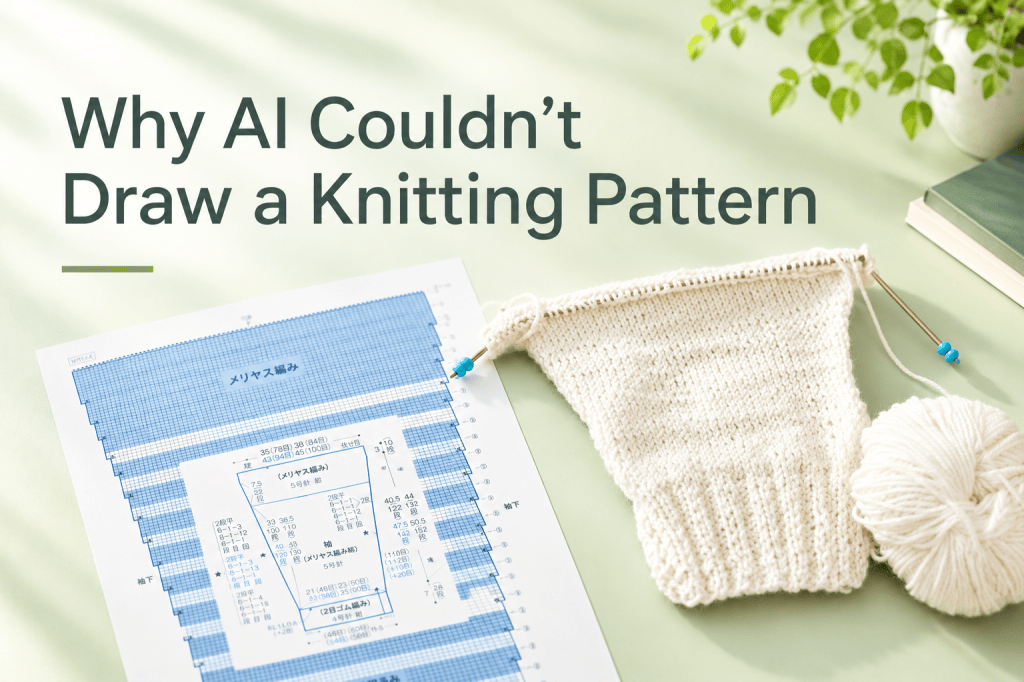
Math was never my strong suit. It reminded me of the confusion I felt when I first heard that the yen could strengthen even as the numbers went down. Okay. Knit smaller. I got that part. But how many stitches and rows should I actually work? I didn’t need someone to point me in the right direction. I needed a map. I opened the book and uploaded an image of the pattern to ChatGPT. “This is an image of a knitting chart. Please use it as a reference to create a pattern for me. Let’s start with the sleeves.”
It was for personal use, so copyright shouldn’t be an issue. Besides, I was doing this on my work account, so there was no need to worry about my data being used to train the model. Actually, I had a feeling another problem had just surfaced, but whatever.
“I’ve created a knitting chart. I’ve adjusted the sizing and seaming details to match your requirements.” It took barely more than a minute to generate the image. I was amazed by the range of tasks AI could handle, and by how quickly it could do them, from preparing work documents to creating knitting charts.
Then I checked the image and was amazed all over again. The sleeve silhouette was wildly wavy. What was this, a costume for a mambo dancer? “This is completely wrong. Why did you make it like this?” “I’m sorry. This isn’t due to the difference in gauge. It’s a mistake in my design.” I know.
“The sleeves should be straight.”
“Will these pieces even fit together when I sew them?”
“I told you to include the knitting symbols, too!”
After several rounds of revisions, the knitting chart had turned into abstract art. Wait a minute. Could it be?
“Can you not draw knitting charts?” “Yes. I’m sorry, but looking back at our conversation, I have to admit that creating knitting charts is a difficult task for me.” Unbelievable.
“Why?” “Having knowledge of knitting and being able to design an accurate knitting chart are two different abilities. A knitting chart isn’t just a visual representation. It’s technical information in which every symbol and position has a specific meaning. It’s closer to a computer program than a simple illustration. Multiplication alone isn’t enough to get it right.”
“But haven’t you been trained on big data?” “I don’t know exactly how much specialized knitting-chart data I was trained on. Even if I had learned from a large number of knitting-chart images, that doesn’t necessarily mean I’ve developed the ability to produce charts that have been verified as workable in practice. Understanding a knitting chart and designing one are different things.”
The excuses were so fluent that I couldn’t help feeling there was something deeply lacking in the whole exchange. “But if we write some Python code, it should be possible to—” At that point, I hit the ■ stop button. If I was going to get exhausted anyway, I’d rather be exhausted by knitting.
“Let’s simplify this. Just tell me how many stitches and rows I need to reduce.” “For the sleeve cast-on, I recommend 42 stitches. As a rough guide, aim for 135 rows.” That was enough. I could make adjustments as I went. I took a mechanical pencil and wrote ChatGPT’s advice into the book. My fingertips felt the glossy coated paper yield gently beneath the pencil.
Come to think of it, I’d been fiddling with my phone for ages. Was I really going to use AI even when I was knitting? I closed the screen, picked up my yarn and needles, and got back to work.
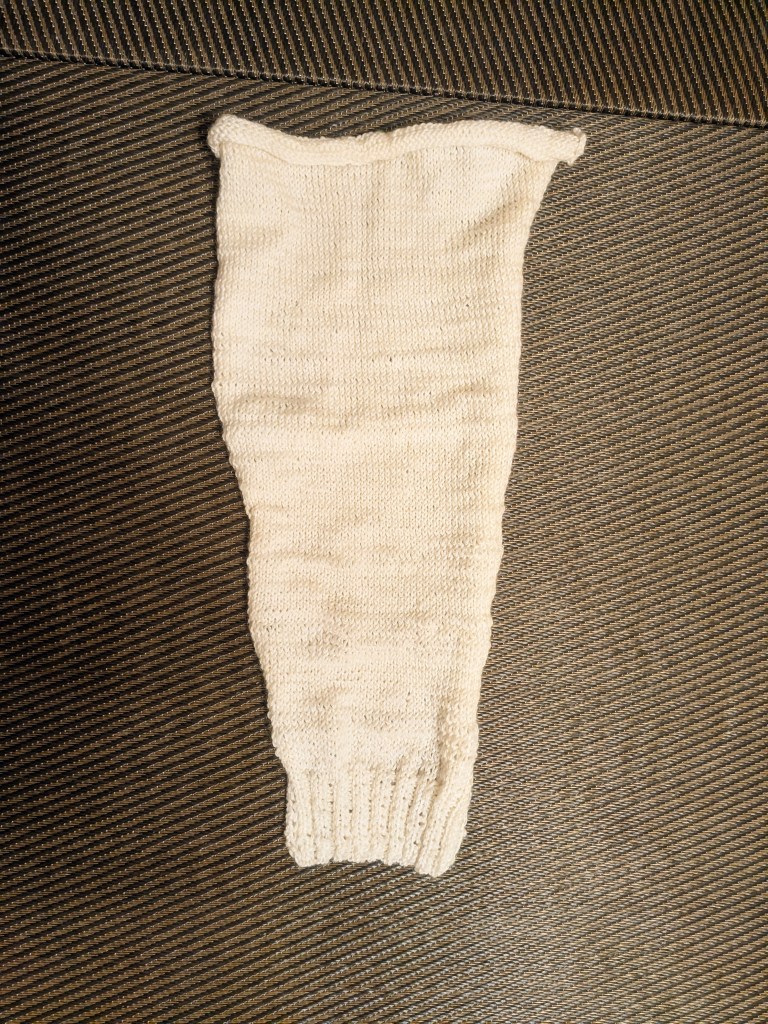
The other day, I finished the right sleeve. The fit was more or less what I’d been aiming for, although I’d fallen a little short on the row count. I looked back through the book, added a few more notes, and started working on the left sleeve.
I’ve grown attached to the book, even though it’s now covered in handwritten notes. It reminds me of the reference books I used to doodle in the margins of as a student.
I’m sure I’ll keep buying knitting books for years to come. I just wish someone would publish a beginner’s guide for big guys like me.


Leave a Reply