I grew up with about three father figures, two of whom had criminal records. Mom sure had a taste for the unconventional.
But they were ordinary guys, trying to make peace with society and protect their families. At least, that’s how they were when I lived with them.
Their buddies and younger associates were much the same. “Hey, how come J hasn’t been around lately?” “He’s at camp.” “Ohhh.” “You know that book The Unrepentant Faces Behind Bars? Never met a guy who came out of there having learned his lesson. Heh heh heh.” You’d think they’d learn. These were men who could joke about their own failings and laugh together, and who, for all their rough edges, were perfectly capable of understanding one another. Maybe toughness and a sense of humor were survival skills they’d developed through years of hardship.
That’s also why I got to see their struggles up close. I could imagine the stories behind their ending up in the “you made your bed, now lie in it” category. There must have been things they’d been through that were too painful or ugly to talk about. They couldn’t leave a story without a punchline. They’d pretend everything was a joke and laugh their way out of talking about it. In their own way, they were fragile and sensitive men, too.
Maybe growing up around people like them was what led me to fall in love with hip-hop, a form of rebel music. So when I first heard about this film, I couldn’t help thinking, If I don’t see this, who will?
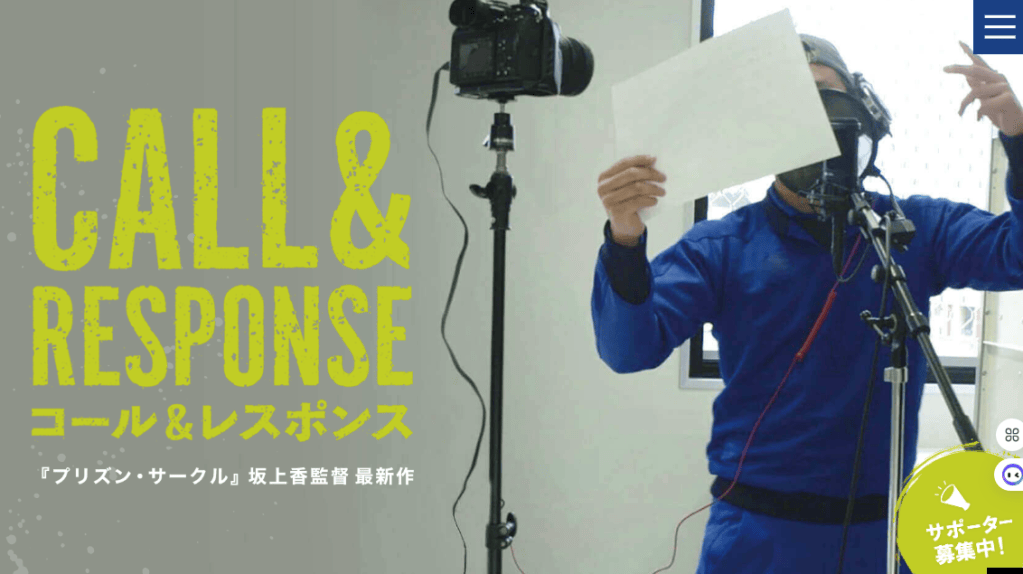
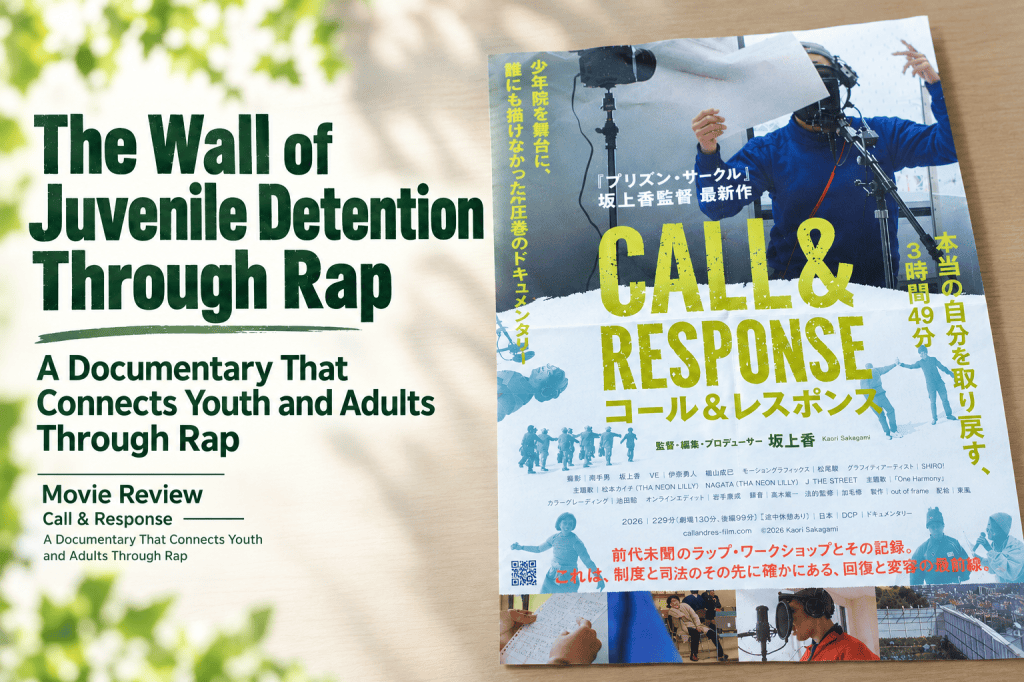
Call & Response is a documentary about a rap workshop held inside a juvenile detention center. Directed by Kaori Sakagami, the film runs three hours and forty-nine minutes.
I went to a preview screening the other day, and “interesting” doesn’t begin to describe it. On the walk back to the station, I was striding along with huge steps, feeling like a rapper just from the way I walked. I came back to my senses at the ticket gates. If a film can get even a 47-year-old guy like me that hyped, it’s unquestionably a masterpiece.
And that’s not all. The film may also have considerable documentary value, both as a pioneering example of juvenile rehabilitation and as a work of music sociology.
I want as many people as possible to see it, so I’m going to do what I can’t help doing and share three things that make this film worth watching.
Out of consideration for the privacy of the people involved and the potential impact on the boys who appear in it, the film will not be released on DVD or made available for streaming. Please see it in a theater. Sakagami’s films often enjoy extended theatrical runs across Japan.
Synopsis
One thing I learned from this film is that Japan has more than forty juvenile training schools. This documentary follows rap workshops held at three of them, in Fukuoka, Kumamoto, and Oita, over a period of six years. The boys give themselves MC names and turn their thoughts and feelings into lyrics, which they then perform as rap. Their songs are sent to volunteers outside the institutions, who respond with raps of their own. That’s the call and response: one side speaks, and the other answers. What happens on either side of the walls? What happens when people find a way to reach across them? That’s what this film is about.
1. A first for Japan: Rap workshops inside juvenile detention centers
The first remarkable thing about this film is the very fact that it brought rap workshops into juvenile training schools. As far as I understand, this was the first attempt of its kind in Japan.
Apparently, the boys are not allowed to talk to one another about themselves. In practice, that may come close to a blanket ban on casual conversation.
Given that many of them have complicated backgrounds, I can understand the need to protect their privacy and safety. But spending years in an environment like that can leave young people even less prepared to return to society when they are released.
Over six years, this project challenged an extremely conservative institution by introducing dialogue through words and music. The film documents an attempt to pry open possibilities that had previously seemed out of reach.
Perhaps that’s why the camera and microphone seem to approach the boys with such openness throughout the film. The filmmakers don’t miss a chance to capture a smile. They create an atmosphere in which the boys can rap without fear. Even their lyrics are left uncensored.
The filmmakers understand that these boys are not only offenders but, in many cases, victims of abuse themselves. What they need is not simply punishment, but healing and recovery.
You can feel the fresh air rushing through the opening this project has made in the system, and see the boys smiling as they breathe it in. That, I think, is what makes this film so refreshing despite the weight of its subject matter.
The official website also explains some technical terms, including “therapeutic community (TC)” and “restorative justice.” Sounds complicated, right? But you can get a sense of what these ideas mean simply by watching the film.
2. The moment the boys’ raps come together
The real stars of this film are the boys themselves and their rap.
They’re a hip-hop generation, quick to pick things up and naturally attuned to the rhythm and energy of the music.
Inside the institution, they weren’t even allowed to share their names or talk openly with one another. Then they begin writing lyrics, pouring out regret, remorse, hope, and stories of devastating experiences.
They’re there because they’ve hurt someone. There are victims, and that is an undeniable fact. But is that the whole story? As one boy stares at the words he’s written and works to refine them, you find yourself biting your lip along with him.
As they practice for the recording sessions, their individual personalities gradually emerge. There’s the charming kid who’s a little goofy, the boy whose clarity of thought is almost heartbreaking, the full-on troublemaker. All kinds of kids.
Rap, incidentally, is a surprisingly physical way of singing. You need to swing your arms and move your body to get the words out. Perhaps that movement helps the boys loosen up, too. Their voices, faint at first, grow louder. Their flow—their phrasing, rhythm, and shifts in intensity—becomes bolder. “Let me do another take.” The more deeply they get into it, the more powerful their performances become. They grab your ears and refuse to let go.
And when songs like these reach the volunteers outside the institution, those adults can’t just sit back and let the challenge go unanswered. They, too, put their whole bodies into their voices. Sometimes they cry as they pour their energy into songs meant to cross the walls and send them back to the boys inside.
Rap originally emerged as a way to get a party crowd going. It’s a form of music that comes alive when someone responds. Think of the classic exchange: “Say Ho!” “Ho!” The moment the boys hear the adults’ answers, their faces say it all. For me, that’s the single most powerful moment in the film.
3. Don’t underestimate the adults’ response
How did they manage to bring together so many adults like these?
The volunteers outside the institutions are such a diverse and fascinating group that you could make a whole film just about them. Among them are people who have themselves been behind bars, victims of serious crimes, and people who are skeptical about whether young offenders can truly recover. Each brings their own life experience to the workshop, playing a different role.
One person who particularly stood out was FUNI, the rapper who served as the workshop instructor.
According to his official profile and the film, FUNI is a third-generation Korean Japanese rapper, with a quarter of his ancestry from the Korean diaspora. He was born and raised in Kawasaki, Kanagawa, in an area he describes as a ghetto. Since then, he’s had quite a ride: he became a successful IT entrepreneur, spent time backpacking, and more. He calls himself “Japan’s most humble rapper.”
Rappers sometimes call themselves MCs, short for Master of Ceremonies. An MC does more than introduce performers. They build a sense of unity with the audience, guide the energy of the crowd, and sometimes take control of it.
Given the twists and turns of FUNI’s life—and the fact that his journey is still unfolding—he seems uniquely qualified to be an MC for these boys.
And the other adults are much the same. When you gather such a cast of characters and have them engage seriously with the boys, there’s no way the result can be a predictable, feel-good story.
As the workshops progress, the connections between the boys and the adults grow stronger. Watching where those relationships lead is another of the film’s highlights.
There’s one scene that left a particularly deep impression on me.
A woman talks about her experience as a victim, describing the scene of the incident in detail. One of the boys asks her a question: “Why didn’t the adults standing around stop the guy? He was right there, with a weapon. Why didn’t they stop him?” In other words: They were adults. Why just stand there watching? Do something.
The boy’s expression as he asks this is strikingly calm, without any visible strain. It’s a moment that offers a glimpse into just how close violence has always been to his life. What if I’d been there? “I would’ve stopped him if I’d been there.” I couldn’t honestly say that with any confidence. If I ever found myself in a dangerous situation, I’d probably be frozen with fear, unable to move. I might do nothing but look away from the reality that victims can become perpetrators, creating yet more victims.
And isn’t that, in its own way, exactly what society has done by abandoning these boys?
Watching this scene, I felt as though I was participating in the workshop myself. All I could do was be honest about who I was.
The boy was able to ask that question because the adults had kept listening to the boys and taking their stories seriously. They had continued to respond, sometimes exposing their own weaknesses in the process.
It was a moment when the adults’ sincere response became the starting point for the next call.
“I’ve learned a lot from living with Musuta.” I once heard my mother say that my “Oichan”—the man who had been a father figure to me—had said this about me. I think it was when he was looking for batteries and I took the AA batteries out of my Walkman and gave them to him.
The idea that you can have a positive influence on someone, and that the feeling can come back to you in a meaningful way: the men around me were late in discovering that kind of call and response. I hope these boys get to experience it in time. “Hope they do? That’s easy to say from the sidelines, isn’t it? You think you had such a good upbringing yourself?” Ever since watching this film, I’ve had the feeling that the men from my past are saying those words to me.
This has turned into a rather long introduction. But then, this is a major work that condenses six years into three hours and forty-nine minutes. Don’t worry, though. There is an intermission. Call & Response opens in theaters across Japan on December 5, with screenings rolling out nationwide. No DVD. No streaming. So if it comes to a theater near you, please go and see it!


Leave a Reply