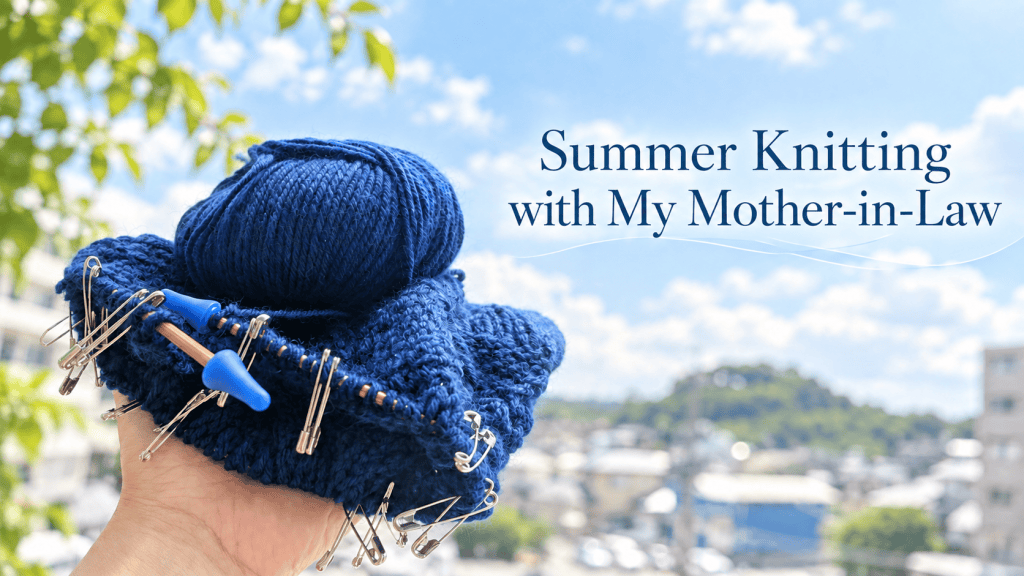
I wondered whether I was actually allowed to bring knitting needles onto a plane. The thought occurred to me only after I had already made it through security and was standing in line at the gate. A little late.
In August, we had gone back to Oita, where my wife grew up, to stay with her mother. My mother-in-law had ordered me to bring my knitting things. Apparently, she had been looking forward to knitting together. “I brought them.” I pulled my supplies out of my backpack and showed her. “Imagine that—knitting with my daughter’s husband. I could cross the Sanzu River tomorrow and die happy.” She said it with a grin so broad, I could picture her reaching the far bank of the river of the dead, doing a U-turn, and swimming straight back.
We knitted together every night while I was there. I was making a balaclava for my wife. She was making socks for her granddaughter—my daughter. Each of us was knitting for the other’s daughter.
“Mucchan, since when can you do patterns like that?” She peered down at my hands, widening her eyes. It had been a long time since I had seen her wearing reading glasses. “Yeah. I already made one for the kid, so now I’m doing an adult version. Mother and daughter in matching outfits. Cute, right?” “Oh, come on. You’re already way better than me.” Two people born in the Showa era, neither of us remotely bothered by the datedness of the phrase “matching outfits.”
That night, as usual, my wife and daughter paid us no attention whatsoever. They were busy belting out old Showa pop songs from a music program on TV. Summer, coconuts, whatever. Cold autumn weather would be here soon enough. Watching those two grasshoppers—who would, without question, be thanking us before long—we carried on with the knitting talk that only the two of us understood.
“Those kids have so much energy. There’s nowhere in Tokyo where they can really go flat out like that. I had fun too.” We had moved on to talking about the bike ride I had taken with my daughter and my wife’s young nephew, a distant relative of mine.
During Obon, the whole extended family descends on the house. Incense gets jammed into the family altar with the enthusiasm of someone lighting a flare, and the drinking starts while the sun is still high. Ding over here at the altar. Pssshh over there as another beer opens. My job was to get the children out of the house and keep them entertained.
Oita, as it happens, is something of an unsung rice-growing region. Rice is one of the principal crops even in Oita City. The paddies stretch all the way to the foot of the distant mountains, and the narrow paths between them run on and on. Down those long straightaways, the children raced.
My nephew charged out in front, exploding with the kind of life force you would expect from a cicada that had been told it only had seven days to live. He pedaled and pedaled and pedaled. “Hey! Slow down! That’s dangerous!” “Hee-hee-hee-hee!” My daughter tore off after him. I chased them both. I couldn’t remember the last time I had stood up on the pedals like that.
The summer sky. Swarms of dragonflies so thick you almost wanted an umbrella. The smell of green rice fields. The whir of bicycle chains.
And then, in the middle of it all, my nephew disappeared.
He had ridden straight into a drainage ditch. “Whoops! I fell in! AHAHAHAHA!” My daughter grabbed his arm and hauled him up, while his laughter only got louder. At this point, he seemed to have forgotten breathing was necessary. “You hurt?” “I’m fine, I’m fine.” Yeah. I figured.
It was recklessness of an almost refreshing purity. I hadn’t seen him in a few years, and somehow he had grown into one tough little kid. “You are such an idiot.” I pointed at him and laughed. It was louder than I ever laughed in Tokyo. The kid his age from Tokyo had come again this year. His uncle had come too. He was having the time of his life. I knocked the mud off his shoes and tucked the hem of his T-shirt back into his pants.
“He’s really getting tough.” “Don’t ever take that boy out again.” My mother-in-law said it flatly. My hands stopped. I looked up. Her lowered eyes and twisted mouth made it clear that she could barely stand listening to me. “I’m sorry. It was dangerous, wasn’t it?” Of course it was. I could have let him get hurt. It wasn’t the sort of story I should have been telling as though it were funny.
My mother-in-law kept knitting. “No. That’s not what I mean. That boy isn’t like other kids. He can’t do everything the other kids can do. You don’t need to take him anywhere anymore. Just don’t. All right?” My nephew had a mild intellectual disability.
Had I sounded as though I were making fun of him? No. There was no “as though” about it. I had literally said that I called him an idiot and laughed. To me, it had been nothing more than a funny story about a mishap. A story about what a wild kid he was. I had thought I was talking about him without his disability having anything to do with it. That was not how my mother-in-law had heard it. Could I have told the same story to his parents? I wanted to bury my face in the knitting in my lap.
“I’m sorry. I shouldn’t have said that.” “I just feel so sorry for that boy.” I could hardly reply, But aren’t you the one looking down on him? She let out a long breath, almost blowing it directly onto the sock in her hands. “You know,” she said, “when I was little, there was an air-raid shelter at my school.”
And from there, she began to talk about the war. “Oita got bombed too, you know.” There had been an air-raid shelter at the school she attended. Not exactly on the school grounds. The schoolyard faced a sheer cliff, and tunnels had been dug sideways into the rock. They had originally been communal tombs dating back to Japan’s Kofun period, more than a thousand years earlier. During the war, they were used as air-raid shelters. I went to see them myself later. There were holes everywhere, so many that the cliff face looked like pixel art.
Whenever the sirens sounded, the schoolchildren would run into the shelters. Among them was one boy who was always restless. He couldn’t stay seated. He couldn’t sit quietly through class. And being inside an air-raid shelter did not magically change him. “Everyone started yelling at him. ‘Shut up! If you can’t be quiet, get out!’” His classmates turned on him.
Eventually, they forced the boy outside. My mother-in-law, still a little girl herself, watched him from deep inside the cave. “He just sort of wandered out. Like this…” She kept knitting as she spoke, her voice matter-of-fact. Then she added only that the bombers never came that day. There had been an alert, but no raid.
His disability has nothing to do with it. Perhaps, hearing me say things like that with the confidence of someone who thought he understood, my mother-in-law had sensed something in me that reminded her of what she had once witnessed. I wondered what she had felt while watching news reports about evacuation shelters in neighboring Kumamoto.
The part of my stomach beneath the knitting had grown damp with sweat. Even half-finished, wool traps heat. But this was not that kind of sweat. I was already hunched over my work, nearly folded in half. Still, I felt myself shrinking further.
“And then…” Years later, she said, the old shelters were closed off. Apparently, some idiots had started lighting fires inside them. One of those idiots was my wife’s older brother, Y. “Oh, the school called me in. I got such a telling-off. Again and again…” “What on earth was he thinking?” She was trying to move the conversation along. I had no right not to follow her lead.
My mother-in-law placed the half-finished sock on the dining table and took off her reading glasses. I stood too, went into the kitchen, and started making something for her to snack on. The kitchen was full of equipment—far more than an elderly woman living alone could ever need. She was probably always cooking for visiting relatives and barely eating any of it herself beyond the occasional taste. Nothing tastes quite as good as food someone else has cooked for you. That, too, was something only the two cooks in the family understood.
I did not know how to apologize. No apology seemed enough. And bringing the subject up again felt wrong. So I decided that, at the very least, I could listen to her stories. There must still be so many things I needed to hear while she was well enough to tell them. The next time we came back, I thought, I would bring my knitting things again.
 Musuta Kusaka's Everyday Journey with Diversity, Equity, and Inclusion in Japan
Leave a comment