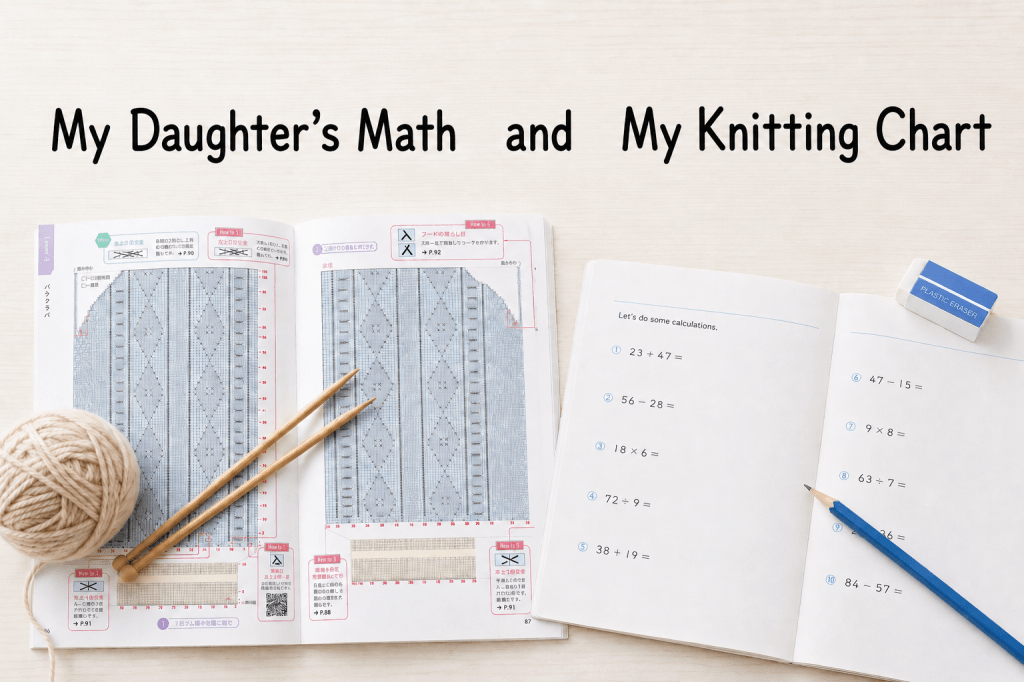
My daughter thrust her worksheet toward me with the dramatic pride of a lawyer announcing a courtroom victory. “We won!”
It was a returned math test. Score: 4 out of 50.
“Well,” I told her, “you answered every question. That counts for something.” For now, praise felt more useful than accuracy.
My daughter is spectacularly bad at math. The drill worksheets my wife gives her are covered in so much erasing and rewriting that the paper practically turns transparent. Sometimes she clutches her head in fake despair while secretly making little sculptures out of kneaded erasers under the table. Watching her is like watching my childhood replay itself in HD.
I was terrible at math too. Honestly, I was terrible at almost every subject. I used to fill my kanji notebooks with fake ancient symbols just to make classmates laugh. Back then, I believed adulthood meant freedom from studying forever.
Instead, adulthood tricked me into studying knitting charts. Life comes at you fast.
I started knitting a year ago. At first, YouTube tutorials were enough. I copied what I saw, paused videos constantly, and somehow made things that looked vaguely wearable. But eventually I hit a wall.
There was, for example, The Sweater Incident. I spent three months knitting a sweater only to discover, after proudly putting it on, that it fit like industrial-strength shapewear. My body still remembers the suffocating feeling. After that, I realized I needed to actually understand patterns — not just imitate hand movements on a screen, especially if I wanted to knit things for my wife and daughter.
They’d probably say they didn’t want anything. But I work in sales. “I don’t need it” is merely the opening round of negotiations. So I decided to level up my knitting skills the same way I’d approach any professional challenge: by learning how to read knitting patterns properly.
I bought a beginner’s guide and opened it. At first glance, it looked oddly similar to a recipe book. Needle sizes. Finished dimensions. Step-by-step instructions. And then, in the center of the page, a dense jungle of tiny squares packed with mysterious symbols.
Honestly, though, the symbols themselves aren’t the hard part. Knitting symbols work like pictograms: one symbol equals one stitch. Very direct. A vertical line means a knit stitch. A horizontal dash means purl. Some decrease symbols even visually resemble the direction the yarn leans. Once you learn the logic, it feels surprisingly intuitive.
The names sound intimidating — things like “right-slant decrease” and “left-slant decrease” — but once you actually knit them, you realize the names are just describing exactly what the yarn does. It’s kind of like snowboard tricks: terrifying until you realize the fancy terminology is basically just counting rotations.
What fascinated me most was the history. Modern Japanese knitting chart symbols were developed in the early 20th century by Haruyo Eto, during a time when many women had limited opportunities for financial independence. The system was designed to make knitting easier to teach, learn, and share. You can feel the care embedded in it.
And yet, even knowing that, turning the pages felt strangely exhausting. Somewhere along the way, I had become the kind of adult who survives using only familiar knowledge. New things started to feel bothersome. Maybe I simply didn’t want to confront how long it had been since I truly struggled to learn something.
So I borrowed my daughter’s study habit. She always studies at the dining table, and I started sitting beside her with my knitting charts, choosing beginner-friendly patterns and practicing row by row on weekends and sometimes weekday nights too.
“I hate this,” she groaned one evening, collapsing face-first onto her math workbook. “I’m never gonna use math when I grow up anyway. Why do I have to do this?”
“You use math all the time,” I said. “I use it at work when making estimates.” “That’s your computer doing it.” Unfortunately, her logical reasoning skills work perfectly fine.
When she asked how long I was planning to keep studying, I told her maybe another twenty minutes, until nine. “Then I’ll keep going too,” she said, and just like that we started holding nightly study sessions together. Unexpectedly, her study time gradually got longer.
Mine, meanwhile, became unbearable.
I had no idea knitting charts would be this visually exhausting. What row am I on? Which stitch number is this? I constantly lost track and recounted the same tiny boxes over and over. “One-two-three-four-five… wait… one-two—” “Dad, you’re distracting me.” Sorry.
Every time I shifted my focus between the knitting in my hands and the chart on the table, my vision blurred slightly. A dull headache settled behind my temples — the same kind of warning ache you get one drink too late.
But the real fatigue wasn’t physical. It was mental.
Knitting charts are drawn from the “front” side of the fabric. When you knit from the reverse side, you have to mentally flip everything in your head. And once you move into three-dimensional items like hats, shaping diagrams become even harder to visualize. It’s like looking at a flat world map and trying to imagine the globe it came from.
Reading knitting patterns turns out to require an absurd amount of spatial reasoning — honestly, more concentration than my actual job. Sweat gathered slowly on my forehead as I stared at tiny symbols that would have meant nothing to me a year earlier.
I found myself remembering elementary school math classes — the geometry problems I hated, the spatial puzzles I never understood. Looking at my daughter’s small hunched back as she fought through her worksheets every day, I suddenly wanted to tell her: You’re trying really hard. I see that now.
Still, as the parent, I couldn’t be the first to quit.
Our study sessions started feeling less like homework and more like surviving a sauna endurance challenge. When I asked how many pages she still had left, my daughter started counting. And counting. And counting. “That many?!” “It never ends,” she sighed. Then she asked whether I was still going too. “Yeah,” I said. “I still have knitting left.” “How much?” “About 150 stitches across 25 rows.” She grabbed her mechanical pencil and started scribbling numbers. “…That’s 3,750 stitches.” “Wait, really?” I checked on my phone calculator. She was right.
I praised her like she’d just solved world peace. “That’s amazing! Seriously! Just deciding to calculate it yourself is already impressive!” She grinned instantly, still very much a fourth grader. “See? Math is useful.” “AI could’ve calculated it too,” she replied, then held her phone up to her face and asked it aloud, “What’s 150 times 25?”
Apparently even calculator apps are old-fashioned now. Watching learning itself change shape in real time somehow made knitting charts feel warm and deeply human.
Around then, my wife wandered over to inspect our progress and casually stole my knitting book. She flipped through it the way people browse furniture catalogs. “Oh, this one’s cute.”
My daughter immediately abandoned her homework and leaned over. “If you make one for Mom, I want one too. Black color.”
Suddenly I had backorders. I’d never expected either of them to genuinely want something I made. For the first time, my practice had a real purpose. And at the same moment, I realized something uncomfortable: I had never really tried to discover what my daughter wanted to create for herself.
The three of us stared together at the pattern page they’d opened. Something unfamiliar was printed there.
What exactly is a balaclava?
And what does ‘cable pattern’ mean?
My knitting-chart education continues.


Leave a Reply