“You look like a kagami mochi.” My wife burst out laughing, then took a big satisfied gulp from her canned chu-hi.*
* Kagami mochi: a traditional Japanese New Year decoration made of two stacked round rice cakes, famously plump and white.
* Chu-hi: a popular Japanese canned alcoholic drink, usually shochu mixed with soda and fruit flavor.
I was trying on an off-white sweater — my first ever major knitting project, three months in the making. “Look! I finished it!” Unfortunately, the fit landed somewhere between “compression wear” and “full-body spandex.”
My stomach stretched the fabric outward so hard it looked ready to tear. My chest and shoulders were packed in tight, and breathing felt slightly optional. The bulky silhouette, plus the unforgiving pale color, completed the image perfectly. A kagami mochi. Honestly… fair enough. “Heh. Guess I got the size wrong.” “Isn’t that supposed to be women’s size?” Still, making my wife laugh felt like a win.
I’m 174 cm tall (5’8″) and weigh 78 kg (172 lbs). My waist is 98 cm (38.5 inches). Before “kagami mochi,” I’d once been compared to “a 1970s Japanese pro wrestler.” I’m already a pretty big guy, and instead of measuring properly, I knit by instinct and rough guesswork. Which is exactly why the sizing went wrong. But on the bright side, I’d at least gotten good enough at knitting to understand that measurements probably matter.
I started knitting about a year ago, while I was on leave from work due to mental health issues. A friend recommended a book about knitting, and somehow I thought: Maybe this is my thing. The startup cost was almost nothing — needles and yarn for maybe two dollars total. Funny how the hobbies you start casually are sometimes the ones that stay with you the longest. Knitting became an unexpected form of self-therapy.
When I focused on the movement of yarn and needles, my fingertips seemed to wake up. I adjusted the tension with my fingers, looped the yarn around the needle, threaded it through tiny gaps. It was millimeter-level work, yet the texture of the yarn felt tangible and gentle.
Thinking with my hands, feeling with my fingers — it gave my brain a chance to rest. The anxiety and tension that had been buzzing nonstop in my head, like a phone that never stops ringing, slowly quieted down.
And as my mind relaxed, my body loosened too. Knitting during weekday afternoons made me realize something: apparently, I’d been tense all the time. At work. At home. Everywhere. Only after putting down the weight I’d been carrying did I realize how heavy it actually was.
Bath. Brushing my teeth. Knitting. That routine continued even after I returned to work, and somehow my life gained breathing room it had never had before.
At night, after my wife and daughter had gone to sleep, I’d knit. Sometimes for thirty minutes. Sometimes only fifteen. The living room empty. Every digital device turned off. Nothing in front of me except the stitches.
From somewhere outside came the sound of a front door opening and closing. A dog barking. Bicycle covers flapping in the wind. Then suddenly, a drunk guy singing at full volume while walking down the street — approaching, then fading away again. A cheerful little Doppler effect. And after that, silence again, as if someone had turned down the world’s volume knob.
Once I finished a section and crawled into bed, I no longer felt like looking at my phone. I slept well. What I gained, I think, was my own time. I used to drink every night just to forget about work. Knitting replaced that. The repetitive motion feels strangely musical, almost hypnotic. The rhythm deepens the longer you keep going.
As a result, my alcohol intake dropped to maybe a tenth of what it used to be. Though the beer belly, sadly, remains as a historical artifact. Instead of piling up empty cans, I started piling up rows of stitches.
That changed something. Every day came with a small sense of accomplishment. If you keep knitting steadily, the piece steadily grows. There’s comfort in that — a kind of reassurance work rarely gives.
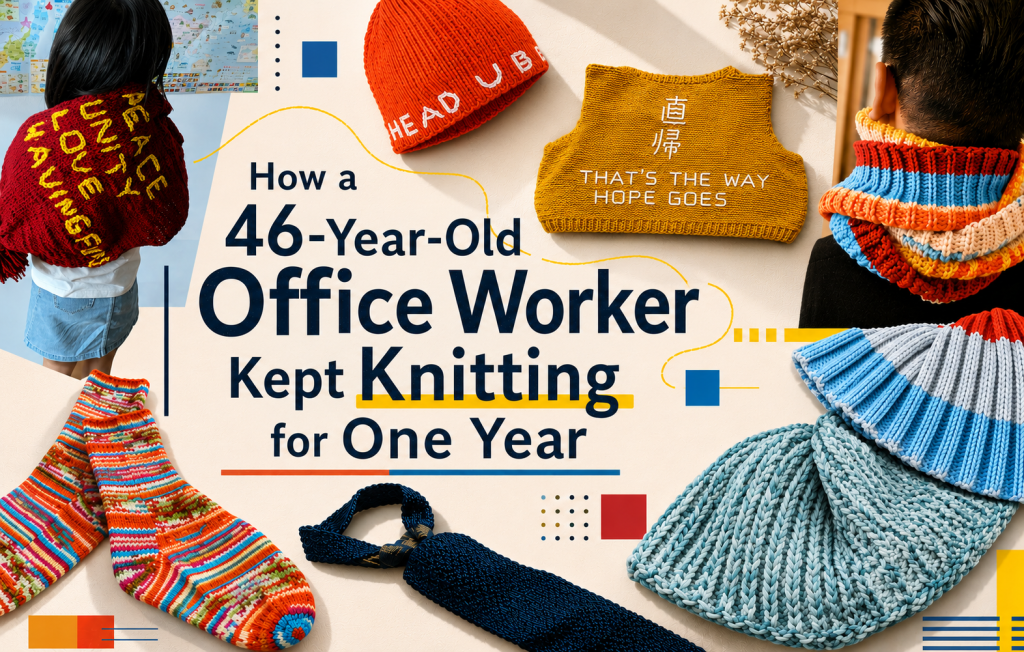
Over the past year I’d made knit caps, scarves, neck warmers, ties, vests, socks… one neck warmer that accidentally began life as a belly warmer… and some mysterious pot-holder-shaped object with no identifiable purpose. And now, finally, a sweater.
“Lemme try it on.” My wife crooked four fingers at me — the universal sign for hand it over. “Maybe I can wear it.” That surprised me. She’d never shown much interest in my knitting before. Honestly, she rarely showed much interest in me. And yet here she was, pulling the sweater over her head. Maybe she felt bad for laughing so hard earlier. I could tell this was her version of kindness. “Oh. Huh. Maybe it works.” She stood there while I looked at her closely.
…Was she always this small?
The shoulders drooped low. Her collarbones nearly showed through the neckline. The fabric sagged around her chest and stomach, loose enough to let the wind through. She wasn’t really wearing it so much as hiding inside it.
Of course I knew it would be too big for her — I’d made it for myself. But still. Maybe, somewhere along the way, she’d become a little smaller.
She’d always been slender. But when she turned around and asked, “How’s the back look?” all I could see was how fragile the line of her neck looked. And the crown of her head — almost completely white now. Had she been dyeing her own hair this whole time?
While I’d been completely consumed with my own struggles, she’d quietly been approaching fifty. And now, I realized, I didn’t even know her clothing size anymore. If I learned how to properly read knitting patterns, maybe someday I could make something that actually fit her.
“Nah. Still way too huge.” She wrestled the sweater off carelessly. “If you actually wanna wear one, I’ll knit you a proper wool sweater next time.” “No thanks. Maybe it’s the stitching or whatever, but it’s kinda lame.” She said lame in Tokyo dialect for some reason. That mouth of hers ought to be sewn shut with a crochet hook.
“But hey,” she added, “you actually finished it. Bet the next one’ll turn out better.” Classic my wife: says something genuinely nice once every total lunar eclipse. Still, I’d been thinking the same thing. This past year had plenty of failures, dead ends, and retries. Even this sweater ended up the wrong size. The seams were clumsy. There were improvised fixes and cover-ups everywhere.
But it was finished. And honestly, just reaching the finish line counts for something. I try to give myself credit for that sometimes. Knitting taught me more than how to make clothes. It taught me how to live with myself a little more gently.
Anyway — congratulations on finishing the sweater. Year two starts now. Next time, I’ll make something my girls can actually wear. First step: learn how to follow a proper pattern.
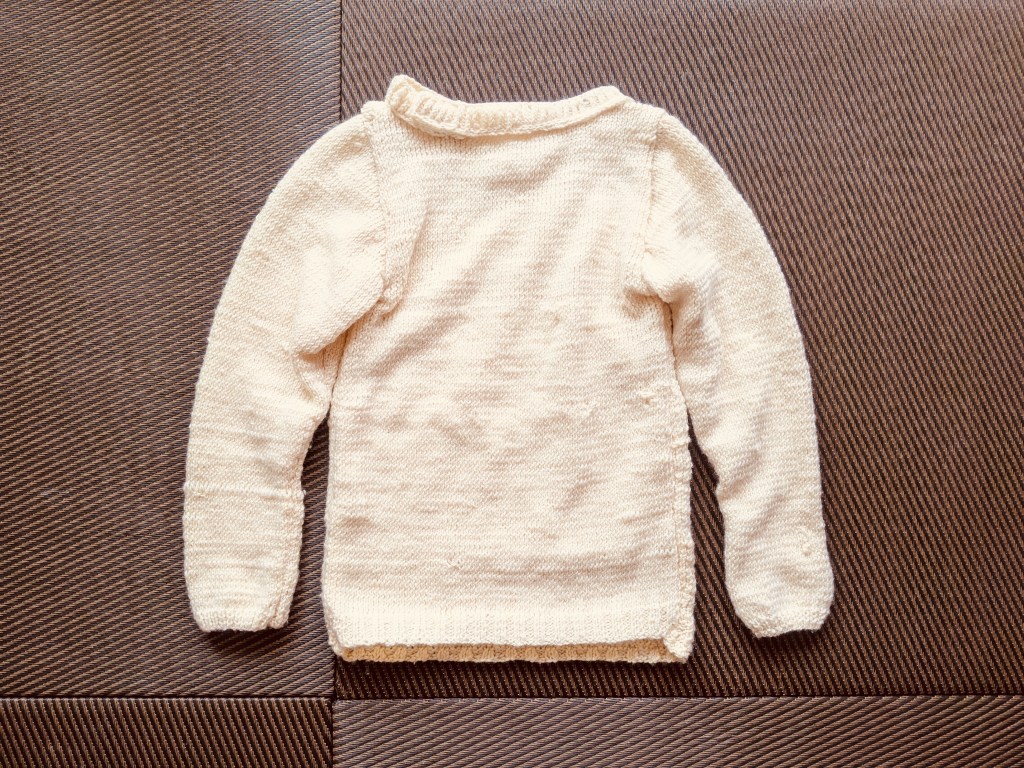
The collar is thick and uneven. The sleeves are oddly wide, while the body is visibly too narrow.


Leave a Reply