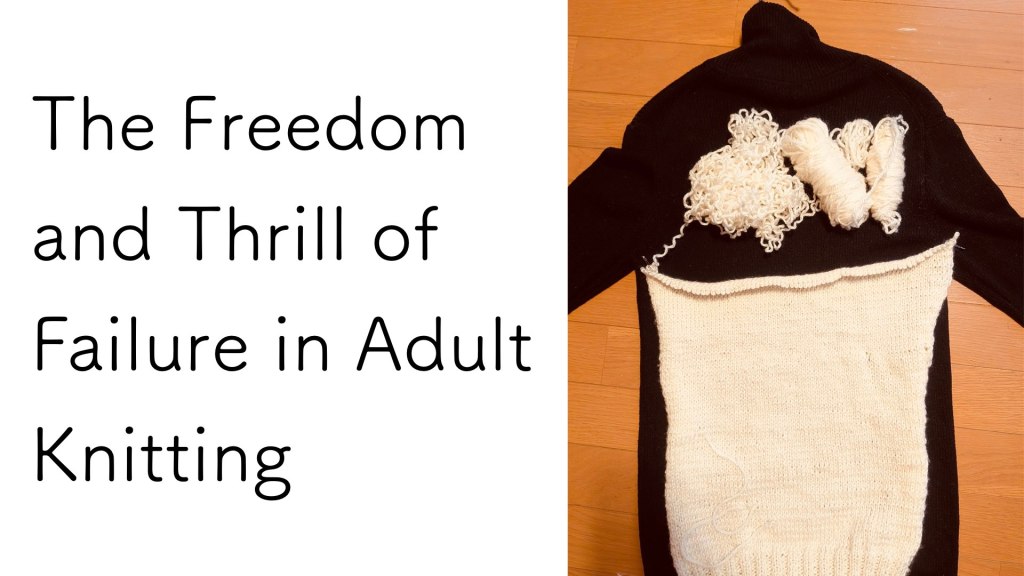
From 148 all the way back down to 100 in one shot. If that had been my blood pressure, I’d have collapsed. Then again, even without the blood pressure joke, I almost did.
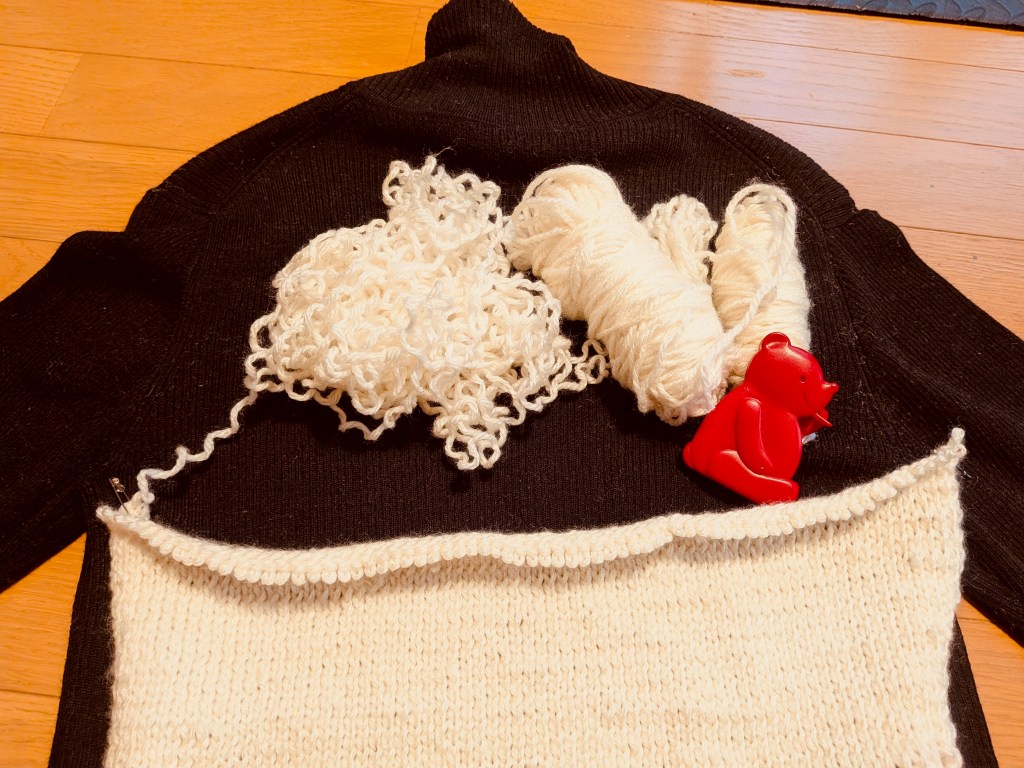
I had to unravel the sweater I’d been knitting. Rip it back from row 148 to row 100. My heart felt the G-force of the plunge. Half a skein of yarn — roughly 30 meters of knitting. Thirty painstaking meters built up millimeter by millimeter, about to disappear in minutes. The white fabric started to look like spring snow to me. Fleeting. Painfully fleeting.
It was the front panel — the section from the neck down to the stomach. Apparently, I hadn’t shaped the shoulder curve correctly, so it wouldn’t line up with the sleeves. I hadn’t decreased enough stitches. This is what happens when you click on YouTube videos promising, “You can totally knit a proper sweater by feel!” Beginners cannot, in fact, knit a sweater “by feel.” This was the price of trying to cut corners. There was no other option. Before regret could freeze me in place, I started pulling the yarn free faster than my emotions could catch up.
Four hours to knit. Five minutes to destroy.
And those five minutes were glorious.
Ping. Piping. Pipipipipipipi.
Each time the yarn slipped free from a stitch, it bounced ever so slightly. Tiny rounded vibrations tickled my fingertips in an uninterrupted stream. It reminded me of the string telephones my daughter and I used to make. Mixed into that sensation was something deliciously forbidden. I was doing something I wasn’t supposed to do. There was no turning back. I couldn’t stop. At one point, I instinctively closed my eyes.
The more intoxicated I became by the sensation, the faster my hands moved.
“Well… whatever. It’s not hurting anybody.”
Maybe that irresponsibility — that freedom — was part of the pleasure too. Like dancing through chaos with a carefree “eh, who cares?”
Unfortunately, real-life chaos had been piling up since April.
The start of the fiscal year in Japan means transfers, resignations, new hires — endless handovers. Every day felt like an obstacle course of hidden traps. I almost wished every day were April Fool’s Day, because at least then the disasters would’ve been intentional.
And because I work in IT, April is also peak season for launching newly delivered systems. Technically, I’m the sales team leader, which means the responsibility lands on me. Except it wasn’t just my team making mistakes — I was making them too. We weren’t falling into potholes anymore. We were plunging into sinkholes.
“Kusaka-saaan, client says they can’t register users.”
One of the younger staff escalated the issue to me in an oddly casual tone. The system had been handled until the very last minute by a mid-level employee whose farewell party we’d held just last month. His “parting gift” was now officially going live. Except the client couldn’t even register users.
Email settings. Browser settings. Security. Network configuration. We checked every possible cause, and nothing fixed it. Meanwhile, the junior employee reporting all this with breezy indifference became increasingly irritating by the second. I couldn’t stop bouncing my leg.
“Wait… how many accounts did we deliver? Six?” “No idea. The handover documents say sixty.” “What? What about the contract?” “Sixty there too.” “…And the estimate?” “…Uh… six.”
Not a configuration mistake. A handover mistake. We’d failed to cross-check the documents. If I’d just looked carefully at the estimate, I would’ve noticed immediately. Accounts are normally sold in batches of ten. Six is such an unnatural number it should have set off alarms instantly. Who was the idiot who approved this estimate? Me. As I loosened my tie, my hands felt cold and damp, like I’d been gripping ice.
Normally, account limits have some built-in buffer. Clients gain and lose employees all the time. But going from six users to sixty isn’t “buffer room.” It’s human error. More specifically, my error.
And because it was entirely our fault, there was no way we could turn around and say, “Actually, could you pay ten times more?” So now we were locked into a year-long project with profit margins as thin as rice paper.
Somewhere, somehow, we’d have to make up the loss. Cleaning up the mess was my responsibility. But inevitably, the burden would spill onto the rest of the team too — indirectly, sometimes directly. The guilt layered itself two, three times over, tightening around my neck.
Compared to that, what was dropping from row 148 to row 100? That mistake belonged only to me. A private failure. No clients. No contracts. No collateral damage. For a brief moment, I got to reclaim time that existed only for myself. So there I was in the living room, swinging my arms wildly as I unraveled yarn.
The next week, after re-knitting the front panel and finishing the back, I finally reached the assembly stage: sewing the torso and sleeves together into an actual sweater. It had the excitement of assembling one of those giant combining robot toys.
I swapped my knitting needles for a crochet hook and began slip-stitching the pieces together tightly so they wouldn’t separate.
Then— Ah. Wrong again.
I thought I was sewing a sleeve. Turns out I was sewing the back panel shut instead. The sweater curled into a tube, making it look like someone had strapped a squid to their bare back. What kind of situation even is that?
I grabbed a box cutter and started slicing through the seam thread, snip snip snip. The feeling was strangely satisfying — like cutting open a soft omelet and watching it fall apart. Not that I’ve ever successfully made one.
I could tell I was getting bolder. Honestly, I might even be getting better at making mistakes than at knitting itself. But maybe that counts as progress too.
Anyway. Now the seams are finally coming together, and I can see the finish line. And yet, a new sense of danger is creeping in. This thing looks really small. …Surely that’s just my imagination, right?


Leave a Reply