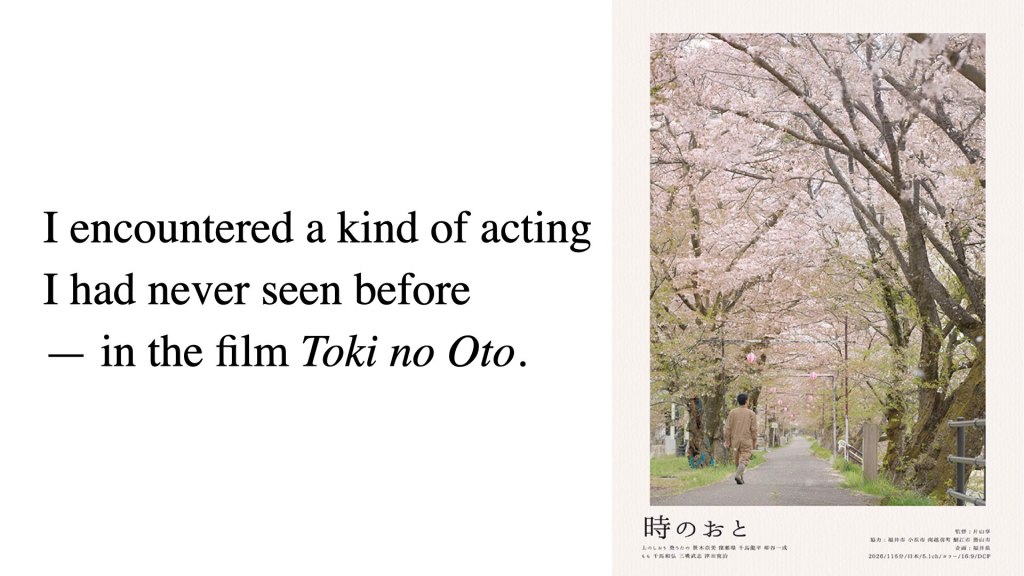
I didn’t just enjoy it. I walked out of the theater thinking, “How on earth did they shoot this?” I found myself frozen, hand against my cheek, unable to move for a while.
The film is Toki no Oto, now in theaters.
Recently, I had the opportunity to contribute to the audio description for Toki no Oto. Audio description supplements the visual elements of a film through narration for those who are blind or visually impaired. But the more I tried to put this film into words, the more I felt: I’ve never seen anything like this.
I was moved—no, more than that, I was astonished. It overturned my sense of what’s “normal.” So I’d like to share at least a glimpse of what makes it so extraordinary.
A film that paints a town—and time—through sound
This is a 117-minute omnibus film composed of four parts.
A group of high school girls spending their final summer in a drama club. A woman captivated by the sounds of the town, learning the shamisen. A fisherman living through a generational transition. A man who relocates to pursue life as a farmer. These are stories of everyday lives—of people simply living.
The setting is Fukui Prefecture. With full cooperation from five cities, the film was shot over the course of a year, across all four seasons. Alongside actors like Kanji Tsuda, many of the cast are people who actually live in those towns. The director, Susumu Katayama, has received acclaim both in Japan and internationally, including at the Sitges Film Festival.
This film portrays the town—and the time that flows through it—through sound. That’s why it’s Toki no Oto—“the sound of time.” It captures what cannot be seen.
Dialects. Everyday sounds. From them emerge human subtleties, the rhythms of life, and the workings of a town.
Past, present, and future. You could even say it uses sound to depict the passage of time itself.
If you want to imitate the lines, it’s a good film
What struck me most was the regional dialect.
Before watching this film, I couldn’t quite picture what Fukui dialect sounded like. But as I listened, I realized—it’s soft, smooth, and restrained. It settles gently into your ears.
Take the word “ottsaa” or “ottsama.” It refers to a father, or an older man. In Part Three, which I worked on, a friend uses it to refer to the protagonist’s father.
Hearing that rounded, light touch of language, I found myself thinking: I might not have a word like that in my own vocabulary.
It’s surprisingly difficult to address an older man with warmth. “Dad,” “father,” “sir,” —they’re all slightly off. Either lacking something, or too much.
But “ottsaa” and “ottsama” land perfectly. Dialects, I realized, are a kind of intellectual heritage, refined over time within a region. They make you want to imitate them.
And any film that makes you want to imitate its lines is, without question, a good film.
Sounds that exist only there, scenes that could only be born there
The film captures not just dialect, but a wide range of sounds: the town, the mountains, the sea, the wind, festivals— even the sound of falling snow or drifting petals, or so it feels. These are sounds you might hear anywhere. So why do they feel so vivid here?
Because sound is irreplaceable in expressing this place and its time. These unique sounds resonate with equally unique memories, creating scenes that could only exist there.
In Part Four, there’s a scene where a young woman pounds a drum from the local performing art Katsuyama Sagicho Bayashi. It’s a festival rehearsal.
She raises both arms high and brings them down with explosive force. Her smile is completely different from her usual self—almost ecstatic, even primal.
It’s more intense than any festival or live concert—a rhythm backed by history itself. Watching it, you understand why such traditions have endured.
These moments—scenes that could only exist in that instant—hold you captive. And somehow, they begin to overlap with your own memories. That’s the film’s magic.
They are acting—but it doesn’t feel like acting
And speaking of magic—there’s the acting. You’d think, well, it’s a film, of course there’s acting. But no. That’s not quite it.
All four parts depict everyday life. At first glance, it feels like a documentary. I even caught myself wondering, Wait, is this a documentary? But the narrative is structured, the visuals are carefully composed—it is undeniably a fully realized fiction film. So then I thought, Does this all follow a script?
What confused me is simple: the performances are too natural. So natural they don’t feel like performances at all. Only six cast members are professionally trained actors.
The remaining 200 or so are local residents. At that point, my assumptions completely collapsed.
When you read a novel, characters move within fiction—but they’re not “acting,” are they? I used to think that kind of expression only worked in the imagination. Of course, there’s manga and animation—but this film achieves something similar in the real world, within everyday life.
The actors seem to live as themselves—and somehow, that becomes a story. How is that even possible?
I think the key, once again, is time. What the actors carry in their minds may be more than lines or movements. Perhaps it’s the past of their roles—their accumulated memories. They live in the present as an extension of those memories. It just happens to be in front of a camera.
They are acting—but it doesn’t feel like “performance.”
It’s fiction—but it doesn’t feel like a lie.
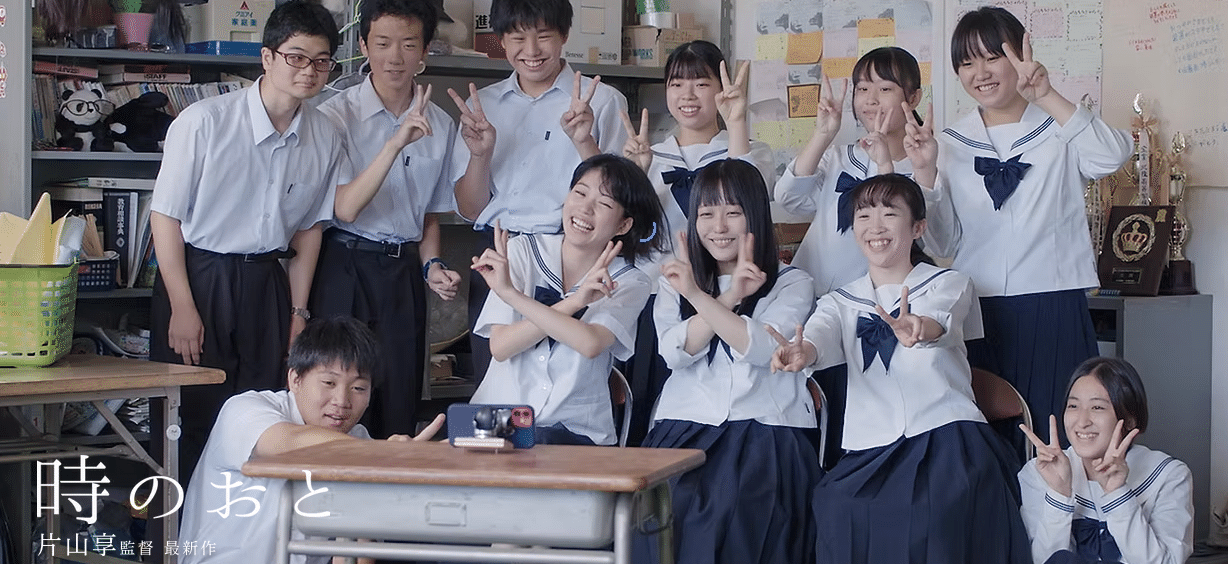
In Part One, there’s a scene where members of a drama club take a commemorative photo in their clubroom. The self-timer counts down—just a few seconds. And yet, in those fleeting seconds—their playful gestures, their poses—you can feel the weight of three years. To live a role may mean to live its memories.
You might think, isn’t that just what acting is? No—it’s on another level entirely. A multiverse. What we’re watching—paradoxically—is a multiverse within reality. I realize I’m starting to lose track of what I’m saying. But truly—this film will overturn your understanding of cinema and performance.
Finally, one more announcement.
Toki no Oto will be screened with audio description from April 16 to 30. The narration for Part Three, by Tsumugi Furukawa, is absolutely beautiful—those nuances are incredibly hard to achieve. Even for sighted audiences, the experience becomes deeper.
The screenings will be held at Cinema Chupki Tabata, near Tabata Station on Tokyo’s JR Yamanote Line. It’s a universal theater, welcoming people with disabilities and families with children. It’s small and popular, so reservations are recommended. There are many films with beautiful music.
But films with beautiful sound are rare. Please, watch it in a theater with great acoustics.
And now I can’t help but think— I really want to go to Fukui.
 Musuta Kusaka's Everyday Journey with Diversity, Equity, and Inclusion in Japan
Leave a comment