There was no acceptable reply to anything Big Bro said except “Yes.” A man who answers quickly rises quickly — that was the work philosophy of my uncle, a former yakuza back in the Showa era.
I didn’t learn that good kids shouldn’t imitate that until I became a working adult. In a mid-Heisei office, a diaphragm-powered shout of “YES, SIR!” was nothing but noise. My career didn’t exactly take off either. I’d like to think that was all because I was raised under my uncle’s discipline.
Still, that sharp “Yes!” sometimes echoed in unexpected places. My wife’s older brother, Y. Take the chauvinism out of a stereotypical Kyushu man, then add back triple the manly spirit — that’s the kind of person he is. Since my wife married someone from her workplace, I suspect she had carefully evaluated that side of me. Uncle, thank you after all.
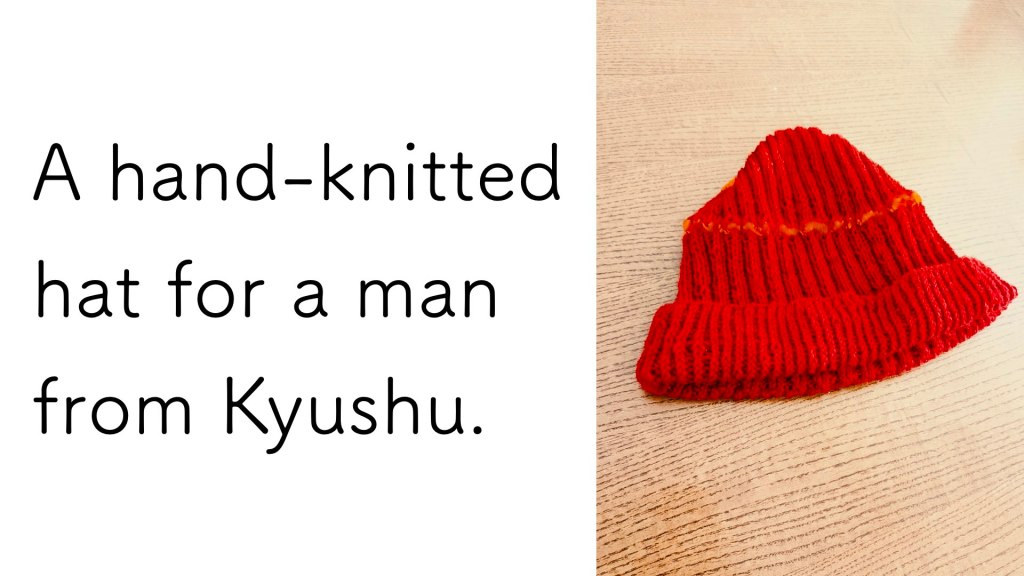
This was when I knitted socks for my mother-in-law in Oita. “Could you make something for Y too? A hat. Red would be nice. Passion red. Finish it while it’s still cold.” It sounded less like a request from my mother-in-law and more like an order delivered on behalf of Y’s mother herself. To me, it felt like an indirect pact between men had just been sealed. “Yes, ma’am!” With a crisp reply and back held straight, I found myself committed to knitting a beanie.
Knitting for someone else is tricky — especially judging the size. The yarn I bought was medium-weight wool, bright red. I’d once made a similar hat, casting on 150 stitches, and it fit my own head perfectly.
But Y is quite small. My mother-in-law had urged me to hurry “before the cold ends,” which suggested a rather slender build. If I made it my size, it would look less like a hat and more like a hood. A Little Red Riding Hood uncle. Not cute.
Photos on my wife’s phone didn’t help with measurements, and asking my mother-in-law for new pictures would take time. So as I cast on stitches with circular needles, I replayed my memories of him.
Whenever we visited my wife’s family home, Y would usually be sitting cross-legged at the low table. “There ya are.”
“Kid’s grown taller, huh?” His high, raspy voice rang out as he greeted us, smiling while patting my daughter’s head and cheeks. After that initial welcome, however, we wouldn’t see another smile until the day we left.
“Well then, shall we drink?” His voice would drop when addressing me. “Yes, thank you.” And so the drinking would begin — incense from the family altar drifting through the living room. Night or day didn’t matter. Somehow he always procured local connections’ treasures: fragrant sweet-potato and barley shochu brands I’d never seen in Tokyo. He poured with the enthusiasm of serving barley tea, and I drank respectfully, sitting formally on my knees.
Whenever I tried to pour for him in return, he stopped me with a hand. “No need. I’ll do it myself. I’m getting old — can’t drink like I used to.”
Then he drank an astonishing amount. Did he used to measure alcohol in barrels?
Veins bulging in his hands, he lifted a stainless-steel tumbler clinking with ice. I found myself absurdly trying to calculate the ratio between the glass and his head — searching for any clue to his hat size.
“How’s work going?” That was our only shared topic. One sentence, silence, another sentence — like trading moves in shogi, exchanging business intelligence between Oita and Tokyo.
“I don’t understand what the young ones are thinking these days. Compliance this, compliance that…” From context, “the young ones” clearly meant male employees.
“What about you?” He raised his previously lowered face and met my eyes. Here it comes. The question you cannot answer wrong. My buzz vanished instantly. What exactly is “there”? Advice? A test of manliness? Agreement? Professional insight? Case studies from my company? I never knew the right answer. Though I’d never offended him, a primal tension always seized me — the kind that freezes your organs. I hold black belts in karate and judo, yet some opponents make you want to retreat simply by closing distance. He was that kind of presence.
He probably didn’t mean anything by it. Which somehow made it harder to read. Looking up as he stood to go to the bathroom, the gap between his small frame and overwhelming presence distorted my sense of scale.
No good. There was no way I could recall his head size from memory. So I borrowed my wife’s head for measurements — realizing I should’ve done that from the start — and continued knitting. I cast on 135 stitches and worked a simple rib pattern. Safe and reliable.
When the hat had grown to about headband height, Y called. He asked to speak to me. “You don’t gotta force yourself to knit that hat. You’re busy, right?” There are clients who place orders without checking with the site first. My mother-in-law was one of those.
I understood it was kindness in his own way, but his tone was blunt — almost rough. “Yes, but I’m already pretty far along.” “Knitting ain’t something men do.” That was… not something I could easily ignore. Does that attitude show up at work too? “But I’ll finish it before the cold ends.” “Hmph. I see. Send it quick.” There it was. Pure Oita dialect: you rascal.
I revised my plan completely. I was going to make the cutest hat imaginable.
Since the hat was entirely red, a man nearing sixty might dislike the hint of a sixtieth-birthday celebration. And with his sloping shoulders, a round shape alone would make him look like a matchstick. Or a roadside Jizo statue.
So I asked my daughter to crochet a thick 180-centimeter cord. Knitting it into the design would add edges to the silhouette and give it a slightly sporty feel.
The brim used single ribbing; above it, double ribbing. When folded, the change in texture created visual contrast. Toward the crown I increased the rate of decreases, making it slightly tighter — a custom fit for someone who would likely find store-bought hats too large.
I mailed the finished beanie to Y by Yu-Pack so it would arrive over the weekend.
Half a month passed with no response — long enough to wonder if I’d sent it to the goats from the old children’s song. Then a Yu-Pack arrived at our house. Had I written the address wrong? No — it was from Y. Addressed to my daughter. Inside was a Nintendo Switch game.
While my daughter danced a “Thank you, Uncle Y!” dance beside me, I called him. “Thank you — it arrived.” “Oh, good. That’s for the hat. It’s great. I like it. I’ll wear it everywhere. Even to Miyakomachi.” He talked a lot. His voice was smiling. My wife, listening nearby, laughed in surprise. “Fits perfect. Warm too. Should’ve had you put my initials on it. You can do embroidery, right?” “Yes!”
“I saw on NHK the other day — knitting’s popular now, huh?” We talked about television for a while. I learned for the first time that he was a fan of Hakata Hanamaru & Daikichi. I hadn’t known he talked this much about himself.
During all the hours I’d spent knitting, I had been thinking about him. Apparently knitting carries those thoughts through touch. Adults spend most of their lives thinking about others, but are rarely thought about themselves. Maybe, for him, the balance between giving and receiving had quietly settled. “Glad you like it,” I said. “You should even wear it to work.”
After hanging up, I realized something. I’d forgotten to explain how to wash it. Well, that’s fine. If it stretches out someday, I’ll just knit him another one. A little smaller again.
Next time, I’ll add the Y embroidery. “Yes, sir.”
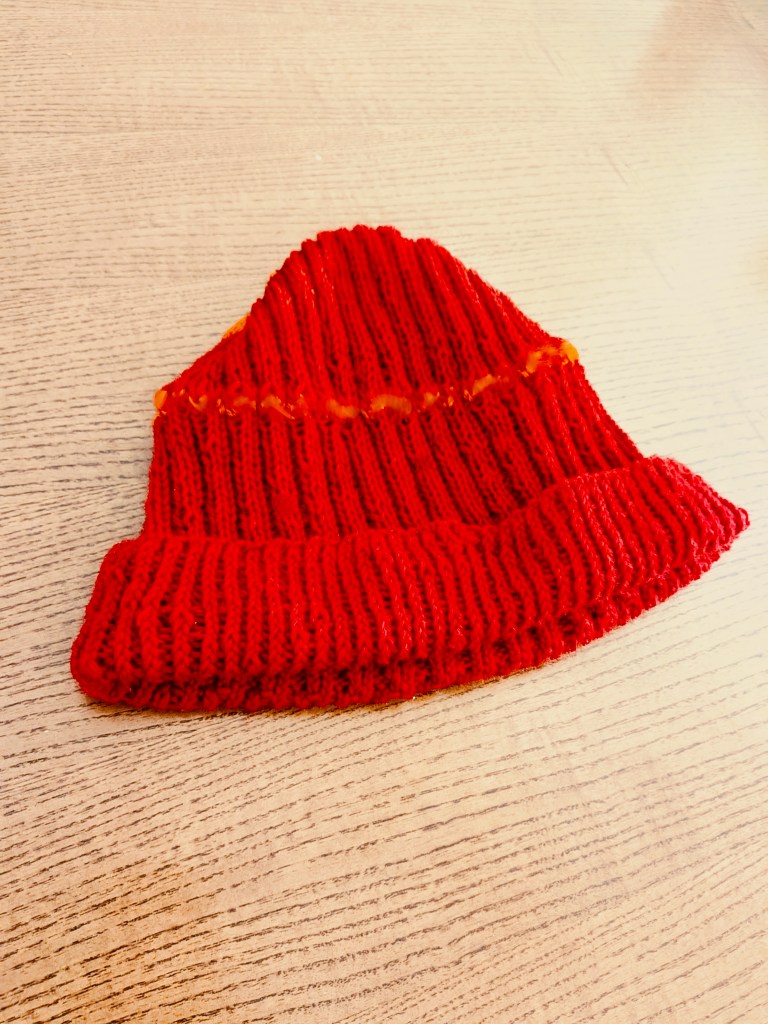
I tried adding an accent to the silhouette by making part of it thicker — closer to a cord than yarn.
 Musuta Kusaka's Everyday Journey with Diversity, Equity, and Inclusion in Japan
コメントを残す