
February started with a cobra twist.
I was out for my usual morning run when my lower back suddenly twisted into something resembling a professional wrestling hold. My spine bent into an awkward angle and locked there, grinding in pain. I froze. Couldn’t take a step. Couldn’t even call for help. Alone in the park, all I could do was keep exhaling white clouds of breath through clenched teeth. I felt like a hiker who’d gotten lost and accepted his fate.
I took the morning off and rushed—well, more accurately, collapsed—into my acupuncture clinic. “Mr. Kusaka, you show up around this time every year, don’t you?” He said it like he was confirming my annual tax filing. As if my physical breakdown were a seasonal administrative task.
But he wasn’t wrong. Every February, like clockwork, I’m struck by a back pain that feels like someone’s snapped me in half. And the older I get, the more convincing the snap becomes.
The cause? My work style. My body can no longer survive December’s final sprint and January’s aggressive kickoff.
“Desk job?” “Half outside sales, half desk work.” “How long are you sitting at a stretch?” “Uh… about twelve hours?” “If it wasn’t your job, that’d be torture.” It is torture. Employment just makes it socially acceptable.
He explained that bad posture stiffens the lower back muscles until they seize up completely. When the cold weather hits, they reach their limit—and then, crack, like an icicle snapping off a roof. Apparently this is the classic office-worker back injury, and the veterans suffer the most.
So the solution: sit less. If that’s impossible, keep your lower back warm. Melt the ice. “Belly warmers are great,” he said. He’d told me the same thing last time too, I remembered, groaning as needles pierced me with dart-like precision.
As it happens, my psychiatrist had also recommended belly warmers. “Warming your abdomen raises your body temperature and helps calm your mood. It’s like soaking in a hot bath.”
So last year, I bought one made of camel hair. Once you put one on, you understand. Life divides into Before Belly Warmer and After Belly Warmer. It’s that warm. You feel compelled to apologize to your own stomach for years of neglect.
And yet—I couldn’t bring myself to wear it. The problem was the color. A drab, defeated beige. Bought on the second floor of a supermarket. The shade had all the charisma of a filing cabinet. It felt like it added ten extra years to my lower back.
Worse, it suited me disturbingly well. “You look like Tora-san,” my wife said, laughing. For context: Tora-san is a lovable but chronically shabby movie character. That comment finished me off. So at the very least, I wanted a brighter color.
This year, I decided to knit one myself. They say turning a crisis into an opportunity is a skill. Now that I’d learned to knit, maybe I could create a belly warmer I’d actually want to wear.
I also had a growing collection of leftover yarn—too short for a proper project, too long to throw away. Six different kinds: different colors, textures, thicknesses. A chaotic rainbow. Perfect. I bought long needles and started knitting in the round.
Knitting in circles—like for beanies or neck warmers—is wonderfully low-pressure. You match the first row to the circumference (this time, my stomach), and after that you just eyeball it. Hold it against your body and stop when it feels right. Even a beginner can handle that.
Sweaters and vests, though? That’s advanced-level anxiety. Bust measurements, sleeve lengths—constant measuring. As a beginner, that makes me panic.
When I knit, I want to zone out. Set my brain down somewhere safe for a while. There’s even something called “knit therapy.” Academic papers and all. It’s probably a cousin of mindfulness. I’ve never quite succeeded at being mindful, but knitting in the round? That I can do.
As I focus on the needles and yarn, my sense of touch sharpens. Each of the six leftover yarns has its own personality. As I handle them, memories from when I first used them come back. I remember through my fingertips. It makes me realize that humans don’t just think with their brains—we think with our bodies.
The first red acrylic yarn I ever bought—cheap, from a dollar store. Because it was cheap, I wasn’t afraid to fail. That’s why I kept going. Its crisp stiffness taught me tension control. The soft pink wool I used for my daughter’s neck warmer. I was amazed at how gentle it felt—and even more amazed at how easy it was to knit. The yarn I used to make socks for my mother-in-law. I hadn’t expected her to be so thrilled. Candy-colored, sweet to the touch. Thin enough to double up with another strand.
I felt oddly relieved to use up these bits of yarn I’d picked up along the way. Each had strengths and weaknesses. Each had color. As a sales team leader, I couldn’t help comparing it to managing people. Yarn and humans alike have their magic in combination.
Mixing yesterday’s yarn with today’s mood, I finished in no time. I wanted to keep going, but any more and it would’ve turned into a psychedelic caterpillar.
I tried on my bold striped belly warmer in the bathroom mirror. Warm. Colors not bad. A little loose, maybe—but after a few washes, or better yet a spin in the dryer, it’ll shrink to size. No problem. Being able to treat it casually—that’s the freedom of making something for yourself.
…You see where this is going, don’t you? There was, in fact, a massive problem. Nothing is more dangerous than freedom without understanding. One week in, the belly warmer began losing its will to live.
From stomach to lower stomach. From lower stomach to thighs. And then—plop. It fell.
It had very clearly stretched out.
Wait. Doesn’t yarn shrink in the wash? In a panic, I searched online. The top answer read: “Our acrylic scrubbers don’t shrink—they stretch.” “Acrylic yarn doesn’t shrink… if anything, it stretches out looong if you’re not careful.”
Best answer. Worst news.
Apparently stretching was an option I had not considered. I had used a lot of acrylic yarn. That was the culprit.
I looked up ways to restore it and found everything from gentle advice—“Try using a hair dryer carefully”—to verbal slaps like, “That’s what we call killing the yarn.” I ended up more confused than before.
Besides, without trying anything, I could tell. The belly warmer lay limp in my hands, heavy and lifeless, like its soul had departed. It was beyond saving.
As I silently stared at what was formerly known as a belly warmer, my wife said: “Why don’t you just wear it around your neck?” A Copernican-level shift in perspective. I may have married a genius.
I twisted it into a figure eight and pulled it over my head. It fit perfectly. Almost tearfully perfect. My neck was warm. My stomach, meanwhile, was freezing in protest.
I considered knitting another one immediately—but stopped. It might be time to reconsider my habit of rushing headlong into solutions. February will come again next year. So will the back crisis. I can knit another belly warmer then. If knitting becomes a seasonal tradition, maybe back pain can be considered a sign of the season too.
On second thought—no. That one’s less “seasonal greeting” and more “chain letter of misfortune.”
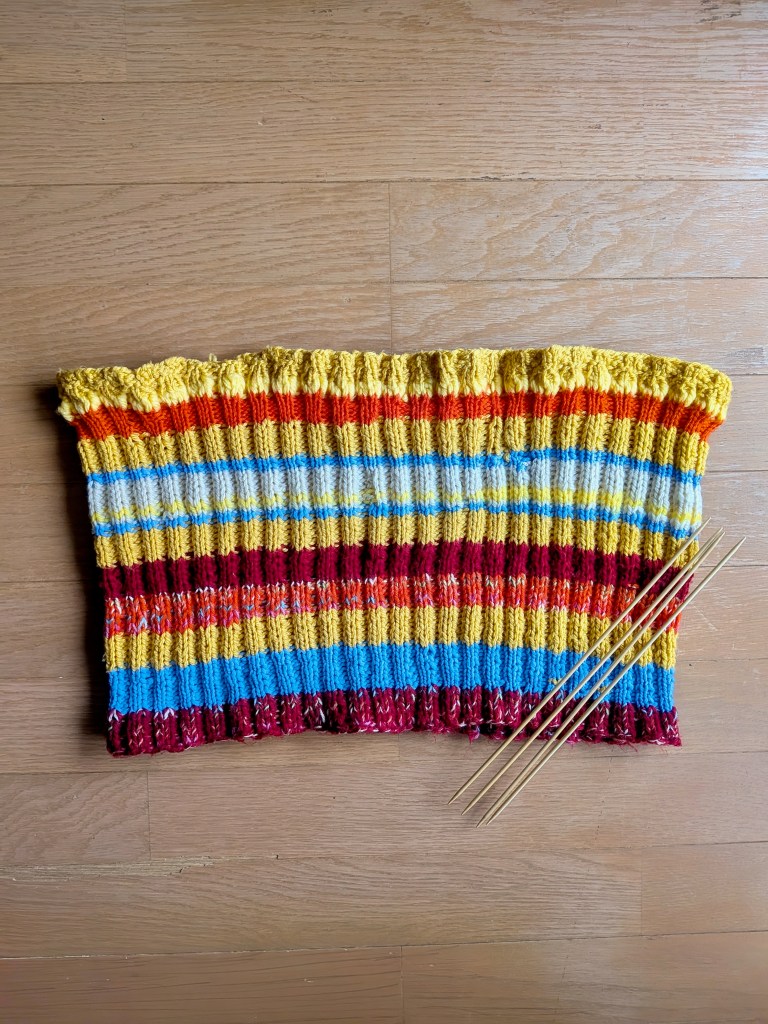
Psychedelic colors. I don’t hate it. Not bad at all.
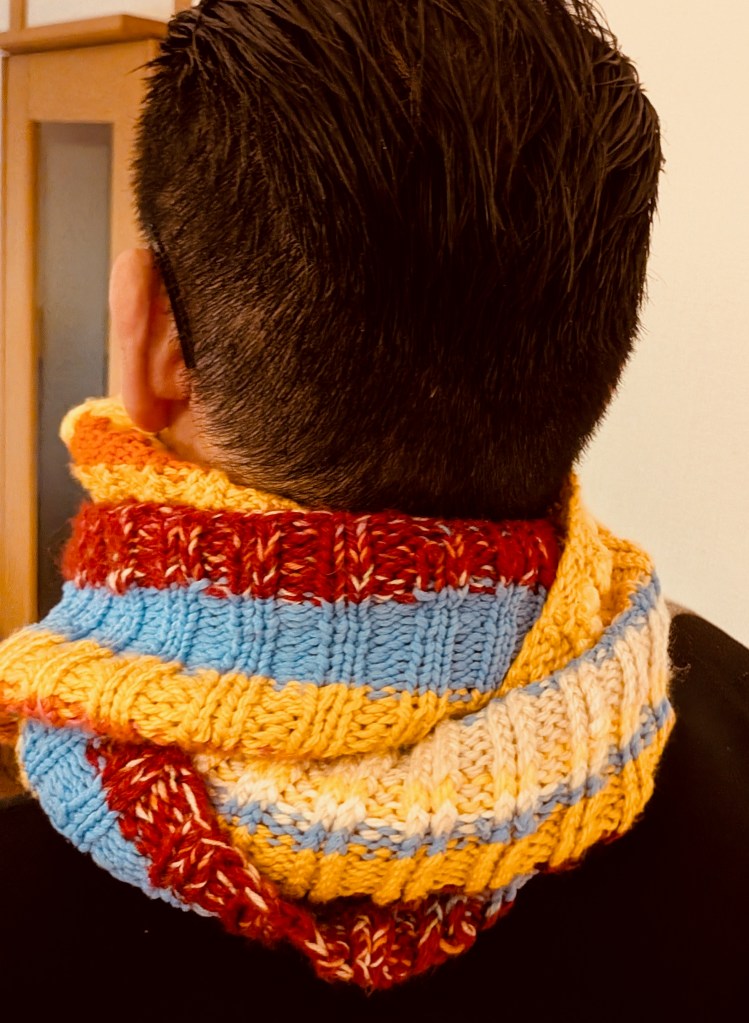
It was reborn as a neck warmer. That’s how stretched out it had become. At this point, it was basically a scarf.
 Musuta Kusaka's Everyday Journey with Diversity, Equity, and Inclusion in Japan
コメントを残す