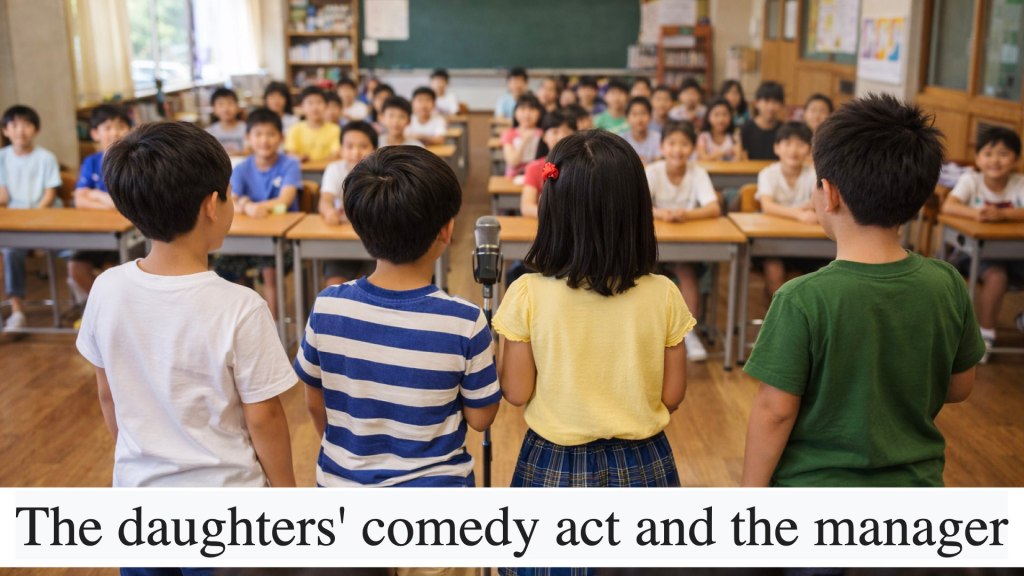
My third-grade daughter started a company.
Of course, she’s not a child social entrepreneur or a genius patent prodigy. What she launched was a Comedy Company.
At her elementary school, there are no classroom “duties.” Instead, they have something called “companies.” Taking care of animals is handled by the Animal Company. Lost items are managed by the Lost-and-Found Company. The Play Company, which controls playground equipment and play areas, apparently holds major “rights” and, according to my daughter, is incredibly bossy. There’s even an SDGs Company that patrols the cafeteria to reduce food waste. “They’re like leftover police,” she says. She’s already begun learning that power drives people mad.
It’s a public school, but surprisingly global. Kids with mixed roots, kids still learning Japanese, kids of all skin tones—altogether they make up about ten percent of the students. Children with mild disabilities share desks with everyone else. Turn Japan into a slightly rowdy miniature, and you get Class 3–1.
Presumably, it’s a system designed to respect children’s autonomy and let them learn from one another amid diverse values. Businesses are idea-driven. Planning is up to the kids themselves. From recruiting to execution, they’re responsible for everything—and if they can handle it, side jobs are allowed too. Nicknames, by the way, are banned. Apparently, weird nicknames are the start of bullying. Everyone is addressed as “-san”—no “-kun,” no “-chan”—out of respect for gender diversity.
You can tell from a distance that it’s kind of ridiculous. I was that kind of elementary school kid. Actually, all elementary school kids were like that back in the Showa era. Well, maybe just in my hometown. Either way, compared to the days when we were getting high on photochemical smog, Japan has probably progressed.
Using this company system, my daughter founded her own business. Admirable. Unlike her parents, she’s got initiative.
And thus was born the Comedy Company. The goofiness clearly runs in the family.
Apparently, there had originally been a Recreation Company, but “It was unforgivably boring,” she said. So my daughter wooed two veteran employees and forcibly swapped out the signboard. To be precise, she staged a takeover. Very Elon Musk–like. Strong traces of her mother’s blood.
Then a boy showed up—even though there’d been no job posting—and joined anyway. His name was W.
Even in a cold snap, he wears a T-shirt and shorts. Always smiling, thrusting out sun-tanned arms and legs at full power. It’s not that his family lacks money—if anything, they’re so rich you wonder, How much lifeblood did they have to suck to build a mansion like that?
He constantly licks both sides of his plump hands. Probably sensory play. With those pleasantly damp, fragrant hands touching everything, people tend to keep their distance.
But no one chases him off. He rarely initiates conversation either.
If you think he’s missing during class, he’s probably wandering freely around the schoolyard. That might explain the tan. Apparently, he only started being able to sit for fifty minutes after my daughter was seated next to him. “Change your clothes.” “Hurry up and eat.” “Get your calligraphy tools out.” W listens eagerly to everything my daughter says, nodding “uh-huh, uh-huh,” or so I heard from the homeroom teacher during a parent conference. They often walk home together. It looked like my daughter was a tugboat, pulling along the luxury liner that was W.
That day too, she came home with W and asked me for advice while yanking off her winter shoes in the entryway.
“Dad, what kind of joke do you think we should do?” She was writing the script. “W can’t memorize lines.” After 46 years of goofing around, my moment had finally come.
The audience would be eight-year-olds. If they ripped off a famous comedian or YouTuber everyone knew, it would probably land—and be easier to perform. But skits are complicated. Stand-up comedy was the only option.
So I showed her a routine by Borujuku.
They’re a four-person group, just like my daughter’s team. Their delivery is flat, making them easy to imitate. The back-and-forth is simple and straightforward. Plug in class-related jokes or teacher impressions, and the comedy equation solves itself. Most importantly, if they end with “maa-neee,” it always lands. Even W could probably do that.
Replaying and rewinding YouTube, my daughter transcribed the lines with a level of focus she never shows for homework.
A few days later, while rewatching the video, she muttered,
“W can’t learn the timing.”
Ah.
No—that wasn’t it. Timing requires real sense. It wasn’t because it was W. Anyone would struggle. Timing is the heart of comedy. “You’ll have to stand next to W and give him cues, like tapping him,” I said.
After that, she’d occasionally talk about how practice was going, but mentions of W clearly dwindled.
I heard that W had dropped out of the four-person act just days before the performance. An Elon Musk–style layoff? I panicked—but apparently, W had chosen not to go on stage himself. “He’s playing the audience role now,” my daughter said, unable to hide her relief.
I felt relieved too, for a different reason. Good. W was shining properly. A joke only lands the first time—it’s proprietary information. Watching rehearsals from the audience’s perspective and giving feedback is a job you can only entrust to someone reliable. Even offstage, it’s a crucial role.
Still, I wondered how the remaining three felt about the stage suddenly being wider by one person. This was something the kids decided in their own world. Adults should keep their mouths shut, I told myself, clenching my teeth. My own workplace isn’t much different, after all. I had no right to comment. And I could imagine the weight my daughter had put down.
Even so, I couldn’t help thinking: if I’d suggested a skit instead of stand-up, might things have turned out differently? Whether it went well or not, I felt unsettled. I no longer knew what kind of feelings I was supposed to have as I awaited performance day.
“Today was the preview, right?” At dinner, my daughter brought it up herself. Thanks—I was too scared to ask.
“So? How was it?” “W got the biggest laugh.”
What?
They’d practiced hard. Too hard. They’d forgotten about promotion. In other words, they never advertised. The performance was scheduled for lunch recess, after the meal. The moment the chime rang—kiiin—everyone bolted for the playground, probably at top speed from the first step.
“Please don’t go play! The Comedy Company has an announcement!” My daughter desperately tried to stop them, but it was hopeless. No one was listening.
“And then, W just yelled—really loudly—”
It’s funny, come watch!
She cupped her hands around her mouth like a megaphone, imitating W.
“He was like, ‘It’s definitely funny! Definitely funny!’ And everyone cracked up.” “W for real? That’s wild. Dude’s loud! That’s hilarious!” “That was the peak,” she said.
W awakened his innate power for drawing a crowd and managed to bring in a sizable audience. And then my daughter and the others completely bombed.
I imagined W, standing outside the cluster of people, watching the act unfold in a classroom so silent you could hear the playground outside. Dinner tasted amazing that night.
Apparently, everyone now calls W the “Manager.” Because he gathers customers. For some reason, the setting is a theater. “Aren’t nicknames banned?” I asked. “Well… the teacher didn’t say anything.”
Well, no one’s going to bully the Manager. He might even get headhunted by another company. W has become a pioneer in the nickname world.
As for my daughter, the CEO, she hasn’t yet come to me for advice on the next routine. Too bad. Dad’s got a pretty good idea.
 Musuta Kusaka's Everyday Journey with Diversity, Equity, and Inclusion in Japan
コメントを残す