At the very start of the new year, that guy is already impossible to talk to. And I’m sure he thinks exactly the same about me: “Kusaka is seriously impossible to deal with.” So, 2026 has begun—working once again with these wonderful colleagues of mine.
But this year, I find myself thinking, “Isn’t that exactly what makes it interesting?” That thought alone has made things feel a little lighter. Why? Because during the New Year holidays, I watched the film Everyone’s Talking!

This comedy was outrageously funny. I saw it at a 10 a.m. screening on January 4th, and the theater was completely full. What’s more, laughter never stopped throughout the entire film. Real, sustained laughter—people going “haaa-ha-ha-ha.” How long had it been since I’d shared a theater with someone laughing like that?
The story is set in a small local shopping district. The Koga family—whose father and younger brother are Deaf—end up in conflict over a trivial misunderstanding with a Kurdish family who have just moved into the neighborhood. Natsumi Koga, the protagonist and a CODA (Child of Deaf Adults), and Hiwa, the only native Japanese speaker in the Kurdish family, are pushed to the front lines as interpreters for both sides. They clash at first, but gradually grow closer as mutual allies. What will happen to the two families, the shopping street, and to Natsumi and Hiwa themselves? That’s the story. A Romeo and Juliet that makes you laugh all the way to the end, set against Deaf culture and Kurdish culture.
But this is not just slapstick—it’s satire. That’s what makes it so layered and so rich. The script. The pacing. The direction. The casting. The performances. The production background. At every level, you can feel a clear gaze directed at society itself.
The themes are broad as well. Deaf culture and embodiment, discrimination, inequality, language, education—these issues are treated seriously and with sincerity. For the characters, the situations are often dire, but that is precisely why they become funny. In an era so divided that you might cry if you weren’t laughing, a film that makes you laugh and think is a masterpiece.
So, I’d like to introduce the appeal of Everyone’s Talking! from three perspectives. And don’t worry—there are no spoilers.
Theme: What a “Comedy About Endangered Languages” Asks Beyond “Not Understanding Each Other”
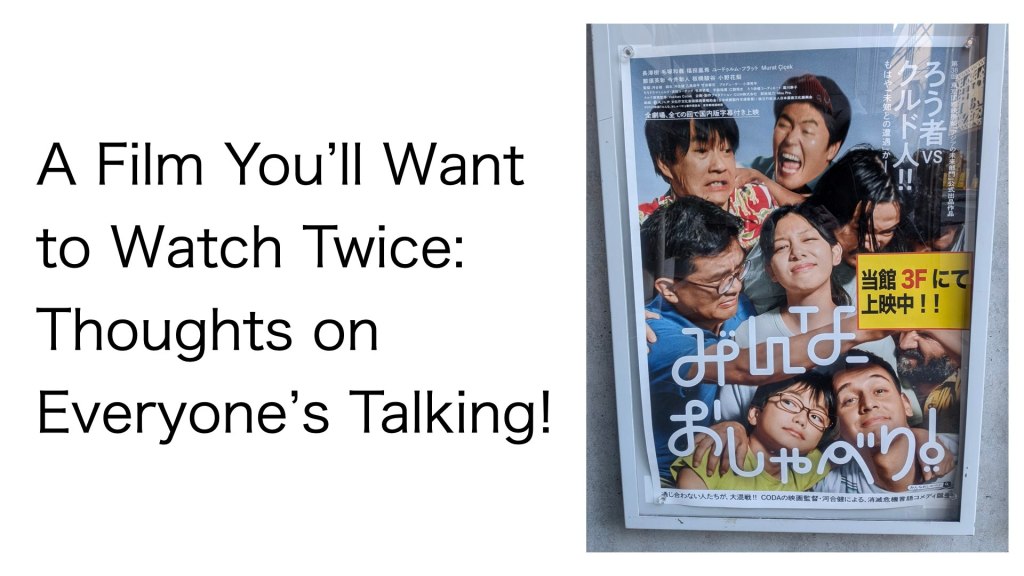
The film’s poster proclaims: “People who can’t communicate—total chaos!! An endangered language comedy!”
The official website explains that Japanese Sign Language—once not recognized as a language and even banned—and Kurdish, whose number of speakers has declined due to historical and political reasons, are used to depict language inequality and communication barriers with irony.
But the languages used in the film don’t stop there. In addition to Japanese Sign Language and Kurdish, we hear American Sign Language, Signed Japanese, Turkish, Arabic, Japanese, and English.
Layered onto this are differences in community cultures, discriminatory attitudes surrounding nationality and disability, gaps in employment and social security, prejudice, misunderstanding, and microaggressions. Ignorance and lack of understanding around language pile on top of one another, snowballing into confusion and conflict.
There are no outright villains in this film. But there are no saints either. Everyone knows discrimination is wrong, yet they clash anyway. Deep down, all they really want is to protect their families and their people. What emerges is a painfully real feeling of “There’s no way these people can truly understand each other.” You smile wryly—and then, a moment later, you feel a jolt as you see yourself reflected there.
The audience is held captive by this tense dead end, and this is where two characters become key: Okita and Shun, the eldest son of the Koga family. Okita is an energetic do-gooder, commissioned by the local chamber of commerce to revitalize the area. Shun, on the other hand, is a Deaf elementary school student at a school for the Deaf. He stands out in class and is treated as a “problem child” by his teachers. I found myself reading them as the most “majority” figure—Okita—and the most “minority” figure—Shun.
In the final stretch of the film, these two take strikingly contrasting actions. “You can talk, but you can’t understand each other. You can’t talk, but you can understand each other. What is that?” It felt like being presented with a riddle—frustrating, yet somehow delightful. In that moment, my image of what it means to “understand” someone was updated. And that was fascinating.
Words only get you so far. Once you accept that, other possibilities come into view. Options are possibilities. Seen that way, even things with coworkers aren’t necessarily a dead end. Maybe for people who can’t understand each other, there are ways of being together other than understanding. That realization left me with a strangely liberating feeling.
Structure: Made to Be Understood—and Also, Deliberately Not Understood
As mentioned earlier, an extraordinary number of languages fly around in this film. And each of them involves speaking, seeing, hearing, writing, and reading. Organizing all of that information and conveying it to the audience clearly—while keeping it funny—requires astonishingly meticulous design.
That’s why the film makes extensive use of carefully crafted subtitles. They allow viewers to intuitively grasp linguistic diversity, and above all, to understand that sign language is a language. Which leads to another realization: if that’s the case, then Deaf people are speakers of a different language. And if so, are we—hearing people—the ones who have been turning them into “disabled” people?
What’s more, this film doesn’t just design experiences of “understanding,” but also of “not understanding.” Some scenes deliberately have no subtitles. What comes into focus then is the difficulty of truly understanding others—and the precariousness of the assumptions the audience carries with them. Watching the first half and the second half of the film, I became acutely aware of how prejudiced my own gaze toward the characters had been.
Pay close attention to how the garbage-picking scene pays off its setup. The way the film drops the audience straight into a “Wow… so that’s what I’m like” moment is masterful. I fell into that trap with great pleasure. That alone is worth seeing the film for.
Development: A Foul That Turns Out to Be the True Straight Play
You can’t recommend Everyone’s Talking! without mentioning the ending. Honestly, it shocked me more than The Sixth Sense.
The film has been very well received and frequently covered by the media. Attendance is strong, and it looks like its run will be extended and shown in more theaters.
It’s great that it became a hit—because if it hadn’t, people probably would’ve blamed everything on that ending. It felt like a high-stakes gamble. I can’t help but wonder if there were arguments on set.
Still, this is how I see it.
The film’s multilayered social themes, its clear structure, and its engaging pacing are all meticulously constructed. Which also means there’s a risk of it ending up too neat—leaving you with nothing more than, “Wow, that was a well-made movie.”
But is that really okay? What this film depicts is the messy reality of society—far from neat or tidy. In a small town with no escape, people cling to each other and hurt each other as they struggle to survive together. It’s a survival story that isn’t funny at all. There’s no way it should end with a clean, cheerful wrap-up.
Great works always carry turbulence and rupture. They’re like cracks that let the gods of cinema slip in. Perhaps that’s why the director chose such a seemingly destructive ending. Or rather—maybe it isn’t destructive at all. As the ultimate “situation where communication completely fails,” it perfectly embodies the characters’ growth. It looks like a foul, but it’s actually straight down the fairway. Sometimes I even think the director made this entire film just to arrive at that ending.
I’m still reeling from it. But maybe one day, I’ll understand it. Maybe I just haven’t caught up yet. That’s why I want to see it again.
Speaking of seeing it again: watching this film with audio description would deepen understanding and make it even more rewarding. There’s so much to read as well as to see that relying on visuals alone means missing a lot. The fact that this film has an audio guide feels inevitable—and thoughtful.
So my recommendation is this: First viewing, just watch it.
Second viewing, use the audio guide. That’s what I plan to do.
If you download the UDCast app on your smartphone, the audio guide is completely free. It works in theaters—just don’t forget your earphones.
And one last time, just to say it again: Everyone’s Talking! is seriously, wholeheartedly recommended.
 Musuta Kusaka's Everyday Journey with Diversity, Equity, and Inclusion in Japan
コメントを残す