“As for this year’s performance, it looks unlikely that we’ll hit our targets. The biggest factor is—” I listened to the president’s earnings briefing, his face flushed bright red, while knitting. Working from home really has its perks.
Our company’s fiscal year ends in December. I had been increasing my knitting time—as a way to manage stress.
In a closing month, sales have to be locked in. Even if it takes a bit of force, deliveries must be pushed through. Which also means stacked-on tension from price negotiations. As a salesperson, it feels less like walking on thin ice and more like sprinting across it while chasing profit. Chasing it would be one thing. But there’s also the avalanche of billing and payment paperwork that comes with it.
Chasing and being chased. Those dizzying days continue nonstop until the last day of work. To stay sane and still hit my quota, I had to keep my stress under control.
And on top of that, I had only just returned to work after taking medical leave for depression. I was afraid my hearing problems and hyperventilation might come back. I remembered my doctor’s gentle smile. “I can write you another medical certificate anytime.” A certificate that can be issued “anytime” is, in its own way, terrifying.
There was no room for decorum. I decided to break a taboo.
I would knit during work.
It’s a small taboo. But for a middle manager in his forties, with a family and subordinates, this was the fullest extent of my courage. It was my own survival strategy.
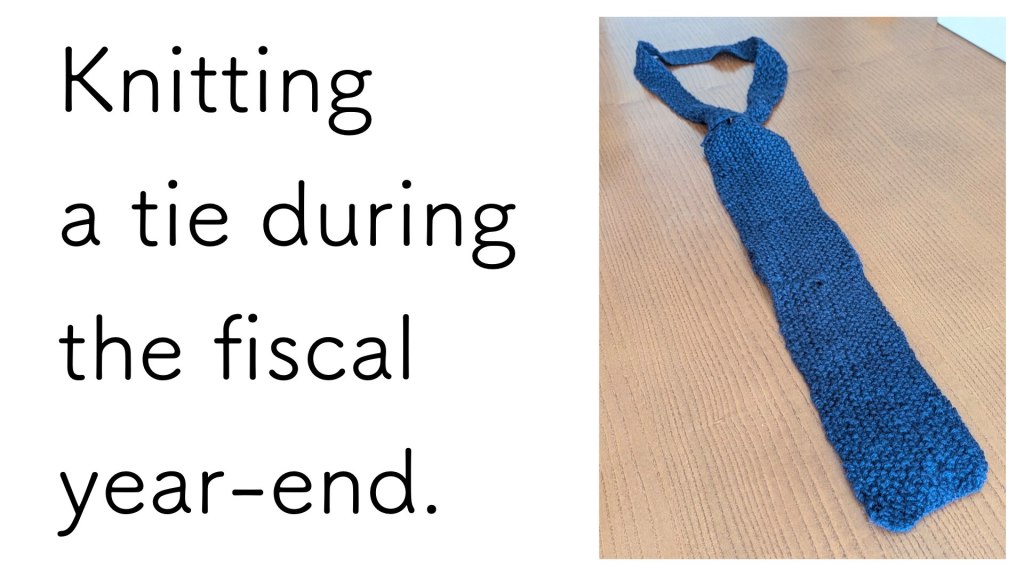
What I was knitting was a navy tie. Something small enough to carry in my work bag. Something I could probably talk my way out of if I got caught knitting on the job. A bit desperate, sure. But I wanted to start the new year feeling even slightly more positive.
According to YouTube, knit ties are usually crocheted. Well, it’s basically like a small scarf. You could probably make one with knitting needles, too. Once you get the basics down, you can adapt them in lots of ways. That’s one of the nice things about knitting.
On work-from-home days, I sat in front of my computer and knitted for ten to fifteen minutes every time I reached a stopping point. Like stepping out for a cigarette. During online meetings, too—on the sly. As long as the camera was off, it was fine. I chose not to think too hard about what “fine” meant.
On office days or when I was out visiting clients, I slipped into cafés whenever I found a gap. Amid the sound of coffee beans being ground and their aroma, I’d lose myself in knitting for the length of one cup of coffee.
Knit, purl, knit, purl. I resisted the urge to check email or chat and focused hard on “this stitch, right now.” The gentle spring of the yarn. The tension and release of the thread, pulled taut and then easing away. The bumpy texture of moss stitch. There was nothing there but the pleasant sensation in my fingertips.
It worked. My stress level dropped almost instantly.
I’d heard people say things like, “If you meditate for just ten minutes during lunch, your afternoon focus improves.” Maybe it’s something like that. Though if I tried meditating after lunch, I’d just fall asleep. Knitting doesn’t carry that risk.
By directing my attention to a simple manual task, I could set down—just for a moment—the heavy load of excess information. My mind stopped swaying left and right, and my thinking slipped back onto its tracks. It felt like remembering how to ride a bicycle called concentration.
I thought I was focusing on what was in front of me, but really, I’d just been fixated on immediate concerns. It was only because I skipped work to knit that I realized this. Or so I insist.
As a result, I became quicker on my feet in negotiations. Sharper, more logical sophistry. Probably because my thoughts were no longer getting crossed. The number of documents sent back for corrections dropped dramatically.
Another surprise was how well “secret knitting during online meetings” worked. By staring at the fabric, the amount of visual information decreased, and maybe that made my ears open wider. What people said sank in smoothly. “Sorry, can you say that again?” “What was that thing you mentioned at the beginning?” Those kinds of rewinds disappeared. I reflected, with some shock, on how little I’d really been listening to my team before. This was no time to be saying “surprisingly effective.”
Of course, after work I kept knitting too—like replacing an evening drink. If you knit all day long, the tie steadily takes shape. This year, no matter how hard I tried, so much effort failed to turn into results. Poor performance was the clearest example. The simple assurance that if you do the work, something will take shape—that was one of the few solid comforts I had.
As I measured the tie with a red teddy-bear tape measure, a thought occurred to me. Ties don’t come in many sizes, do they? Length-wise, maybe standard and long. Width-wise, regular and narrow. Maybe it’s just my ignorance, but all the ties in mass retailers look the same size to me.
I’m bigger than average—especially width-wise. Waist, belly. After a bath, my wife calls me “a Showa-era pro wrestler.” In other words, standard ties look skinny on me. That was another reason I wanted to knit my own.
Among people who wear ties, there are pro-wrestler types and there are marathon-runner types. And yet everyone adjusts themselves to a size decided by someone else, for someone else’s convenience. Another name for a tie in Japanese is erishime—“collar tightener.” To me, it feels more like a noose.
I draped the half-finished tie around my neck and stood in front of the mirror. Does this tie suit me? Can I breathe? More importantly, isn’t it dangerous if I don’t re-knit the way I work next year? Staring at the thing hanging from my neck, I thought about all that.
Or maybe there was something I should be re-knitting before my work style. The tie was a disaster. I’d rushed the decreases, and the silhouette ended up looking like a shovel. The moss stitch was warped, full of holes. One glance told you it was completely worn out. I had invented a tie that radiated total lack of motivation.
“That’s you this year,” my wife laughed as she walked into the mirror’s frame, seeing me wrapped in what looked like a rag. “Well, whatever,” I laughed too.
Just finishing something isn’t enough. Being easy isn’t enough either. When you fail, you fail spectacularly. That’s also part of what makes knitting interesting. Knitting sometimes lets you laugh at yourself. Come to think of it, “well, whatever” was another thing knitting reminded me of.
After all, crochet really is better suited for ties. Maybe next year I’ll give it a try. Crochet hooks are easier to carry around than needles, too. Honestly, I can’t forget that guilty thrill of knitting during work—like feeling someone’s gaze from the other side of the camera. I’ve become the kind of person who wants to knit as soon as a meeting starts.
Productivity matters, sure. But maybe this is my way of working. For now, I’ll just say, “well, whatever.”
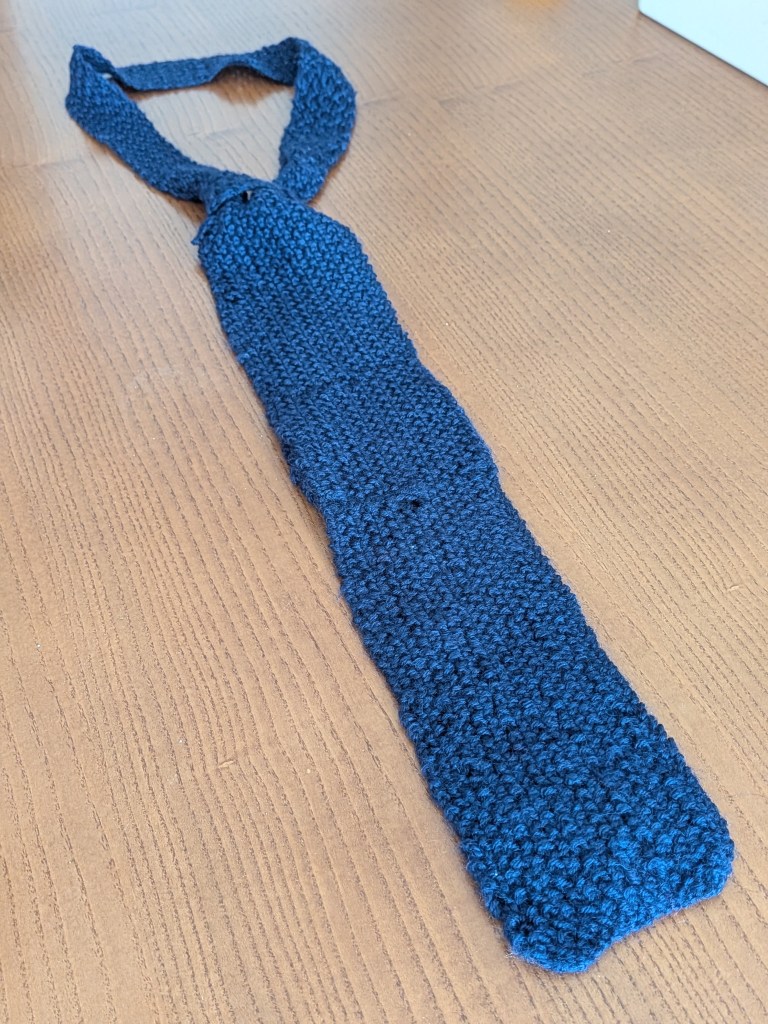
Oh…terrible…
 Musuta Kusaka's Everyday Journey with Diversity, Equity, and Inclusion in Japan
コメントを残す