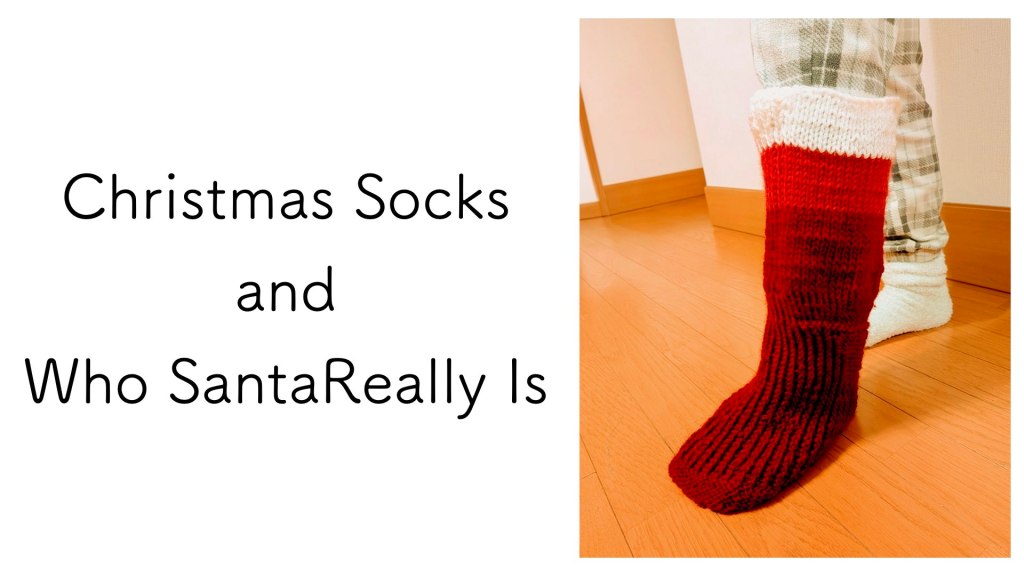
The hasty Santa Claus had already begun preparations in November.
First came the presents. I casually tried to draw out my daughter’s wishes, weighing the risk of her changing her mind and keeping an eye on trends among third graders, while searching for the earliest possible moment to make the purchase. Just imagining items selling out or deliveries being delayed was enough to make my legs go weak.
At the same time, I wanted to prepare something to build up the festive mood. But our home isn’t the kind of fine house where you can hang wreaths or put up flashy illuminations. If I had that kind of budget, I’d rather spend it on presents—that’s the honest truth. In the end, I usually arranged nothing at all, and then, right before Christmas Eve, suddenly remembered and put up a small tree. That’s been our pattern every year.
Until last year, at least.
This year, Dad had a new skill. I’d learned how to knit—just a little. So I decided to knit a stocking. The one Santa puts presents in. If I place it under the tree, the Christmas mood rises instantly. That’s why I wanted to finish it within November, in time for the start of the season.
So, I got down to knitting.
First came researching how to do it. I watched YouTube videos and immediately reeled back at how difficult it looked. The cuff, the leg, the toe. The structure was complicated—small, yet packed with techniques like a department store of knitting skills.
The heel, especially, was a nightmare. Even on a large computer screen, I couldn’t follow it with my eyes. I felt like I was being enveloped in smoke. “Heel?” Sounds like a villain, doesn’t it? I clicked my tongue while looking it up and found that “heel” and “heel” were spelled exactly the same. Figures.
I decided on a simple sock that even a beginner could knit. A long, icicle-shaped tube with no heel. It would be stuffed with presents anyway. As long as it looked like a sock, that was fine. What I really cared about was the color. Definitely white and red. By matching it with the green of the tree, it would look unmistakably Christmassy.
I could use leftover yarn from projects I’d knitted earlier that year: off-white, berry red, wine red. But it wasn’t enough—not even halfway. I could buy more, of course, but yarn has a way of eating money if you’re not careful. What I could afford was maybe 500 to 800 yen per skein. Even then, costs add up as the number grows. You pick up a skein thinking, “Oh, what a cute color,” only to realize it’s an overseas brand costing several thousand yen. Not cute. Back on the shelf it goes.
“Wouldn’t it be cheaper to just buy one at Uniqlo?” my wife sometimes said. True—but saying that kind of ruins everything. Still, year’s end is expensive in all sorts of ways, so keeping extra spending down was definitely the right call.
So I decided to buy yarn at a 100-yen shop. Daiso and Can★Do really come through at times like this. The color, thickness, and sheen would all be different from the yarn I already had. But if I could find something close enough, maybe it would work. It would have to work.
With my head spinning from equal parts anxiety and determination, I headed to the Daiso in Shinjuku Subnade. Winter sales rounds chill you to the bone. As a salesman’s survival strategy, I know Tokyo’s underground malls inside out. I was pretty sure there was a big store there.
When I arrived, I was stunned. “What? This many kinds?” It was nothing like the shop near my house. Colorful yarn, of course, but also knitting needles and crochet hooks in every size, sewing tools, decorative items like beads—it didn’t feel like the same chain at all. Just looking at the shelves was a pleasure.
Later I learned that store size doesn’t necessarily correlate with selection. Some large stores have weak craft sections, while some small ones go deep. Stock probably varies by location, customer base, and the store’s own philosophy. In any case, the Daiso Shinjuku Subnade store was serious.
Luckily, they had a wine red yarn that closely matched what I already owned. Two skeins for 200 yen. If I’d bought it at a craft store, it probably would’ve been around 1,500 yen. Saving the equivalent of three bowls of gyudon was huge. I silently offered thanks as I headed home.
About two weeks passed after that. As winter deepened day by day, I knitted the stocking, feeling the cold creeping into my fingers.
The cuff was off-white—like a snowy crown on a Christmas sock. Around the knee area, berry red. A pinkish shade, meant to form a gradient into the deeper red ahead. From the shin down, a single calm wine red. Just because it was for a child didn’t mean it should look childish. That’s the trick to appealing to kids. Playing at color design, I felt myself using a different part of my brain than usual. It reminded me of coloring books from when my daughter used to sit on my lap.
The main wine red came in two types: one from a craft store, one from the 100-yen shop. Combined with the other yarns, that made four in total. Handling them was interesting—the difference in texture was tangible. You could almost call it a “knitting feel.”
The three yarns from the craft store were all wool, each with different origins and twists, each with its own personality. Smoothness, elasticity—almost a sense of richness transmitted through my fingertips. That breadth of character is probably what makes a specialty craft store special.
The 100-yen yarn had a different feel altogether. Being acrylic, it lacked quirks in elasticity and texture. That made it easy to handle—quick, crisp, and satisfying to knit. Maybe you’d call it sharp. Perfect for a beginner like me, and surely designed that way.
Even if the knitter’s skill is low, even if the yarns don’t perfectly match, if you knit carefully, it still turns out decent. Knitting has that kind of reassurance built into it.
Late November. The finished stocking, just barely in time, was immediately slipped onto my daughter’s foot, and she slid across the floor. “Look! I’m skating!” Acrylic yarn, true to form—the floors had never looked cleaner. I’d made it quite large for presents, but it fit surprisingly well.
“Only one?” “Only one.” “Why did you make it?” “For Santa to put presents in.”
Her skating stopped.
“Hey. You know… Santa’s Mom and Dad, right?”
So the moment had come. Is Santa really the parents? I’d thought about how to answer that ever since becoming one. But now that it was real, the clever responses I’d prepared felt like they would make light of her courage. I couldn’t bring myself to say them.
“Yeah. Correct. You figured it out?”
The year she mistook Santa’s disguise for a red ogre. The year her letter to Santa was glued shut, forcing me to guess. The way the hiding place for presents crept higher each year. Every December 25th morning, sharing the joy with you—“Santa came. We were good this year.” I loved that more than anything. For eight years, I was your Santa, and it made me very happy. Thank you. When I answered her, what kind of face was I making?
The next moment, she thrust her right fist into the air and shouted, “Yes! Perfect timing!” Is there such a thing as “perfect timing” for this?
“Mario LEGO is on sale right now. We don’t need Christmas. Buy it now.” Black Friday. I immediately understood that this was her way of being considerate. She’d known for a long time, probably—why our Christmases were so modest, and who Santa really was. She keeps growing up. I’ve never once managed to keep up with that speed.
Still, I’d never heard of borrowing Christmas in advance before. I immediately searched for the LEGO set on Amazon, and she leaned over to look at my phone.
“That one? The Mario one?” “Yes! That!” “Oh, you’re right. It’s down from 14,000 yen to 13,000.” …Wait. 14,000 yen? Plastic blocks, 14,000 yen—13,000 even on sale. My yarn was 100 yen a skein. Trying not to think too deeply, I kept tapping until the purchase was complete.
“It doesn’t get used now,” I said, holding the stocking as I reported to the other former Santa. She’d been quietly listening the whole time. “Yeah. Then knit one more. Mom says her feet are cold. Send it to my parents’ place.”
And so here I am now, knitting socks for my mother-in-law. With slightly better yarn, properly practical ones. A Christmas present for Grandma—an unexpected turn of events. One Santa leaves, another becomes Santa.
What should I knit next year?
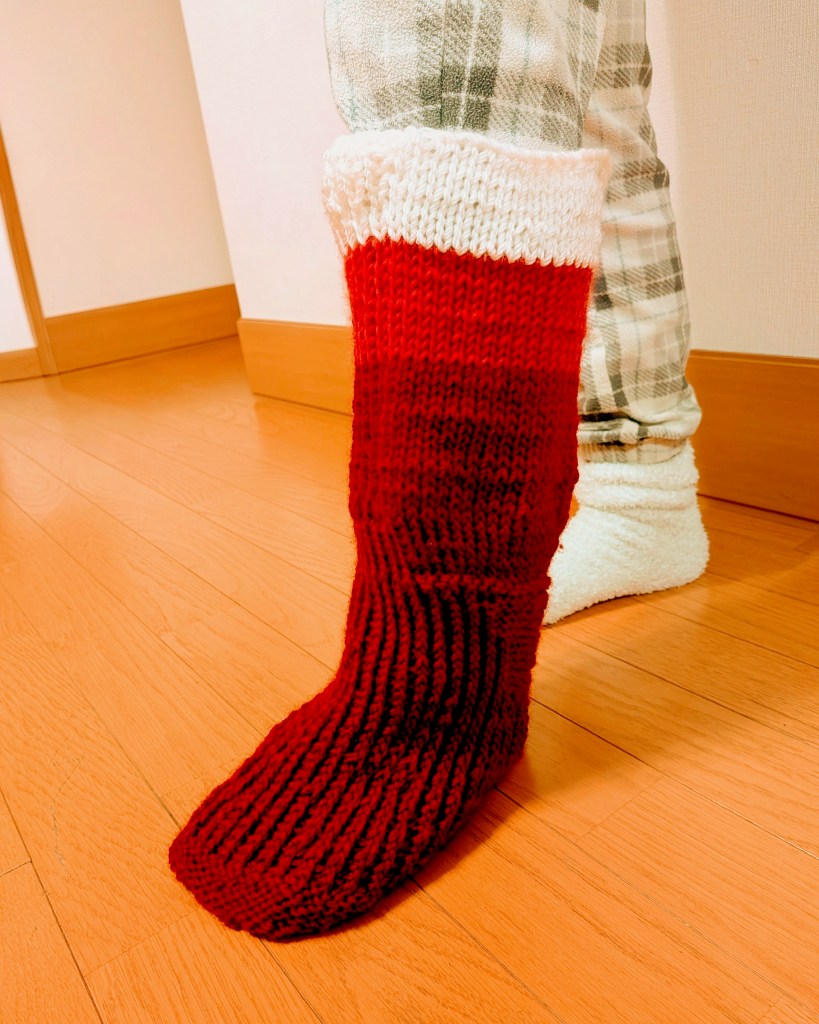
“The sock my daughter shoved her foot into. The stitches are loose. But the floor gets clean.”
 Musuta Kusaka's Everyday Journey with Diversity, Equity, and Inclusion in Japan
コメントを残す