There’s a guy at my company who claims he goes to the gym eight times a week. “Isn’t that more than every day?” “I don’t go every day. I’m not that free.” The mystery only deepened.
Then one day he injured his lower back. Seems he tweaked it doing an exercise that involves lifting a barbell from the floor—in other words, the deadlift.
The Japanese character for “waist” contains the element for “meat” and the one meaning “essential,” and it really is essential. Hurt your lower back, and the strength drains from everywhere else. Thus his gym visits—or rather, his gym lifestyle—were put on hold for a while.
So I decided to recommend knitting to him. “You’d expand your winter wardrobe,” I said. A little missionary work.
Here’s a secret: muscular people often struggle with clothes. Their waist might be M, but their shoulder width and chest could be XL. If they settle for oversized clothes, their hard-earned V-shape gets swallowed up. You can imagine them looking like they’re wearing a poncho. Summer is manageable—they can still wear T-shirts. But once winter comes, they drift through stores thinking, “This is not what I signed up for.”
“Kusaka-san, you knit?” he asked, half-smirking. His bad habit: sneering at things he doesn’t know. And saying “you knit and stuff?” to a senior’s heartfelt suggestion—how dare he.
Trying to stay calm, I looked straight at him across the desk. “Listen. Weight training and knitting are remarkably similar. I have three reasons.” Some people slip into formal speech when their blood pressure rises. I’m one of them.
For the next five minutes or so, I gave him a full-on presentation. Anyone in the next department probably thought it was sales-roleplay practice.
First: both are “solitary pursuits.”
For us corporate workers, it’s not an exaggeration to say that almost all our waking hours are taken by someone else—clients, bosses, coworkers, family, friends, partners, social media.
Being alone these days is a luxury.
Weight training is basically a conversation with yourself, right? “I’m done.” “No, I can still go.” When you’re pushing your limits, you want to focus inward. Part of the reason you train may even be because you want to be alone.
Knitting is the same. It’s a way to monopolize your own time. Nobody’s ever heard of “doubles knitting” or a “crochet relay race.” When your fingers are guiding soft yarn, you forget your phone. That alone lets you escape the noise of relationships. It’s emotional noise-canceling. If you knit in a café, your coffee tastes somehow deeper.
In other words, both are forms of cultivated solitude. Even admiring the finished product alone is exactly the same.
If you like weight training, I guarantee you’d enjoy knitting too.
“Hmm, interesting,” he said, poking a straw into a protein drink. Listening to a silly story you don’t care about isn’t easy. But he’s a guy who listens properly if you speak properly. Whether “interesting” is a phrase used for inferiors by feudal lords—I let that slide.
“You’d be top-tier in Shimbashi if contrived analogies were an art form,” he added. He really might be making fun of me. “But knitting’s all stillness and weight training’s all movement. They’re totally different at the root.” “I get why you feel that way. And that’s an excellent observation. Yes, knitting is stillness and weight training is movement. But what’s the underlying principle? That’s my second point.”
Both weight training and knitting are forms of healing.
Everyone knows rest is as crucial as exertion—almost Buddhist-level wisdom. It’s 50:50, like the front and rear wheels of a bike. You heal your muscles by damaging them—that’s how supercompensation works. And it’s not just muscle growth. Your mind clears too. One reason is that after training, your body switches into recovery mode. Your parasympathetic nervous system takes over. You’ve heard of that, right? That’s what gives you that refreshed feeling.
Knitting works the same way. When you sink into the rhythm of yarn and needles, your mind calms down. Your attention settles into the “here and now”—Which stitch next? How many rows so far? That’s parasympathetic dominance too. Modern mindfulness. In fact, a study published around 2015 in the Journal of Research and Studies—from the Chiba Prefectural Health Promotion Foundation, with Chiba University researchers—showed mindfulness effects (attention focus) of hand-knitting for people with depression and anxiety. Ask Chappie; there are tons more.
So ultimately, both are healing. And since he’s recovering from a back injury, he might feel that effect even more.
And here’s the important part: nothing is more vital to us businesspeople than healing. Without it, we can’t keep working. In terms of sustainable development—well, weight training and knitting are practically SDGs.
“Yeah, definitely not SDGs.” “No, definitely not.” “If it’s healing you want, why not just hit the sauna? My gym has one.” Damn. He goes to a good gym.
Realizing logic wasn’t enough, I changed tactics. I was going to argue my third point—“Both offer guaranteed results. That moment of ‘I actually made this!’ is a stabilizer in a VUCA world”—but I switched strategy.
“So, why exactly do you go to the gym so much?” “To build my body.” “That all?” “For my health.” “And?” “For staying in shape.” “…” “…” When someone starts repeating themselves, it usually means they’re cornered. I liked his earnest simplicity. In sales, you don’t poke someone’s weak point—you soothe it.
Here’s the truth: both weight training and knitting become your “business card.”
Salespeople survive by being remembered—ideally with a good impression. Sure, a muscular body looks good. It signals discipline, competence. Some people may even think, “Nice.”
But ever since at-home workouts boomed during COVID, muscles have become a commodity. An inflation of abs. You need differentiation.
That’s where knitting comes in. Just like you can vaguely imagine the personality of a muscular guy, you can vaguely imagine the personality of a knitter: gentle, delicate, honest—nothing negative. There are no bad knitters. Probably.
A hobby like knitting makes your character visible. Are you really going to keep that kindness hidden under your armor of pecs? Say “I actually knit in my spare time,” and nobody will forget you. That’s what we call gap appeal. It’ll help you someday—professionally or personally.
Of course, it’s heresy. Knitting has no gender; it’s not for attracting anyone. Flirting tactics have no place in the office—compliance-wise or morally. But sometimes you have to sell the hole, not the drill. I wanted a knitting buddy. That was all.
So, based on the three points—“solitude,” “healing,” and “business card”—weight training and knitting are basically the same. Even the involvement of fiber in both isn’t a coincidence. They’re like the North and South Poles: opposites, yet twin-like.
Lastly, cost. Supplies from a 100-yen shop are enough. Needles and yarn: minimum 200 yen. Think of it as a tiny fraction of your gym fee. Zero risk.
“Let me see something you knitted, Kusaka-san.”
Got him. When they ask for samples, they’re halfway in.
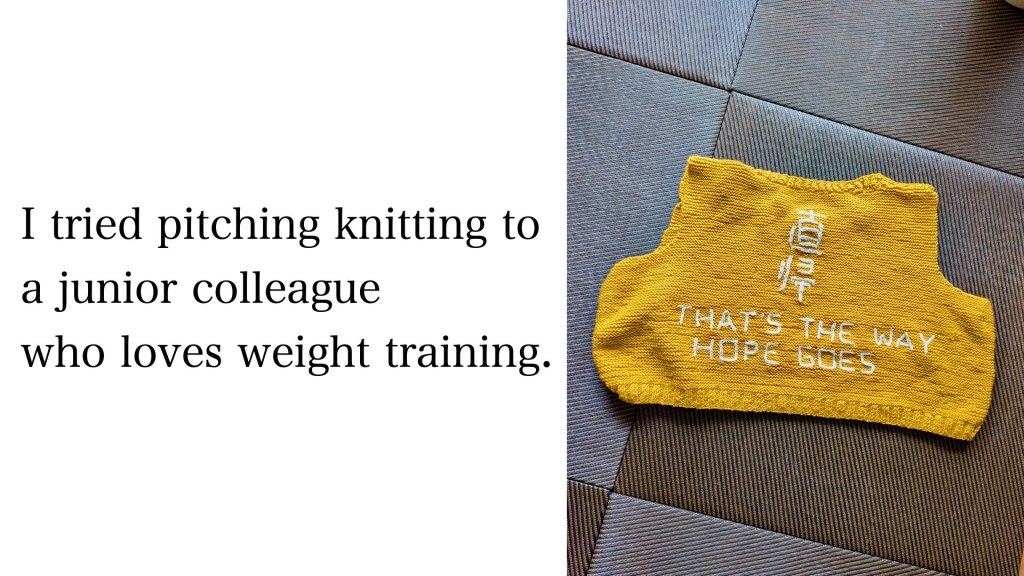
But I had a problem. I’d only finished one wearable item—and it was terrible. I’d tried to impress my wife and failed spectacularly.But showing failures is also part of mentoring. I showed him my phone.
“…It looks like Dayōn!” This one:


He knew it from Osomatsu-san.
Does it look like him? …Yeah, maybe. The word choice was genius.
He was being considerate in his own way. Instead of saying the embroidery was cringe, or the proportions off, or the whole thing kind of shabby, he swallowed all critiques and burped out “Dayōn.”
“Give me this vest. Looks like I could wear it even with a back brace. And it’s warm.” Again, his version of kindness.
You’re a good junior, kid.
When you keep knitting, there comes a day when you knit for someone else. You think of the person as you stitch. That’s a big part of knitting’s charm. He’d be perfect for it. Anything that guy knits would be warm, I’m sure. I didn’t tell him, “This straight-home vest is perfect for someone who hits the gym eight times a week.” A missed chance. My missionary work failed.
Or so I thought. Then a senior colleague—someone fairly high up—who’d been listening chimed in: “I knit.” There she was. A hidden knitting tribe member. And a veteran at that.
Having her hear all my pompous theorizing was mortifying.
Now the two of us are plotting how to lure the junior into the knitting world.
 Musuta Kusaka's Everyday Journey with Diversity, Equity, and Inclusion in Japan
コメントを残す