
There was a documentary god.
It was such a miraculous ending that I couldn’t help but look up at the ceiling. There may have been other audience members who felt the same way. After the end credits, applause broke out in the cinema.
As for me, I was moved, of course, but at the same time I felt a bit complicated, a mixture of nostalgia and anger.
I was raised by two moms myself, so my own family and the families in the film overlapped, and it didn’t just happen to me.
The film in question is “Futari no Mama,” *
a documentary that follows four same-sex couples living in Japan.
*:In Japanese, the title Futari no Mama carries a double meaning: it can mean “just the two of us forever” as well as “two mothers.”
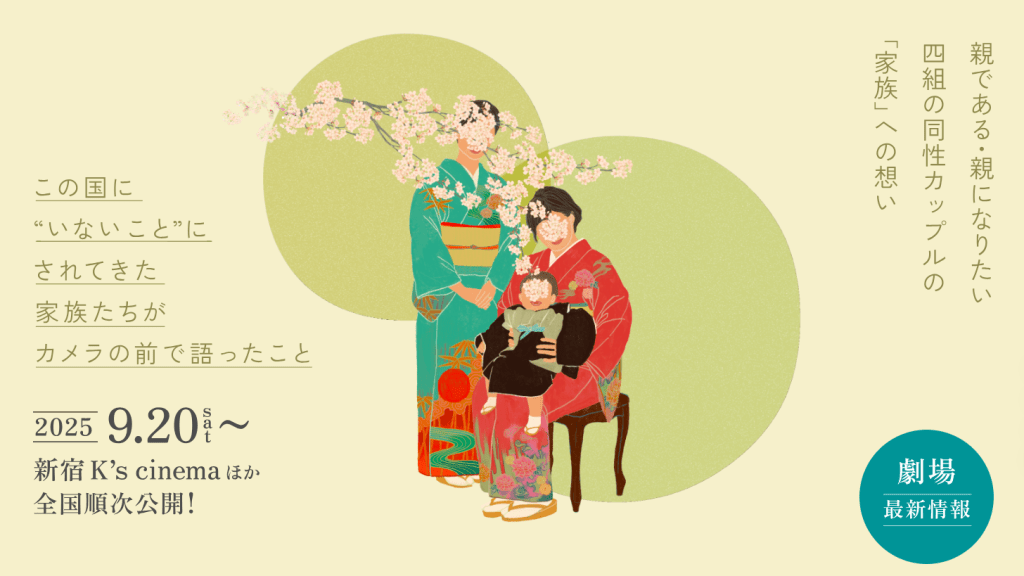
The situations the families find themselves in are incredibly diverse. There’s a couple who gave birth to a baby through sperm donation and are raising it with the help of their grandparents. There’s a single mother and her partner who are raising a child and have just started living together. There’s a couple who have struggled with infertility treatment for many years and are battling various limitations. There ‘s also an older couple whose daughter, conceived through a sperm bank, is about to reach adulthood.
The choices, happiness, conflicts, and obstacles of four couples. The film’s highlights lie in the close-up shots of joys and sorrows, which leave viewers impressed and exclaiming, “How did you get so close?”, and the warmth of family life glimpsed through them. You can almost smell the scents of each family’s home.
However, issues such as changes to laws relating to reproductive medicine and assisted reproductive technology, same-sex marriage, and workplace environments sometimes violently surround these families. This is both very personal and very social. The viewer will be moved back and forth between these two experiences, and be forced to reflect deeply.
When I finished watching the movie, I felt like those families were us . I too grew up in a single-parent household. Later, I lived with my mother’s partner, who became my stepfather. After entering the workforce, I had a daughter, but my wife gave birth at a later age. Although we benefited from reproductive medicine, the years of infertility treatment were a painful and exhausting battle. Now, my mother-in-law is my daughter’s biggest supporter. I found that we, and I, have a lot in common with the families in the film.
And above all, there was a time when I had two moms.
My mother and her friend K-chan. Including me, my younger brother, and K-chan’s daughter, there were five of us in our family: two moms and three elementary school-aged children. We lived together around 1990, 35 years ago.
My mother worked as a hostess at a club catering to the yakuza in Kabukicho. K-chan worked as both an insurance saleswoman and a hostess at a pink salon. They had no money, no education, and no relatives. They were also the same, even covering the debts her ex-husbands had incurred. “Yours too? Us too!” A comrade-in-arms appeared. The two single mothers decided to live together.
Life with two mothers was tough, but energetic. With only two brothers, my family put up our first Hina dolls. We went to the beach in our expired car, singing a parody of Bakufu Slump’s then-hit “Riso Lava,” repeating, “It’s not a lie, it’s not innocent, summer women are wicked.” K-chan’s persimmon compote shocked me, as I couldn’t believe I’d eaten stewed fruit. At the end of Tokyo Love Story, we all complained, “What on earth is three years later?”
Just because I had two moms, I was nothing special. I don’t remember being bullied by my classmates. My life was just like everyone else’s, yet unlike anything else.
Then one day, my mother was unable to get up. “It’s a waste to pay for an ambulance. K, Musuta, take me to the hospital.” K-chan sped off in her car and rushed my mother to the hospital in the middle of the night. “Her heart is quite enlarged. It’s twice as big as normal,” the doctor said matter-of-factly. She was admitted to the hospital urgently.
“Are you her sister?” the doctor asked K-chan, looking a little suspicious. “No, I am her roommate,” K-chan replied. We were then taken to the examination room, where the doctor explained her condition in detail. However, as he listened more carefully, it became clear that the diagnosis he had been making for the past few months had been a misdiagnosis.
K-chan lost her temper. “That’s strange, isn’t it? It’s completely different from what you’ve been saying so far!”
I could hear K-chan’s voice echoing down the hallway. “Calm down, calm down,” the doctor tried to soothe her with a half-smile. This only rubbed K-chan the wrong way.
To be honest, I was more scared of K-chan’s rage than losing my mother. But now I understand that her rage was an attempt to protect us. The look on K-chan’s face as she charged at me with no makeup on. That night, family became something that could not be described simply as blood ties.
In the past, even if you weren’t a relative, it wasn’t uncommon for friends or colleagues whom the doctor deemed trustworthy to be admitted to a hospital or treatment room and told about the patient’s condition.
But now it’s different. Basically, only “family” can hear about a patient’s condition, and visits are restricted.
What if K-chan had been turned away by the doctor that night? It’s frightening to think about it. Things were just looser in our time. We were just lucky.
I think that a heightened awareness of privacy is a good thing. It is also necessary to have laws and systems in place. However, laws and systems inevitably create those who are included and those who are excluded. When this happens, the discriminatory attitudes and structures of society become apparent.
Today, the couple, like their mother and K-chan, are treated as “strangers” at the hospital. And not only that, they are also “invisible” to many of society’s lifelines, including inheritance, pensions, insurance, and taxation.
I know. My mothers were heterosexual. It wasn’t a relationship based on romantic or sexual love. So our circumstances and choices were very different from those of the same-sex couples in the film. We couldn’t be together. I know that.
But we were a family. Two moms, three kids, a family with nothing to be ashamed of. I still believe in family. That’s the best proof of that. So I know. The couple in the film are definitely a family, too. There’s no difference between us and that family.
Humans did not evolve to live alone. So marriage is not only the pursuit of happiness, but also a right to exist, allowing people to come together and survive. How would that change if it were between people of the same sex? Many surveys show that 60 to 70 percent of the public supports same-sex marriage. Is this a feudal society where other people get to decide what kind of relationship people want to survive together in?
We need same-sex marriage as soon as possible in Japan. That’s the anger I felt.
But even if I get angry, it would only be me ignoring myself for not trying to change society. A documentary that leaves you grumbling even after you leave the cinema is a good documentary.
But the reason I was so angry was because it conveyed how irreplaceable the happiness of that family was. There’s no doubt that this is a film filled with congratulations. The baby is adorable.
Especially that ending. I’ll say it again, I’m not sure if it’s appropriate to call “that” a miracle. But the fact that they were able to capture “that” can only be described as miraculous. I’ll never forget that moment, the light streaming in through the window, and her smile. This scene alone is worth the price of the ticket.
If we read into it further, we feel that this ending actually forms a circle with the opening scene. Even while we are watching this movie, somewhere, a new life is being born, and someone becomes a mother and a father. What we see in this continuous cycle of events is up to the viewer, and this is also the depth and richness of this film.
I don’t think this movie will be available for streaming or on DVD, because of privacy issues. So you’ll have to see it in theaters while it’s still playing.
The film “Futari no Mama” is one I want as many people as possible to see. Watching that family through to the end will help protect families somewhere. I can’t help but feel that way.
 Musuta Kusaka's Everyday Journey with Diversity, Equity, and Inclusion in Japan
コメントを残す