“Is Daddy dead?” my daughter asked, peering into my face. It’d be a trouble if he were dead, that’s how she spoke.
Now that she’s in third grade, she’s clearly started to dislike me, her father. Don’t stay. Don’t come. Don’t talk. It was rare for her to show any interest in me like that.
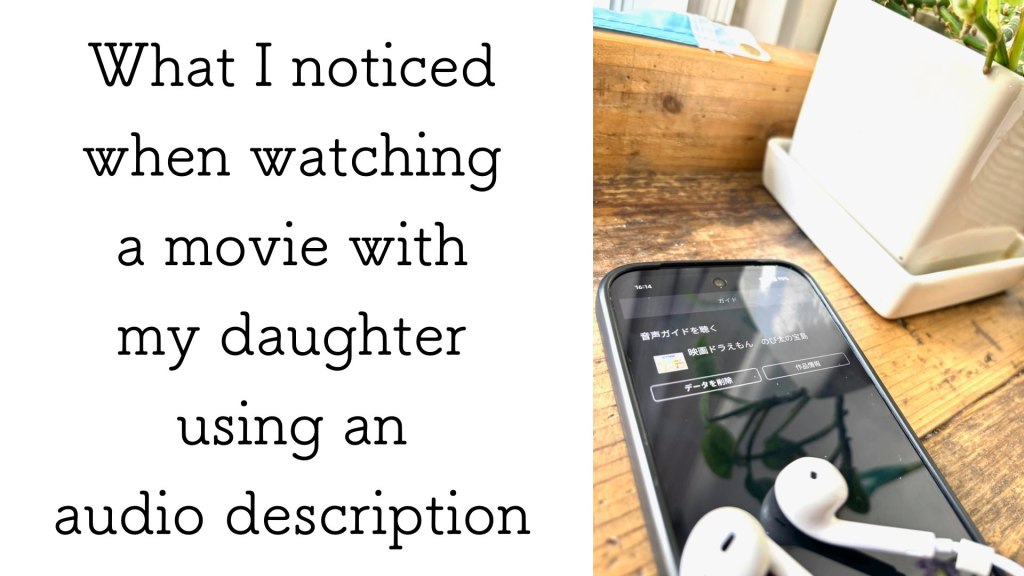
I certainly was creepy at the time. I sat motionless on the sofa with my eyes closed. Earphones were hanging from my smartphone. Even though my eyes and ears were covered, a movie was still playing on the TV. What on earth was daddy doing?
I answered, still in the posture of a god. “I’m practicing using my smartphone at the movie theater.” I could sense that she was confused and said, “Huh?”
To be precise, I was practicing listening to the audio description for a movie. An audio description is a narration that supplements visual information with words so that people with visual impairments can enjoy a movie. It briefly explains the expressions and movements of the characters, the scenery, scene changes, etc., in between the dialogue and sound effects. I started taking a course on audio description production this summer, and that day I was studying a previous film.
I handed one earphone to my daughter and asked her
if she wanted to listen. But she frowned and ran into the children’s room. That’s right. I was rejected after all.
But she returned with her own earphones. “I don’t want Daddy to use them,” she said. No, one end of these also goes into Dad’s ear canal, but is that okay?” I didn’t ask so.
It was fine if she was just curious. She was so keen to try them out. I wanted her to take this opportunity to learn about people who need smartphones at the movie theater. Common sense always needs updating. This is also part of summer vacation learning. My daughter plugged the earphones into her smartphone, and we both wore them, one in each ear.
First, we need to download the audio data to the audio description app “UDCast.” My daughter downloaded “Doraemon the Movie: Nobita’s Treasure Island” onto my device with surprising ease. It’s an app that even a third-grader can easily use. That said, the list of titles must have been quite long. Imagine this for someone with a visual impairment, and it might not be as easy.
My daughter stares intently at her smartphone.
“I can’t hear anything!” Wait, wait, wait. Since when have you started jumping to conclusions like that?
This app is meant to be used in movie theaters. The description starts automatically when the microphone picks up sound from the movie. Conversely, to listen to the audio description, you need to play the movie. Since I’m using a subscription movie instead for study purposes, let me just give it a little time to prepare. I quickly tapped the “Start Audio Description” button and played “Doraemon the Movie: Nobita’s Treasure Island” on my TV remote. Then…
“A sailing ship moving forward. Suneo on the lookout tower,” the narrator began in a gentle male voice. “I really heard it!” I wondered if she was skeptical. But that makes sense. She’d never seen a movie with his ears. She couldn’t imagine what it was like. My daughter was already reaching the climax of excitement. Doraemon hadn’t even appeared yet.
From there, I closed my eyes and focused all my senses on listening. My daughter gave up on closing her eyes and just stared straight at the screen. “Because I’II fall asleep,” she said.
The TV speakers played lines, sound effects, songs, and other sounds from the film, while the earphones played scene descriptions. The timing and length were perfect, so as not to interfere with the main story.
When my daughter asks what radiation means, “radiation raining down from the pitch-black sky,” I reply, “I’ll tell you later!” There’s a lot to learn in August.
“Nobita holds his trembling knees as he falls into the hole.” “Oh, he fell? Or was he sucked in?” my daughter muttered next to me. It’s a good thing there was an audio description.
“Floch and Sara go to the end of the Ark, waving and saluting.”My daughter proudly said she knew what a salute was. The description was also quite detailed, as they kept the dialogue to a minimum in the last scene. It was supposed to be a tear-jerker, and my daughter was in tears.
After watching it, my daughter commented, “It’s easier to understand with this.” This is probably due to the influence of variety shows and YouTube. She is used to subtitles, so it seemed easier to understand with the verbal explanations.
Indeed, the description was concise and accurate. It filled in the blanks in my mind, allowing me to build a film in my head.
It didn’t stress my ears, and it let my imagination run smooth. It felt similar to reading a book in that it kept the audience engaged with words without losing interest.
Speaking of reading, it’s similar in that it makes I feel like I am inside the story. That feeling of jumping into the world of the story and witnessing the characters’ adventures.
That’s why the audio description barely included any dramatic depictions like close-ups of faces or slow-motion tears.
Come to think of it, this might have been the first time I’d ever seen a movie without being conscious of the rectangular frame of the screen. I wonder if this is what the “immersive” that’s been talked about so much lately means.
However, there were some parts that I found difficult.
First of all, I couldn’t distinguish between the voices of the characters. In particular, I often couldn’t tell if the girl’s voice was Shizuka-chan or Sara. It seems like it would take some practice to distinguish between the voices.
Furthermore, there is no room for audio commentary during fast-paced scenes such as battles and escapes. It was common for the scene to move on to the next one while I was still imagining what was going on. Huh? What’s going on?
This causes my concentration to be broken. My ears tend to wander, and I find myself getting separated from my description. Being lost and alone is lonely, and I even feel left out. It’s a sense of alienation of a quality I’ve never felt before. I wonder if this is something similar to what visually impaired people experience on a daily basis.
On the other hand, this also means that audio description users approach the viewing experience with a level of skill and concentration that I probably could never match.
“If it’s a Doraemon movie, does that mean children will use it too?” my daughter asked as we downloaded the next Doraemon movie. I was timid, but managed to reply, “Oh, yeah. That’s what it comes down to. Even blind children will use it.” I was taken by surprise. Without a shadow of a doubt, I had imagined that audio description users were adults. But I was wrong. Of course, children use them too.
“I wish this was more common,” she said, noting that she had never seen any blind children her age at the cinema.
My daughter was able to perceive things that she hadn’t been able to see before, with a keen sense and agility. She was able to effortlessly redefine what was “normal,” and she must be able to see far more than I could. It was I who was the one who learned this.
If she were to create an audio description with that perspective, it would surely be wonderful. With this thought in mind, I played the new Doraemon.
 Musuta Kusaka's Everyday Journey with Diversity, Equity, and Inclusion in Japan
コメントを残す