“No way. This isn’t a joke…” My wife muttered while watching TV. The screen showed a live broadcast of the Upper House election results.
No way that party. No way that candidate. No way that electoral district. Especially the “no way” caused by the Sanseitō party had us both cursing bitterly for a while, then my wife sighed, “I miss Mac Akasaka.”
Mac Akasaka. About 10 to 20 years ago, he founded the Smile Party with the slogan “Change the world with a smile,” repeatedly ran in the Tokyo gubernatorial and national elections as an independent candidate. Some might remember him for his trademark catchphrases like “10 degrees! 20 degrees!! 30 degrees!!!” that aimed to make voters laugh.
Everyone thought, “No way this guy could win,” and he invariably lost every time. My wife and I liked his reckless fighting spirit and the way he fell spectacularly, even finding a kind of pro-wrestling-like aesthetic in it. Even if he had pulled off a “no way,” some might have been stunned, but no one would have been afraid like this time.
That’s why we went together to see the documentary film Candidate, which followed his election campaign. It was 12 years ago, at a small theater called Pole Pole Higashi-Nakano in Tokyo.
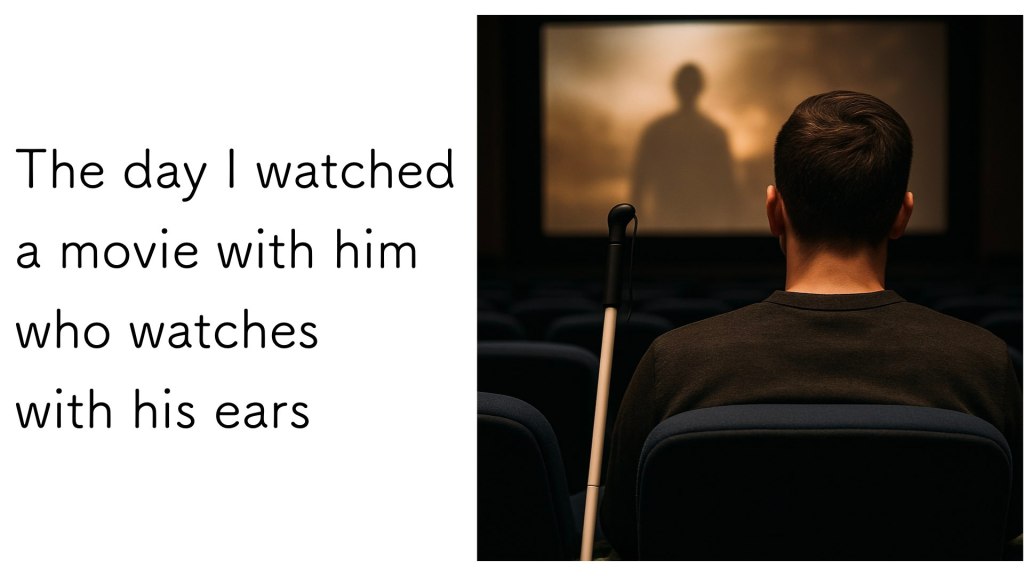
When we arrived in front of the cinema, my wife let go of my hand and called out to a stranger. “Are you okay? Where are you headed?” The man stood just beside the entrance, with a poster for the upcoming screening behind him. His large body slightly bent, holding a white cane in his hand. My wife never hesitated, assuming he was just waiting for someone.
He looked up and answered, “Um, I think this is the movie theater, but where do you enter?” I almost blurted out “What!?” but swallowed it. Even with a visual impairment, he was coming to watch a movie.
But my wife showed no surprise and circled around to face him directly, loudly asking with no concern for mistaken identity, “Are you P-san by any chance?” “Eh? Ah, yes.” She got it right, and this time he was the one surprised. “I always listen to your radio!” He was a famous postcard writer for the radio program my wife liked. Known among listeners as a visually impaired movie fan. Apparently, the logo sticker on his bag gave him away.
“I thought it might be you. Tokyo really has all sorts of people walking around.” My wife, who had come up from the suburbs of Oita, was thrilled as if she’d met a celebrity.
“Candidate, right? Us too. Shall we go in together?” She quickly spoke and immediately switched to a casual tone.
“Wow.” My wife put P-san’s hand on her shoulder and leaned back. Beyond the opened door, the place was overflowing with people, almost unbearably hot with their presence. The staircase down to the basement theater was jam-packed. At the landing, those trying to go in and those trying to leave collided in a whirlpool of bodies. There was no way P-san could wave his white cane here.
“This won’t do. P-san, we’re going at a snail’s pace.”
From there, my wife led the way step by step, telling P-san behind her about the situation. “People coming out go to the right, so keep slightly to the left.” “Here come the stairs.” “The number of flyers is insane. The walls are plastered with them.” “Three more steps and the stairs end.”
Even after finally getting down the stairs, the lobby was still packed. People buying tickets, browsing pamphlets, heading to the restroom, leaving the theater, waiting to enter—all packed in like a festival crowd. Movement was even more restricted than before. The noise surrounded us 360 degrees, making it hard to hear one another.
Then my wife said, “Excuse me a moment.” She moved P-san’s hand onto my shoulder, took her place beside him again, and started speaking into his ear. “Tokyo’s mini-theaters are pretty chic. It’s my first time here too.” “Tickets are cash only. Better have your wallet ready.” “Restrooms are over there. P-san, what do you want to do? Musuta, please go with him.” She then took control of me and escorted P-san to his seat.
Finally, she asked, “Shall we leave together after the movie?” P-san laughed and said, “Ah, that helps a lot. It’s nice to have fellow listeners around.” I felt that a short ten-minute companion felt like a much longer relationship.
I still can’t forget the ending of that film. The son, who had denied Mac Akasaka’s campaign, attends his father’s street speech. In response to the relentless jeers, what words did the son return? The film’s tagline, “You haven’t even lost yet,” echoed his shout.
As far as I know, that was the only “no way” Mac Akasaka ever caused. No way it would make us cry. My wife and I couldn’t stop laughing through our tears. And P-san was crying too. Even after the house lights came on, he was busy with his handkerchief. For a while, my wife and I quietly waited around him.
After leaving the cinema, P-san invited us into a café right next door. The aroma of freshly ground coffee beans was rich. Ignoring that, the three of us ordered beer. Good movie and cold beer—our toast felt like replenishing the fluids lost through tears.
Then came the post-movie discussion. He had watched the film very precisely, even in high detail. “Mac Akasaka’s natural voice carries really well. Outdoors and underground alike.” “The scene where he gets pelted with jeers on the street was scary, but no jeers at all would be scary too.” “The son at the end sounded like his voice was trembling—was I the only one who noticed?” We, just watching, were shocked at how much we hadn’t seen. The real voices of candidates and voters heat up elections. In other words, Candidate was a film of voices and words, my wife and I realized. Surprised by how P-san shed unexpected light on the film, we drank many more beers late into the night.
Back then, how many films had audio guides? At least Candidate, which I saw with P-san, didn’t have one. Now, I truly respect his listening skills.
Twelve years later, starting this summer, I’ve decided to attend a course on creating audio guides for movies. To supplement visual information with narration so people with visual impairments can enjoy them. I will write those scripts. The preparatory materials said, “Walk together with people who have visual impairments through the world of the film.” I feel that day’s experience with my wife is a hint.
A society that wants to draw lines between people. Sure, it’s always been that way, but now I have a foreboding that the lines will multiply and thicken. Tomorrow, new lines might be drawn, and new targets might be pushed beyond them. It could be P-san, my wife, or even me.
But precisely for that reason, I want movie theaters to be a place where delightful “no ways” belong. A place where you can say, “Shall we go in together?”
I hope the day will come when the audio guide I create will bring joy to P-san.
 Musuta Kusaka's Everyday Journey with Diversity, Equity, and Inclusion in Japan
コメントを残す