“Can they play rugby in a wheelchair?” My daughter happened to ask a simple question.
Let’s find out together whether we can do it or not. So, my family and I decided to go watch a wheelchair rugby match.
Wheelchair rugby, as the name suggests, is rugby played in wheelchairs. The differences between wheelchair rugby and wheelchair rugby are “four players per team,” “the ball can be thrown forward,” and “a simple one try, one point system.” There are many other things, but if you know these three things, you can just go with the vibes.
After all, it’s a wheelchair vs wheelchair clash show with tackles and chases.
After reviewing all that, my parents and I headed to the “Mitsui Fudosan Wheelchair Rugby SHIBUYA CUP 2025” held in Shibuya, Tokyo. The venue was Yoyogi National Gymnasium No. 1, the same venue as the Tokyo 2020 Paralympics, a large stage with a maximum capacity of about 13,000 people. Moreover, admission is free, and you are free to leave and re-enter during the event. It was the perfect first time for a third-grader to watch a live parasports event.
Now we enter the venue. This is a hidden spot for parent-child leisure.

The main entrance is an impressive gate with trusses. Whether we like it or not, our excitement rises. Still, there were few people around. Just a few people taking commemorative photos.
This is good, this is good. After all, we have a third-grader with us. Suddenly, a big event with a full house would be intimidating. What’s more, there is a sense of luxury, like having Yoyogi National Gymnasium No. 1 all to ourselves. This is definitely a hidden gem for parent-child leisure.
“It’s a beautiful place,” my daughter said. Dad hadn’t noticed the architectural beauty of Yoyogi National Gymnasium No. 1.

By the way, wheelchair rugby is also known as murderball. When I told my daughter this story, she seemed to get into a fighting mood. She entered the venue with a bold step, as if she was going to fight. I explained that rugby is also a gentleman’s sport.
Is this a construction site? The sound of wheelchairs crashing echoes throughout the facility.

As soon as we entered the venue, my daughter saw female athletes in action. She was surprised, saying, “There are women!” Sorry. Rugby is not only a sport for gentlemen, but also for ladies. Wheelchair rugby in particular is mixed. It’s not just rugby for wheelchairs. It seems that my daughter’s common sense was shaken by the sight of men and women fighting together.
I was surprised by something. There was a player on the Australian team who had no hands. “Wow…” He couldn’t move his feet. He had no hands. But he still threw himself into the fight on the murderball court. He was more than amazing, he was punk.

Even so, the crashing sound of the wheelchairs, commonly known as “rugby wheelchairs,” was incredible. I wonder if this is the first time that such a metallic sound has echoed through Yoyogi National Gymnasium No. 1 since its construction.
When I told my daughter, “That seems to cost 1.5 million to 2 million yen per wheelchair,” she replied, “What! That would buy 100,000 Umaibo sticks!” , a response that may or may not be typical of a third-grader. Is an Umaibo 15 yen now? In my father’s time it was 10 yen.
And as expected of a 1.5 million yen, it doesn’t break or fall easily, and it’s fast. The battle between two men who combine the contradictory qualities of strength and speed at a high level was somewhat reminiscent of a match between top professional wrestlers.

We watched the Japan vs. Australia match on the second day of the schedule. Needless to say, Australia is one of the strongest rugby nations. That doesn’t change when it comes to wheelchair rugby. They have the three qualities of being big, fast, and skilled.
However, Japan, who won the gold medal at the Paris Paralympics, played a fascinating game. With Australia trailing by one point, 10 seconds before the final whistle. Japan took advantage of a momentary gap to tie the score, and then took the lead with two seconds left. They won the death game just before the goal and won a brilliant victory.

Of course, a hard-fought victory is more interesting than an easy win. My daughter was also very excited by the dramatic turn of events. She suddenly let out a patriotic cheer, “Japan won! Japan is the best!” Here, the volume of your voice is important. I wonder how many years it has been since I last shouted so loudly.
By the way, I remember that the concession stand also sold food and drinks. I also remember that beer was on the menu. If it was going to be such a hot game, I should have bought some beer.
Exciting for parents and children. The shock of the tackle becomes an addictive experience with the rug car.

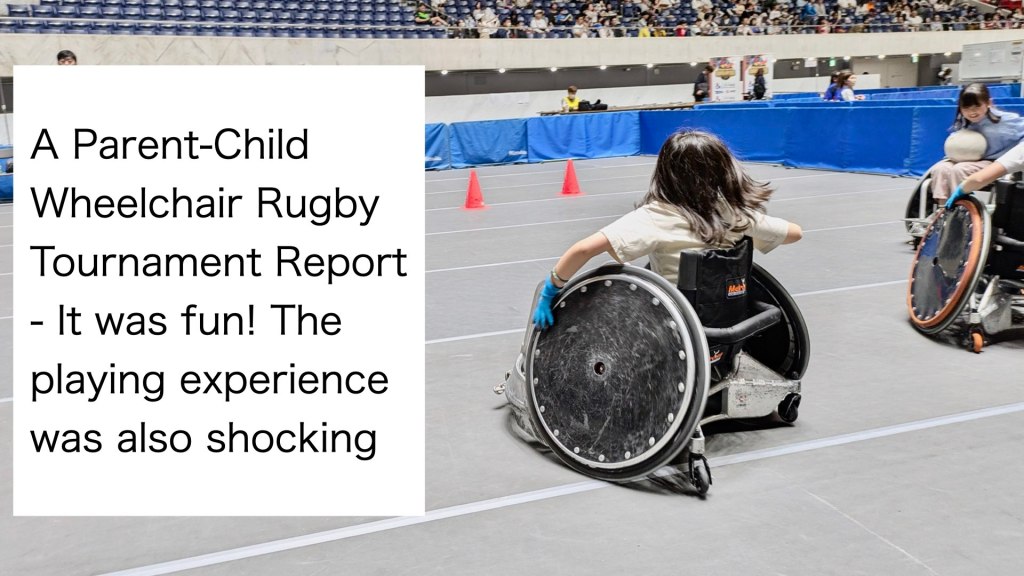
At the venue, we could also test drive a rugby wheelchairs next to the court. This was very popular with children. There was always a long line. The seat fits your body perfectly, so they feel one with the car. The wheels are light enough for children to control, and they are very quick and maneuverable. They also go very fast. It reminded me of a rowed go-kart.

We can tackle and crash into anything you want. It’s shocking, or more like a collision, and the shock penetrates our whole body. But at the same time, it doesn’t hurt because we’re protected by the machine’s frame.
Full speed, crash! Full speed, crash! It even feels exhilarating, like an immersive game. It feels like you can safely release our violent impulses. Not only children, but adults too can’t help but smile wildly. “Dad! I’m going to crash into you!” “Dad! Chase after me!” My daughter was hooked on this. We experienced it a total of three times.

“My arms are sore…” That’s right. But it’s hard to operate a wheelchair. It overturns preconceptions about wheelchairs. It also overturns prejudices against wheelchair users. It seemed to be an opportunity for my daughter to learn while playing.
After getting sweaty from the experience of riding the rugged wheelchair, we left the venue, talking about various things. You see, there are numbers written on the backs of the wheelchairs of the athletes. They represent the degree of their disability. The lower the number, the more severe the disability. They can’t move from the stomach down, or they can’t move their legs. And that’s why they play so hard. “What do you think?” “Hmm, that’s hard to say .
” My daughter didn’t just brush it off with a simple amazing” and I couldn’t help but pat her on the head. If she could sense something that can’t be easily dismissed, then 100 points out of 100. We went to Yoyogi Park and had some ice cream before heading home.
For children, watching live sports can be a big hurdle. “It’s hot,” “It’s cold,” “I’m hungry,” “I want to go to the toilet,” “I’m bored,” “I want to go home,” and so on.In that respect, wheelchair rugby was the perfect sport and leisure activity for us parents and children, as it was an indoor sport, was mostly empty, and there was also an experience corner for kids. It was also an opportunity to learn things that we can’t learn at school.
In fact, many of the spectators had children with them. It seems that there are many families out there who were thinking the same thing.
Apparently wheelchair basketball, blind football, and boccia have also been well thought out in their tournaments. I’m thinking of taking part in those events next.
(End)
 Musuta Kusaka's Everyday Journey with Diversity, Equity, and Inclusion in Japan
コメントを残す