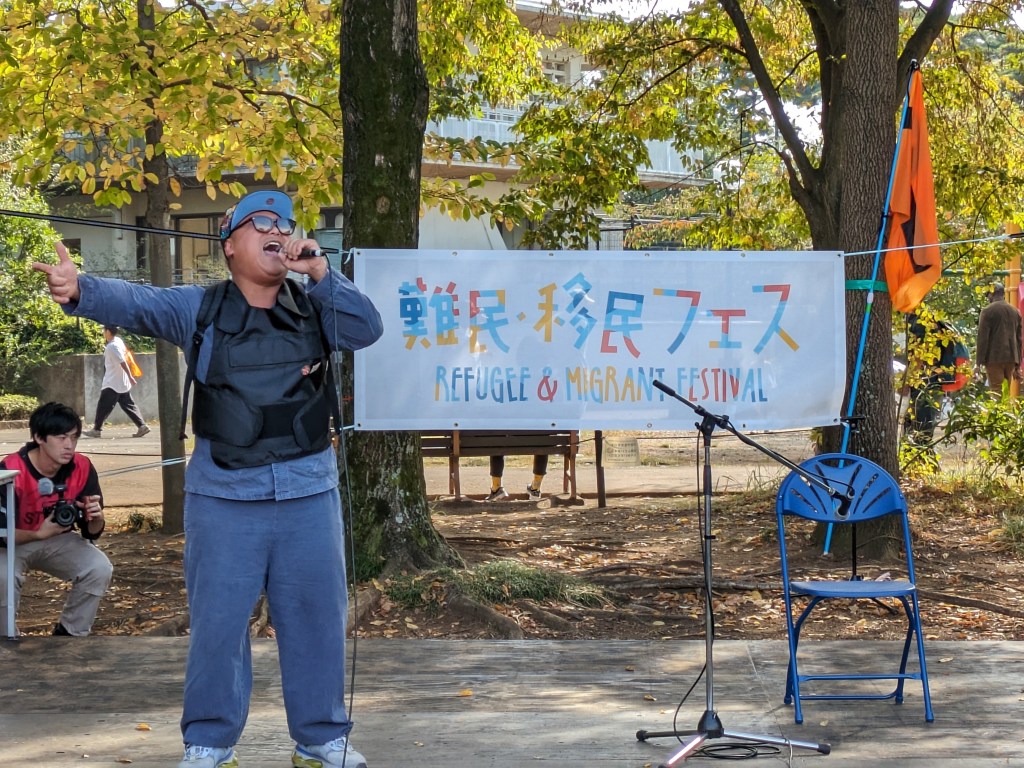
It feels like autumn only lasted a few days this year. On a rare, clear autumn day, November 4th, I went to the Refugee and Immigrant Festival. This was the fourth charity festival to learn about, engage with, and support refugees and immigrants living in Japan. This was my third time participating, having previously attended in Kawaguchi and Nerima.
When I arrived at the venue, there were food stalls from various countries, regions, and ethnicities, such as Myanmar, the Philippines, and Kurds. There were also miscellaneous goods for sale and workshops. And this time, everything was delicious, cute, and fun. That’s why every booth was popular. It had become a regular sight to see long lines that seemed to coil around each other. In other words, people who were interested in refugees and immigrants, had come to the event, and were trying to get involved, even if only for a short time, were lining up. People aren’t so bad after all. Far from being fed up with the lines, this is probably the only place where I could feel hope.
The atmosphere was simply peaceful. Some people were concentrating on the delicious food. Some were enjoying shopping. Some were chatting with others. Some were sitting on the grass sipping tea. It felt like a slightly large outdoor tea party. I’ve never been to a tea party though. “Would you like some sweet cake?” the vendor kids asked as they went around the venue. They were cute, friendly and pushy. Good at business. The sweetness of the cakes was certainly quite pushy.
It is always held in a park, but with each passing year, the venue has been moved to a larger park. Perhaps the number of booths and visitors is increasing. However, there is no sign of the place becoming unruly. In these times, it is not surprising that violent or hateful people would come to disrupt the event. But there was no sign of them here.
Then, I heard on the radio later that there had been some trouble. Some newspapers had also reported on it. Apparently, a group of ward council members had come to the festival and asked some festival participants, presumably the people involved, questions about privacy, which caused a bit of a quarrel. The radio and newspapers each had a different tone. So I don’t know what happened on the ground, but the common thread was that the participants expressed anger.
I think there must have been a reason for the anger shown by the participants in that atmosphere. I don’t think we should speculate on whether the reason was on the ward council’s side or on the participants’ side, but I think it’s certain that private questions should have been avoided. I don’t ask people or children who have fled to a shelter about their homes. It seems similar to that.
Among the participants, there are people with trauma. There are people who are being chased. There are people whose lives are in danger. There are people who don’t want to talk about themselves, and can’t talk about themselves. If you read the organizers’ guide, you would understand that there are many such people in this place. Behind those who raise their voices, there is often a cliff. For those who have come to Japan and suffered at the hands of Japanese people, it is no wonder that the screams and the angry voices sound similar.
On the other hand, I was scared. I might do the same. If I had the chance to talk to the person involved, I would easily cross the line. I can easily imagine myself letting my guard down in that friendly atmosphere of peace and forgetting their tension and seriousness. Or rather, that’s the only way I can imagine myself. I just happened not to get in their way. Just by chance. It was painful to hear that no one was to blame. I wanted to remember that the shadows were all the darker under the intoxicating autumn sun.
By the way. The radio program I listened to later was TBS Radio’s ” Ogiue Chiki Session .” I’ve been listening to it since its predecessor, Session 22, and was looking forward to the public recording on the day. It was actually a lot of fun, and I learned a lot more than that.
The most memorable performance was by FUNI, who was my main target.
FUNI is a rapper, poet, and businessman. He has roots as a third-generation Korean resident of Japan. And he expresses himself based on his roots. About adversity and discrimination. About suffering and conflict. And about solidarity and hope. Wrapping up raw emotions with rhyme, philosophy, and humor.
The lyrics are very raw and serious. The beat is heavy, or stoic. So when you listen to it, your head gets hot. And your heart gets light. Your heart gets heated by the words, and you feel a strange excitement in your chest, as if it is taking off like a balloon.
Although it is clear that anger is at the root of his expressions, the contrast between his use of polite language and the polite “desu/masu” throughout is irresistible. He calls himself the most humble rapper in Japan. I like the way he speaks, including this sense of being down to earth.
“Our grandparents, the first generation, didn’t have words. Money was more important than words. To survive. But we, the third generation, have words. That’s why we speak up. We’re rappers, so we have to do it.” That’s what he said. I think it was “me.” Or maybe it was “me.” But this was the punch line that hit me the hardest that day.
“The first generation are all dead. Oh, I was wrong. Sorry. I’m still alive. I came from Kawasaki this morning, and as a senior immigrant, I’m doing a kimchi workshop there.” That’s what she said. On that day, first generation grandmothers were also doing a kimchi workshop. The secret ingredient seems to be adding pears. I regretted from the bottom of my heart that I didn’t go to their booth. I love kimchi.
“Our generation was told, ‘You Koreans stink of kimchi. Go away.’ But now, when you turn on the TV, you hear that kimchi is good for your health. Times have changed,” the grandmas said. The pioneers of the past have survived, and now their very existence is a source of hope.
Living Hope. This is hip-hop. This is one of the reasons why I love the Refugee and Immigrant Festival. Peace, Love, Unity and Having Fun. The wisdom of surviving together with your neighbors, born from the struggle. This is what you can get a glimpse of at this festival.
The background of becoming a refugee or immigrant is probably full of unreasonableness and absurdity. Seiho won’t solve anything. I know that. The reason why the festival scene looks beautiful is because of my arrogance, seeing only what is convenient from a safe place. I know that too.
But. Hip-hop doesn’t allow for bystanders. It makes everyone who listens dance, inspires them, and makes them part of the floor. The party continues and eventually becomes a community. There will be various troubles in the future, and they will increase as the scale grows, but the props will increase more than that. I am definitely one of them.
That’s why I will continue to go to this refugee and immigrant festival. To eat delicious food. To buy cute things. To participate in the workshops. And above all, to listen to FUNI’s rap. And to experience hip hop for living in the present, and the wisdom of living with others. Because this festival shows that humanity isn’t all that bad.
Ah, I’m looking forward to the next time.
 Musuta Kusaka's Everyday Journey with Diversity, Equity, and Inclusion in Japan
コメントを残す