Fashionable people are scary.
When I face them, I feel like I’m being looked down upon.
Or rather, I’ve been looked down upon. If I could muster all the lung capacity I’ve been laughed at up until now, I could even float a hot air balloon. But that’s not how hot air balloons work. Yeah. I know. Just for example.
So for the same reason, I don’t like Yokohama either. The fashionable streets, the fashionable people. Every time I go there, I’m confronted with the fact that I don’t meet the dress code of this city, and I don’t have the talent for it. Eh? But I still went there for the first time in years because I wanted to go to a certain event.
The last Sunday of September. An event called Gradation Campus in Kanto. Organized by a student group called “WataPro”.
It is a group of university and graduate students interested in gender and sexuality who are working to revitalize the local area in the field of SOGIE. Apparently there are even junior high school students among the members. Wow. A sigh of respect.
This event is part of the group’s “Cotton Candy Project,” from which the group’s name seems to have been derived. The purpose of the event is to create a place for young sexual minorities and to disseminate information, and it has been held in Shiga and Fukuoka prefectures so far. It will also be held in Tokushima in November.
Why did I decide to go? Because when I heard about this event, it reminded me of S. S was a friend of mine from college, and he was gay.
It was the middle of the Heisei period. Social media was just starting to take off, the term “sexual minority” hadn’t been introduced yet, and the word “gay” hadn’t gained as much acceptance as it does now. At least, I hadn’t heard it much in my neighborhood.
However, even though all of his fellow students knew that S was gay, none of them mocked him like they did on TV. Not a single one of them. They were all undoubtedly sincere, caring friends, and good people. “I don’t care.” “We’re friends, so it doesn’t matter.”
It seemed that S and I were the only ones who felt “…” .
Something was out of focus. But why was it out of focus? Even if it was in focus, what would we see? I’m sure neither of us knew. Everyone was a nice guy, so it was okay. Maybe that wasn’t the reason, but we got along well.
He was always dressed in traditional, tight-fitting outfits and had a somewhat aloof side to him, but he called me endearingly “Kusa-kun, Kusa-kun” and we hit it off over trivial things. I was happy about that.
I was living with a trans man at the time. He was my mother’s boyfriend. When I told him about it, he laughed and said, “Kusa-kun, you look good in complicated situations.” After laughing, he sighed.
At the graduation party, S came out to his seminar friends. He was completely drunk. And that was the last conversation I had with him.
Now, more than 20 years later, students themselves have become aware of the problem, created a forum for disseminating information and a place for friends to gather, and this has spread all over the country.
If S were a modern college student, would he be here? I headed to Yokohama with the feeling that I was going to find some traces of him.
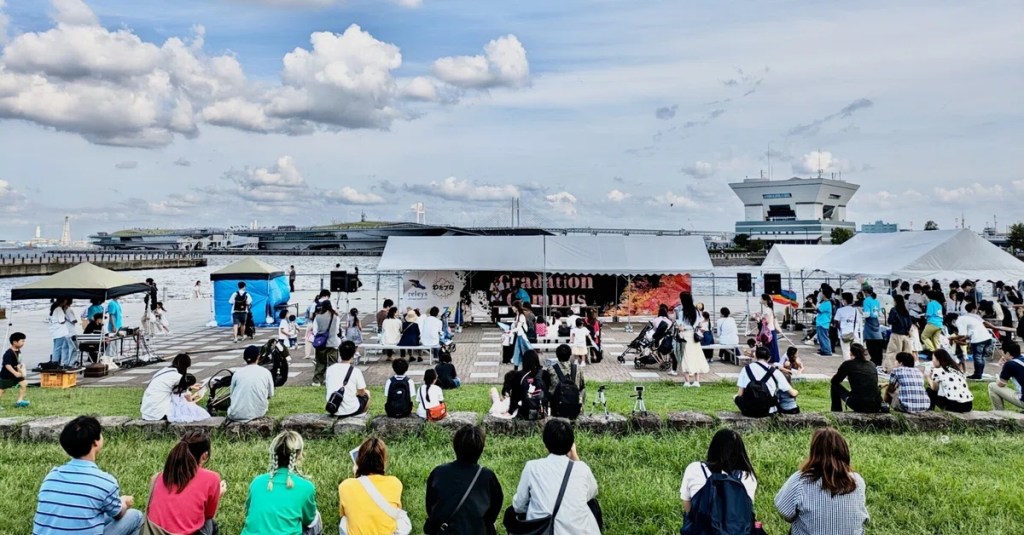
When I arrived at the venue, Zo-no-hana Park, the sky was so vast that I felt lonely. It was the sky of a harbor. I prefer the sparsely populated autumn sea to the midsummer when there are more people than fish, because it tickles my sadness.
But I realized that was a jump to conclusion. What? A line? Yes. It was a packed house. It almost felt like a festival. This was completely unexpected.
There was a stamp rally at the venue, and families could get cotton candy or shaved ice if they collected enough stamps, a great perk for families. Families who happened to be in the park participated in the event.
The Cotton Candy Project was started to encourage people who had no interest in LGBTQ+ to think about sexual diversity, along with rainbow-colored cotton candy. Ah, I see. That’s why it’s called the Cotton Candy Project.
Of course, the fun of the event wasn’t just the stamp rally. The stage program also had a wide variety of activities, including bingo, quizzes, talk sessions, professional singing and impersonations, and more. All of them were SOGIE-themed.
The audience laughed and applauded, and there was a lively call-and-response with the stage. I also liked the slightly rough, or should I say friendly, way they teased the audience.
Given the theme, there were bound to be people who were hostile, and in some cases, even hateful disruptions. The performers managed to rock the audience perfectly. Hats off to their skill and courage.
Although I wasn’t able to see the parade, I think I was at the event venue for a few hours. What impressed me most was the ingenuity and ingenuity of the students who ran the event. So that children can have fun.
We hope to get parents who have not been interested in SOGIE in the past to take an interest in the subject. If you are experiencing this, let it be known that you are not alone.
How can they do that? It was clear everywhere that they had repeatedly thought about it, revised it, revised it, and thought about it again and again. From the tone of the explanations, the footwork of the staff, and the progress of the stage.
What was even more impressive was that it created an atmosphere of “everyone is welcome!” A welcoming atmosphere is not something that the management can intentionally create. It is something that customers respond to and then spread to the next customer.
That day, the venue was filled with smiling people wherever you looked. The bright atmosphere was not only due to the clear weather.
There were probably sexual minorities among the organizers and performers on stage. It would have been impossible to have achieved something like that without all of them putting their heads and hearts into it.
Looking at them, I was reminded of something I felt that day that I couldn’t put into words. I don’t care if he’s gay. We’re friends so it doesn’t matter. “Ah. Maybe we just stopped thinking.”
My seminar classmates and I were young and didn’t think too deeply about it. We didn’t even have to think deeply about it, we just believed in our friendship. We were content to believe in it.
No, it’s disrespectful to the students of WataPro to blame them on their youth. They are thinking and acting. So it’s not a matter of age. We were just naive and cruel.
I wonder what S was thinking as he sat at the same desk as us before he came out. Maybe he didn’t take it so seriously. Maybe he felt lonely.
“Because loneliness is an axiom of life”
“Why did you come to our university?” S, who was so smart, might have boasted like that. If so, what kind of person was I to him?
On the way home, I saw Minato Mirai in the distance, and another memory was opened. Come to think of it, the graduation ceremony after party was held in Yokohama.
After returning home, I opened the pamphlet I had received at the venue. Inside was the following message from the organization’s representative:
“What we are working on is not an issue for the minority group LGBTQ+, but an issue of the lives of young people who suffer from loneliness and anxiety. We want to eliminate young people who take their own lives because of their SOGIE identity.”
Haa. I felt something else mixed in with the sigh of respect.
Oh. By the way. S isn’t dead. He’s alive. But he’s already 44 years old. So he’s probably alive. I think he’s alive, probably.
But I was the type to rush through life. I’m approaching the age where I’m getting more condolence gifts than congratulatory gifts. I’ll try to get in touch with him for a bit, even though it’s been a while since we graduated.
He’s a really fashionable guy. I wonder if we’ll meet again.
(End)
 Musuta Kusaka's Everyday Journey with Diversity, Equity, and Inclusion in Japan
コメントを残す