There is a class that changed my values. So much so that I could divide my life into before and after that class. Even though it was so important, I forgot the name of the class.
I think it was psychology or cognitive science. But even if I forget the name of the class, I will never forget the content of the class.
Humans may seem to act of their own will, but in fact, this is not always the case. Various elements of the environment affect humans, bringing out emotions and actions. In other words, humans can be manipulated by their environment. This is called affordance. For example, if a box has a round hole, you will put an empty can or a plastic bottle in it. If the doorknob is spherical, you will twist it, and if it is rod-shaped, you will push or pull it. It’s also the case that you will casually sit on a guardrail.
“So, gentlemen, look at yourself from 3 meters above the ground. Humans cannot block the influence of the environment. So you need to be aware of what is influencing you. You either dance yourself, or someone makes you dance. That’s the difference,” the professor said. I feel like that.
Humans live by free will. For me, a freshman in college who never even doubted that, it was a Copernican-like major shift in values. After that, I became a working adult who looked at the world with a negative attitude, thinking, “everyone is always being made to dance,” and that’s how it is now. A valuable lesson, ruined.
And then, for the first time in about 25 years, I encountered the word affordance again. This time, however, it was not through a classroom lecture, but through hands-on experience.
The venue is ” Summer Session 2023: Connecting Everyone through Culture .”

The event was organized by the Tokyo Metropolitan Government and Arts Council Tokyo at the Tokyo Metropolitan Art Museum in Ueno.

The official website said, “This nine-day event will create a new way of communicating with the arts and culture to realize a symbiotic society. Please enjoy the experience of appreciation that everyone can enjoy.” There are a lot of kanji characters. I don’t really get it. I was only able to understand “an experience of appreciation that everyone can enjoy,” so I decided to go. Even if I say that the lecture on affordance changed my values, this is the extent of the result.
A wide variety of artworks, installations, records, etc. were on display at the venue.

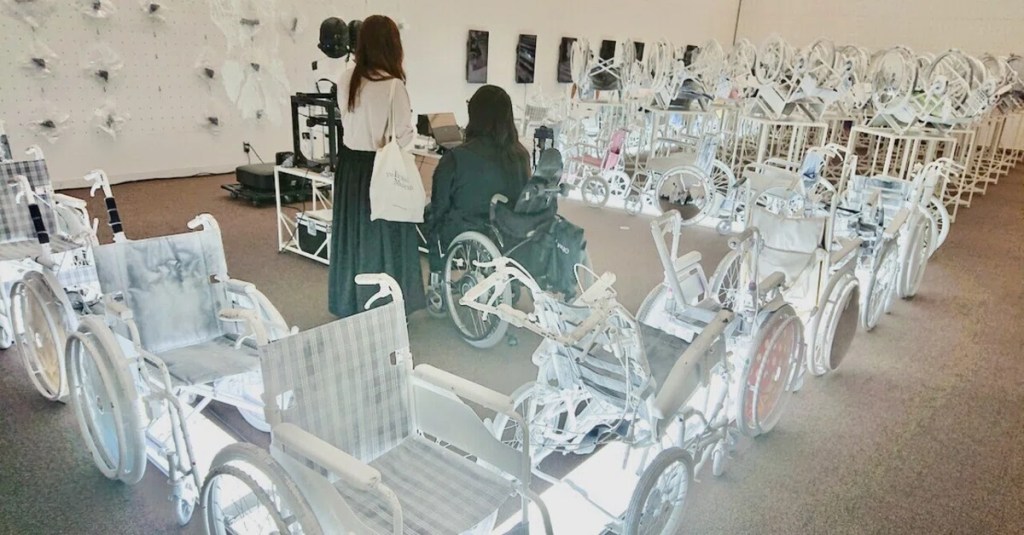
More than 60 wheelchairs were painted white and lined up in a cyber-like style. I didn’t have any other impressions than, “More than 60 wheelchairs painted white and lined up in a cyber-like style .” The explanation said, “The wheelchairs raise questions about diverse perceptions, bodily sensations, and communication with different others .” All I understood from reading the explanation was that I was unlikely to catch the question. My antenna was pointing in the wrong direction. Or rather, I was forced to face the reality that there was a very high possibility that the wheelchairs were hopelessly low-performance in the first place. That was also a learning experience.

On the other hand, there were some works that really caught my eye. “NISHIANRI YOSHIO” is a fashion brand launched by the aunties and grandmothers who gather at the Kioku Handicraft Museum “Tansu” in Nishinari , and the artist Nishio Miya . It’s so cute. I especially liked the jacket. I wonder if it would suit me? Apparently the shop is in Nishinari, so it’s not that far away. But it seems they also have an online store. I’ll try my best to save up some money and buy it. It’s been a while since I’ve found a brand that makes me think “I want this!” The price range is around 15,000 to 30,000 yen. But what is Yoshio?

This is the “See with your hands” exhibition at the Anteros Art Museum Tokyo Branch. You can “touch” various paintings. Needless to say, it is intended to allow visually impaired people to appreciate art, and it is also a new way to enjoy art. Without hesitation, I stood in front of “The Last Supper,” closed my eyes, and touched the work. I thought I
was about to touch the face of Christ who was about to be betrayed and crucified. But then I found myself caressing the faces of Peter and John. It’s difficult to appreciate hands. “The Last Supper” is said to have various ingenious ideas, mechanisms, and secrets in its composition and placement of figures.
It’s fun to look at it with your eyes, but it’s also fun to move both hands at the same time and experience it with your sense of touch. “If there was someone to explain it to me, I would be able to appreciate it 1,000 times more deeply,” I thought, while the addictive feeling of the plaster remained on my fingertips. A beautiful painting may be sensual even to the fingertips.
There were other very interesting exhibits such as information security and devices, deaf people and expression, etc. The “Exhibition of Works by High School Students from a School for the Blind who Experienced QD Laser and Photographer Ikeda Akira” was amazing, showcasing the joy and possibilities of taking photos, and the technology that allows you to see regardless of your eyesight by applying a laser to your retina.
The thing that really made the biggest impression on me was this one. It’s called “Touch Maze.” It was created in collaboration with Hayato Tabata, a tactile designer who is deaf-blind, and the magnet team, which creates works based on the theme of “connecting.”


It looks like a very pop athletics. It is made of PVC pipes.
You close your eyes and go around the whole thing relying only on the feel of the pipes.
The pipes not only go up and down like a roller coaster, but are also broken in places. There are short distances that you can reach by jumping your hands, and long distances where you will get lost until the next pipe if you let go of the pipe. The key is that the beginning and end of the pipes have signs called “tactile parts”. You know which direction to move your hand up, down, left or right to grab the next pipe, so you move forward while absorbing the information with your touch. In other words, it implements “tactile affordances”. Earlier there was a “painting to look at with your hands”, but this one could be called a “maze to read with your hands”.
I closed my eyes and put my hands on the pipe. I straightened my back like I was in ballet class. I felt like I would get lost even if I was holding the pipe as I shook the center line of my body. I walked step by step along the pipe, relying only on the feeling of my hands. The pace of rehabilitation. I was aware of the space not only of front, back, left and right, but also up and down.
Following the sign, I jump my hand. It feels like I’m jumping to the other side of a cliff. I land. Good. My hand has reached the next pipe. The next sign is for my hand to reach the ceiling. Ah. The back of my hand has hit the next pipe. Is this it?
Sign. I jump my hand. Land. Sign. Jump my hand. Land. Gradually I get used to it and my pace becomes a little smoother. A thrill. As a playground equipment it’s extremely fun. Another sign. I jump with practiced hands.Refreshing.
Huh? I can’t reach it. Where next? No matter how far I reach out, the pipe never touches my hand. Where is it? I’m anxious. I don’t want to do anything that would ruin the fun by opening my eyes here. But I’m scared.
“Look at your feet,” came the voice of a staff member from beside me. They probably couldn’t bear to see the man looking around restlessly even though he had his eyes closed. “Ohhh!?”

There were braille blocks there. Their official name was guiding blocks for the visually impaired. I didn’t even notice them. The sign was at my feet. Caution. Go ahead. “I didn’t notice them at all.” “Hahaha. That’s true.” Even though I knew the braille blocks were at my feet, I still couldn’t feel them under my feet. So I took off my shoes.

“Ah, I understand this.” A truly tactile affordance.
Why was I so surprised? Because there were braille blocks right under my feet, which I had never expected. Of course that was part of it. But there was more to my surprise than that. It was because I realized that I had completely missed the point of understanding that braille blocks are something to touch. Braille blocks are something to touch. Some people touch them with their feet, or with a white cane. Of course, there are also people who look closely at them. I felt like I had rediscovered not only their existence, but also their significance.
To put it another way, up until then I hadn’t imagined it. That someone would touch them in some way. For me, braille blocks were something I would step on without realizing it, passing by without noticing. I had lived a life in which I had never imagined that I would use braille blocks. In other words, perhaps I had not fully imagined that someone else would use them.
This is not limited to visual impairments, but also to any other disability, gender, nationality, illness, religion, etc.
What we think we understand intellectually is far from being fully understood.
I wondered if I had really learned what I had learned up until then. I wondered if I knew it properly. I felt as if everything I thought I had built up was crumbling beneath my feet.
It seems that my learning is still slow no matter how much time passes. I remembered the lecture on affordance once again.
 Musuta Kusaka's Everyday Journey with Diversity, Equity, and Inclusion in Japan
コメントを残す