
Documentaries are stranger than fiction
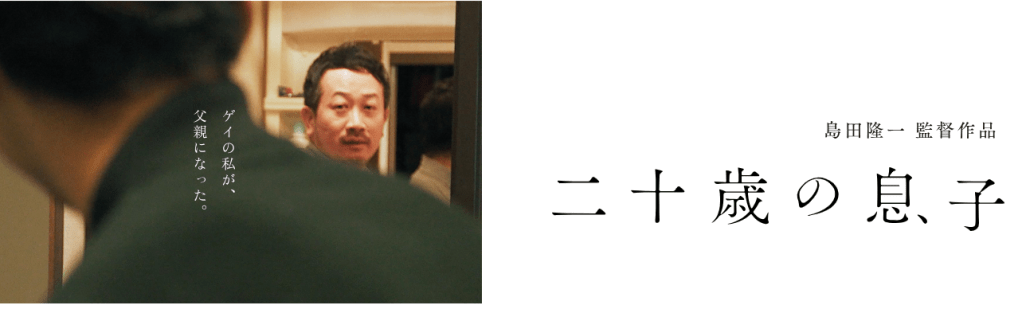
The movie “Twenty Year Old Son”.
I first learned about it on the website of a movie theater called Polepole Higashi Nakano in Tokyo. The tagline for the movie was:
I, a gay man, became a father
From the official website of “Twenty Year Old Son”
My first impression was “I see.” I don’t like stories that use SOGIE as a setting too easily. However, this movie was different. The lead sentence that follows reads as follows:
A gay man who became a “father” and his “son” who grew up in an institution. This is a documentary about a slightly strange and unusual “family.”
What? What? It’s a documentary? I was surprised. And here is the story introduction.
Amitani Yuki (40) works at an organization that supports the independence of children in child welfare facilities. He is gay and has set up organizations for various minorities, and holds lectures.
One day, he moves into a small apartment and welcomes a young man named Wataru (20). Wataru is one of the children Yuki has supported, but one day he commits a crime and is put in detention. With nowhere to go, Yuki offers to adopt Wataru and live with him as his father. Wataru was placed in a child welfare facility from an early age and grew up without knowing the faces of his parents, and Yuki had never imagined starting a family. The two of them begin their new life together, tinged with embarrassment and tension. While Yuki is confused about how to interact with Wataru, who has a complicated upbringing and is at a sensitive age, Wataru, who has found a home to return to for the first time in his life, begins to move toward his dreams while working part-time.
Wait wait wait wait. I absolutely want to see this. Damn. The screening in Tokyo will end in one week. So I forced myself to open up a break from work, in other words, I skipped work to see it (there’s nothing more sweet than skipping work to watch a movie).
I was right to slack off. “Twenty-Year-Old Son” was a wonderful movie. From social perspectives such as sexual minorities, children and young people in social adversity, human rights issues, and organizations that support and solve these issues, to personal perspectives such as family, lovers, friendship, and trust. It is a work that can be viewed from many different angles. And from any approach, it is a work that poses sharp and deep questions.
So I would like to introduce it a little here. As a fan of this movie, I hope that as many people as possible will watch it.
I will avoid spoilers, but there will be a few. Be careful. But it’s okay. It’s not the type of movie that has a true meaning in the plot.
The power of images allows us to read between the lines of the relationship between the two people.

The main characters, as introduced in the previous chapter, are the adopted father, Amiya Yuki, and his son, Wataru. The film begins with Yuki picking up Wataru from Tokyo Detention House and them living together in an apartment. In other words, the film unfolds by following the lives of the two men. We enter the house with a bang. Even dinner is shot so closely that you can practically hear the sound of them chewing.
However, this film does not have any obscene or nasty touch that incites lust, such as peeping into the private lives of others. It is straightforward. A gay man, a young man in his twenties. He was adopted and lives together with his wife. If you want to look at it from a critical angle, it is possible to make endlessly vulgar assumptions. Of course, this is largely due to the personalities of Yuki and Wataru, but I also feel that another factor is largely due to the uniqueness of this film.
That is, there are almost no interviews with the two. There
are almost no interviews with people, which is a common method in documentaries, and the film simply continues to film the two of them objectively in a dispassionate manner.
This allows the audience to focus on the distance between the two. Rather than what they are thinking, the attention is focused on how they are behaving. The
tentative trust they share as they eat dinner together. A nighttime walk where they keep their distance and say few words, and strangely, they are perfectly in sync. A smoke in front of a convenience store. A conversation over their shoulders at the low table and in the kitchen.
By deliberately sticking to their posture and appearance throughout the film, the viewer is able to read between the lines of their relationship. Therein lies the eloquence that only film can convey. This is perhaps the true essence of documentaries.
But of course, this is not a film shot only in a closed room at home. While the main focus is on the couple living together, the director also carefully follows Yuki’s daily life as a working man and Wataru’s lifestyle as a young man. Their families, colleagues, lovers, and friends. He even
captures the exact moment Wataru breaks up with his girlfriend. Zero delicacy. That’s how a documentary should be, but it’s really cruel to a boy who’s been dumped.
Again, he doesn’t interview the couple, let alone the people around them. Instead, he carefully films each of the supporting characters. It’s as if he’s trying to bring out the contours of Yuki and Wataru by doing so.
In that sense, I think this film can be said to be quite alienating to the audience. It doesn’t explain anything in words. You have to judge what message it contains from the images alone. Those who don’t understand are left behind.
However, I felt that this stance was most effective for this film because, like water that falls through your fingers, the charm of Yuki and Wataru cannot be fully captured in words. This is because it evokes various perspectives and interpretations.
The rage of courage gives heat to the film
Eliminate words and focus only on the images. It’s easy to say, but the audience will get bored if that’s all there is to it. After all, both Yuki and Wataru are ordinary people. What is shown on the screen is just the everyday life of ordinary people. Boring. So why is this film so compelling? I felt that it was Yuki’s presence. Who exactly is he?
Yuki is full of imagination for others and seems to have good communication skills. He has a carefree yet confident side. He is intelligent yet friendly, which is a good impression. I thought, “There were a lot of IT millionaires like this in the past,” and it turns out I was a little bit right. The official website of the movie introduces Yuki like this.
Born in Tokyo in 1978. After working for a major information service company and an IT venture company, he is currently working for Bridge for Smile, an NPO that supports the independence of children who leave orphanages and enter society. In 2014, he founded Bubbling, an NPO that provides mechanisms for people to think of “other people’s problems” as “personal problems.”
From the official website of “Twenty Year Old Son”
But this is just a cursory profile. While watching the film, my head was full of questions. My thoughts went back and forth between admiration that he can support his 20-year-old son and how he manages to do that. He
lectures seminars on sexual minorities for companies and government offices, and sometimes serves customers behind the bar counter. He sometimes holds meetings in an office that looks like a multi-tenant building, and sometimes plans workshops with his colleagues in rented conference rooms. He’s elusive…
All we know from the film is that Yuuki is a good guy and a smart guy. The rest is a mystery. It’s this mysteriousness that draws you in.
Speaking of mysterious, the question of “Why did Yuki decide to adopt a 20-year-old young man named Wataru?” is naturally raised. Although I know that not all actions have a reason, I am still curious about it.
In the previous chapter, I said that this film has “almost” no interviews, but one of the few interview scenes with Yuki was about “Yuki and Wataru’s encounter, and what he thinks of Wataru.” What did Yuki say in that interview?
It’s an important scene, so I hope you’ll pay attention to it in the main story.
Apart from this, I thought there was a more important scene that gave us a glimpse of Yuuki’s true nature.
It was a scene where he was discussing the planning of a workshop with NPO members. Should they make a case of a murder of a disabled person the theme of the workshop? The members hesitated because of the sheer brutality, antisocial nature, and heavy social impact of the case. However, as they tried to escape, Yuuki said this to them: “We are all perpetrators. I think that anyone who doesn’t realize that should just die.”
It’s not just the perpetrators who are perpetrators. Ignorance and indifference are pure violence, and we are all complicit in it. It may be an extreme way of saying it, but I took it as a message. Ouch.
Anger. Perhaps it is anger that drives Yuki. I felt that his adoption of Wataru was not unrelated to this. Of course, there is love and fate involved, but I think anger is what heats them up. He occasionally speaks about his upbringing, in which he felt a sense of discomfort with society. He relates it to his own gayness. It seemed like the source of the anger was around here.
However, this is merely a live commentary from the audience. Yuki’s character is very complex. In the end, I was only impressed by his many sides. Pure actions may often be accompanied by such a prism. It is also true that even though his personality is unfocused, I felt a sense of empathy and a feeling close to respect. It is a very strange viewing experience.
However, the way Yuki is portrayed seems to symbolize the stance of this film. Complexity as it is. Sometimes narrowing the focus can reduce the resolution of how we see the world. Things that are difficult to understand remain difficult to understand. Because that is the reality of the world.
Only one thing is certain. There is something there, opened up by heat and warmth. There is, without a doubt. That’s all. It is complex, yet at the same time pure. And it is something that is connected to the relationship between Yuki and Wataru.
The end was unexpectedly refreshing. Wataru’s departure leaves a warm feeling

Like Yuki, Wataru’s personality was difficult for me to grasp.
However, unlike Yuki, his quality seems to be a little different.
Wataru is introduced on his official website as follows:
Born in 1998. Entered an infant home at age 0, then transferred to a child welfare facility. Has no memory of his parents. Was placed in institutions and foster parents during his childhood, but experienced abuse from his foster parents and bullying at the institutions. In 2018, he was adopted by Amiya Yuki and officially became a part of the family.
From the official website of “Twenty Year Old Son”
This alone is enough, but the half of his life he talks about in the play was much more than this. It seems that he had a much more twisted, hard, criminal, and unapproachable upbringing.
In the play, various people ask Wataru about his past.
Of course, when welcoming someone as a new family member or friend, there are times when you need to ask them what you need to ask. If you don’t take a step further, there is a possibility that you won’t be able to provide adequate support if something happens. Wataru knows this, and he talks openly and frankly without refusing.
The more he talks about himself, the more I sense that there is a lot he cannot and will not talk about. Even
if I were to ask him about half his life in detail, it would be beyond my imagination, as someone who has lived in a safe zone.
Because it is beyond the reach of the imagination, it feels distant, and therefore less real. There is no doubt that it reflects the everyday life of an ordinary young person, but it seems like something that could possibly disappear while going to the convenience store. If courage is a prism, Wataru is an abyss. This is what I felt was different from courage.
Speaking the truth and speaking your true feelings are completely different. It may be a persona he acquired as a way of getting by in order to survive the world he finds difficult to live in. It is possible that he never thought about being understood by others. No, I think that possibility is very high. Old age brings loneliness. If that’s the case, perhaps he is much more mature than the older people around him.
As expected, at the end of the film, the room is shown with no sign of Wataru. Yuki explains to the camera. All of a sudden, he’s started living alone. He called and asked where he could buy a bed. When he asked why, he was told he was living alone. When he replied that he hadn’t heard that, he was told, “I just told you.”
Well, they’re 20 years old, so it’s good that they’re full of energy. It’s their privilege to make great strides. I just hope that Wataru’s single life will be fulfilling. But I’m a little worried.
I was touched by the additional comment that Yuki made.
When he said, “Why don’t you just take the bed with you instead of buying one?” Wataru replied,”What are you going to do when you get home? I’ll sleep there.” I think that’s what happened. Yes. Yuki had been able to create a home for Wataru. A place for him to come back to.
Needless to say, Yuki and Wataru are not related by blood.
They don’t have easy-to-understand names like love, romance, friendship, affection, or responsibility. However. There is a unique bond between these two. It is not some implicit role-playing that someone decided on, like “act like a father” or “because he’s a son.” He is not a father, but Yuki, and not a son, but Wataru, and they live together as they are. It is a form of family that can only be created with the personal names of Yuki and Wataru, and cannot be influenced by the interpretations of others.
I once had a father figure who was not related to me by blood. He called me “Yuta” and loved me. However, I couldn’t bring myself to call him “Dad” and continued to call him “Oji-chan” and we ended up parting ways. Whenever I watch family movies, I still feel the awkwardness I felt back then, but I also feel like these movies are stroking my head as a young child.
We don’t have many choices. To have hope, to believe in it and take action. Those are the only two things. Their relationship embodied that. I felt a sense of nobility. Like I had come across a rainbow or a shooting star. It was a movie that made me feel the sparkle of living with someone. After watching it, I was left with a faint scent of hope that maybe the world isn’t so bad after all.
So, I’ve written a lot, but if you haven’t seen it yet, please do. There are movie theaters all over the country where it will start screening from May 2023. It seems that the number of theaters showing it is also increasing. I hope that as many people as possible will be able to see it.
 Musuta Kusaka's Everyday Journey with Diversity, Equity, and Inclusion in Japan
コメントを残す