“This is what I wanted to do. This is what I’m scared of.”
The moment this documentary began, I was hit with a wave of admiration and awe at the same time, and that feeling continued until the very end.
After watching the movie, despite my brain being exhausted from the constant back and forth of emotions, something surged in my heart. ”So, what do I want to do? What can I do?” I remember that when I left the movie theater and walked up the stairs, my legs were filled with strength.
The movie is “Chocolate People.”
The story goes like this.
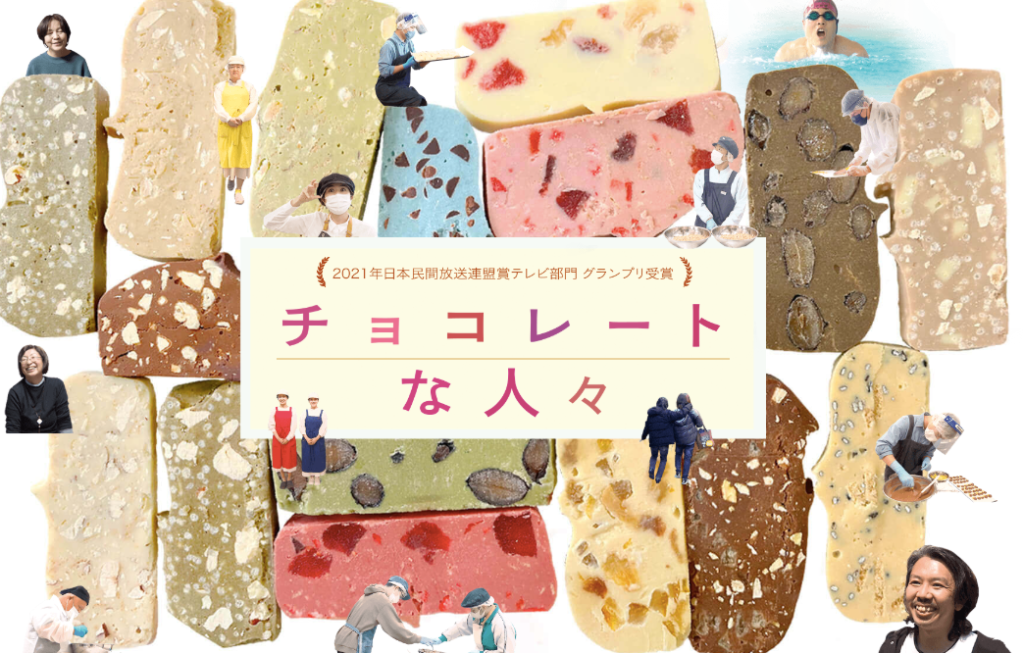
“Kuon Chocolate” is located on a street corner in Toyohashi City, Aichi Prefecture. It uses cacao from all over the world and carefully crafted flavors that show the faces of the producers. Its refined sweetness and colorful design quickly gained many fans. Its popularity spread throughout Japan, and now it has 52 locations nationwide, including shops and laboratories, and is a regular at glamorous department store events. “Kuon Chocolate” is a little different from other brands.
Representative Natsume Koji and his staff have unique and colorful ways of thinking, just like the chocolate they make. They have continued to create a workplace where diverse people, including people with mental and physical disabilities, single parents, people with school dropout experience, and sexual minorities, can work easily and earn a good living. (Omitted)
“Even if chocolate fails, it can be remade by heating it.” Moreover, chocolate is a magical ingredient that can increase its added value depending on the idea. The door to the dream of accepting diverse people was in sight. Thus began the bumpy story of a new and kind chocolate brand.
This is a documentary that follows Kuon Chocolate and its president, Mr. Natsume, over the course of 19 years. It
details his high aspirations, his likable personality, his ability to put things into practice, and his business success. It also covers the rationality and superiority of his business model. Above all, it details the lively work and smiles of his colleagues.
I couldn’t stop smiling while watching the movie. There were some scenes where it was hard to hold back the laughter. “Ah, this is what I wanted to do. I wonder if I can live with good vibes without classifying people. If possible, I want to be in a good mood and in good spirits. This is what I wanted to do.” It’s a movie of longing and happiness.
But it also reveals the financial risks and real-time disasters it faces, and it’s brutally relentless in its focus on past mistakes and people it has hurt and parted ways with.
I was groaning the whole time I was watching it. “This is the risk I’m taking. I know this is what’s going to happen, so I don’t take on anything.” It’s a movie of fear and reality.
In other words, this movie is interesting no matter how you slice it. It’s 100 minutes long, and thoroughly entertaining. As you’d expect from a Tokai TV documentary.
So, it’s actually hard to summarize my impressions. Analyzing in detail what’s so interesting about it seems foolish, like breaking delicious chocolate into pieces and eating it. Chocolate is best eaten with a big mouthful.
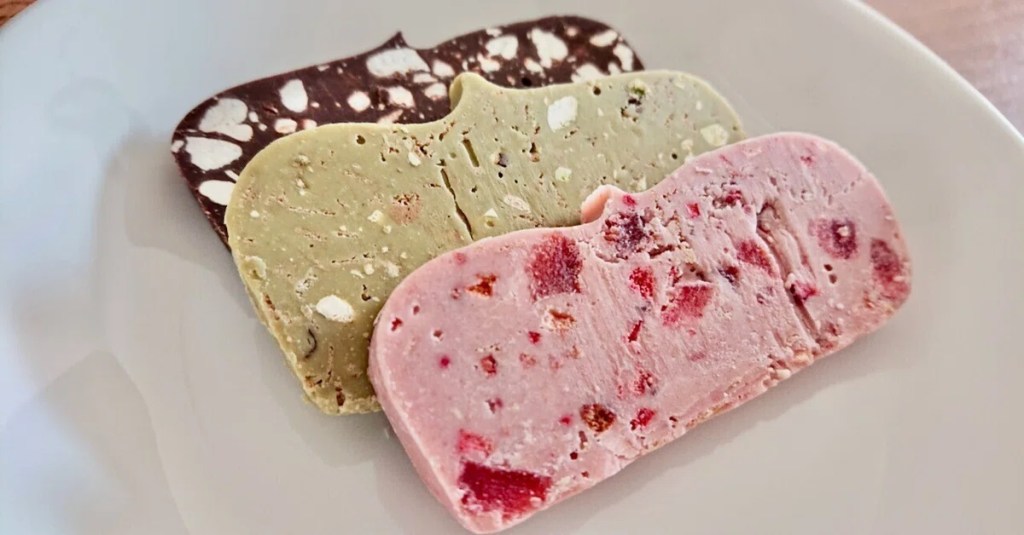
(That’s how my family ate the Kuon chocolate we bought. It was incredibly delicious. The flavor was surprisingly adult.)
Here, I would like to introduce the words of Natsume that made the biggest impression on me, in other words, the punch lines. I hope you can at least get a sense of the aroma.
“By combining Deco and Boko, we want to create a society with good taste.”

Gender, sexuality, disability, nationality, religion, etc.
As I do my research every day, I feel that many people and organizations that advocate diversity have categories such as sexual minorities, disabilities, and race.
Of course. If activist organizations do not focus on specific issues, their claims will be scattered. It is difficult to understand, so the number of people who understand will not increase. They cannot gather friends and activities will not proceed smoothly. Selection and concentration. This is understandable and makes sense. In the first place, with limited people, time, and money, they practice while covering with wisdom, drive, and ambition. That’s why I respect and support the people and organizations that are active, and I have no intention of dissing them.
However, it is true that there is a dilemma in that selection and concentration. Because there should be multiple categories at the same time. There are also sexual minorities with disabilities. There are also people who are double minorities in race and sexuality.
So sometimes, when I come across events that tout diversity but are not barrier-free or content that is not available in multiple languages, I wonder. Hmm? Aren’t we unconsciously dividing minorities into groups and thinking, “This is only for these people?” That kind of categorical thinking leads to a society that discards people (even though everyone is a minority in some way), and ultimately creates a society that cannot be sustained as it is.
Aren’t we inadvertently preserving categorical thinking?
In fact, we are gradually seeing more and more attempts to remove the barriers between categories. Events related to the Paralympics, large-scale events related to sexual minorities such as Rainbow Pride and Trans March, and events hosted by the Tokyo Metropolitan Government and the Nippon Foundation are actively working on this. Chizuru Azuma’s Get in touch is one example. But… I wonder if this is enough of a leadership force.
I wonder if there’s something we can do about our unconscious categorical thinking. Especially in the case of LGBTQ+, even if awareness of the term spreads, if a society of categories awaits us, discrimination will continue.
Is it possible to think beyond categories, based on the premise that everyone is some kind of minority, and has multiple minority characteristics, rather than a borderless society of majority and minority?
Hmm. How should I express it? There are groups and events that call themselves “diverse society” or “coexistence society,” as well as “mixed society” or “mixed society,” but I feel like they don’t fully express the “ease of living” that awaits us beyond that. I’ve been thinking about this for a long time, and I felt like Natsume-san hit the nail on the head. “By combining Deco and Boko, we want to create a society with good taste.” That’s it! A society with good taste! I’ve lived a life that’s far from any sense or sensibility, but this is it! I was struck by this.
What’s good about this phrase is that it leaves it up to us to decide what good taste means. What makes a good taste? That too can be diverse. However, he cautions us that it should be done by combining deco and boko.
As a result, Kuon Chocolate now employs a wide variety of people, including not only people with disabilities, but also people who are caring for others, single parents, transgender people, and more. In other words, it has become an easy place to work. It’s easy to live and work. Is there anything more tasteful than this? Don’t you want to see the workplace? Yes. This film shows that.
“I’m going to get the people of Kitashinchi to buy them and use the money to start a children’s cafeteria.”

Our representative, Natsume-san, is always fighting something.
“There are many organizations and welfare corporations that take it for granted that others will do this for them.”
As someone who has worked with welfare facilities and companies across the country to open stores in various regions, Natsume probably has many questions.
“Kuon Chocolate is run only by people with mild disabilities, as people in the welfare sector often say,” he said
, and the company has also started a new challenge by hiring people with severe disabilities as employees. It has opened a new factory to process the tea and fruit that are mixed into the chocolate.
“I’ve stopped bowing! If I bow, everyone who makes these will bow too. I want to tell them that our sweets are delicious too!” Why was Natsume bowing? I recommend you watch this film to find out, but you can also see him fighting for someone.
And the best part is this. “I get money from the people of Kitashinchi and use a few percent of the sales to run a children’s cafeteria” is the best (I forgot the exact wording, but please watch the main story).
Kitashinchi is a well-known entertainment district in Osaka. It is an area where ultra-high-end clubs (or boo-kura in Showa era terms) where you can sit for tens of thousands of yen are crowded together. However, Nishinari and Amagasaki are also nearby. In other words, it is a city where wealth, poverty, and economic disparity draw a sinister map. That is Kitashinchi, Osaka.
Natsume-san, as if to show his middle finger to the disparity and mock moneyism, sells a new product targeted at the wealthy customers who come to high-end clubs. It is called “Kitashinchi Madame Chocolate Banana”. The name is a sarcastic one. This is also a chocolate with a beautiful marble pattern, and it is a dessert in which you dip bananas.
Natsume-san himself goes to the club and sells it to the female employees. “Tell the customers who come to the store that you want to eat Kuon Chocolate”. How many people’s living blood do you have to suck to be able to sit on a chair that costs tens of thousands of yen just by sitting on your butt? He takes money from the rich and uses a portion of the sales to run a children’s cafeteria.
Wow! It’s hip-hop! This is what got me the most excited. So cool! Yes. Here too, he has “good taste.” It’s an idea that doesn’t come from a thought process that categorizes people. No, it might be more accurate to say that it’s an idea that doesn’t come from trying to jump over categorization. There’s no further description of the children’s cafeteria, but I think it probably went well. I hope it went well.
Although it is subtle, this is one of the highlights of the film.
“Most business people say things that don’t concern them.”

When Natsume, the representative of Kuon Chocolate, was studying barrier-free architecture at graduate school, he learned that the wages of people with disabilities were extremely low, so he started a bakery in Toyohashi City, Aichi Prefecture, with six staff members, including one with a disability. He set a goal of paying all employees a salary that exceeds the prefecture’s minimum wage.
At the beginning of the film, in an interview looking back on that time, he said , “It’s not inevitable that wages are low. It’s not convincing unless you actually create a workplace.”
And in the interview just before the end, he also said this:
“(Everyone says Kuon Chocolate is amazing and wonderful. But) most people in the business world say things that don’t concern them .” Ahhh! My ears hurt! The words of practitioners have a different eardrum-destroying power!
It’s easy to praise and praise. It’s easy to give a like! or donate money. But that’s just a view from the cheering section. “When am I going to stand on my own field?”
This film forced me to ask a big question. I’m 43 years old and at the halfway point of my life as a company employee and as a human being.
Until now, I’ve been doing my best to shake off various karma and entanglements and get my life and my family on track. You could say that I’ve spent half my life just getting into a company and getting on an economic track, as if to rely on the shade of a big tree.
There are probably many people who end their lives on that track. The baby boomer generation may be a typical example. However, I don’t know any attractive people among those predecessors. Not a single one.
People who got on the train called a company and were busy waiting for someone to take them somewhere.
It’s a job, it’s for profit, that’s what a company is like. An abandonment of thought, a lack of understanding of human beings. Even if they think they’re thinking for themselves, in reality they’re only tracing the convenience of the company. Naturally, it’s a narrow-minded world. As a result, there are people who spend the rest of their lives with something degenerating. And when I say the rest of their lives, I mean about 20 years after retirement. In reality it’s a re-start of adulthood. With brains specialized for the company and weak stamina. How many of these people plan to become when they retire from the business world?
I think many people will rethink how they live their lives after seeing Natsume, who is at the opposite end of the spectrum. Like me, they will think, “Maybe I should start slowly working on something that is not someone else’s problem, but something that is my problem
. “
In that sense, this film is also a movie that makes you feel like you can dream. Perhaps this is what we call empowerment. To be honest, it’s a little scary to watch Natsume, who has taken huge risks, sometimes pushing himself too hard, and yet has come this far without losing his aspirations. It’s real. That’s also the true joy of documentary films. Some people will feel a sense of heat in their own values and lives that were starting to solidify after watching this film. Just like chocolate, which “if you warm it up, you can start over again and again.”
Calling myself a diversity content researcher, I would like to first get my feet wet and see the situation on the ground.
This film is full of other punchlines and highlights. What I’ve introduced here is just a small part of it, not even a fraction of the Kuon Chocolate. So I’ll say it again: this is a must-see film. Tokai TV documentaries are famous for not releasing them on DVD, let alone streaming them. Be sure to see it while it’s playing in the cinema. Who knows when it’ll be screened again!
 Musuta Kusaka's Everyday Journey with Diversity, Equity, and Inclusion in Japan
コメントを残す