Did you have your first dream of the year?
Mine was a dream about love. And a luxurious double feature in one night.
Love for someone who dumped me when I was a student.
And love with someone who cheated on me after I became a working adult.
I got dumped by both of them the next day.
I woke up to the first laugh of the year, the kind that makes you cry if you’re not laughing, as the nightmarish events are purposely recreated in a nightmare. The
reason I had such a dream about love (or rather, being dumped) is because of an incredibly interesting movie I saw at the end of the year. There’s no doubt about it.
The movie I found so incredibly interesting was
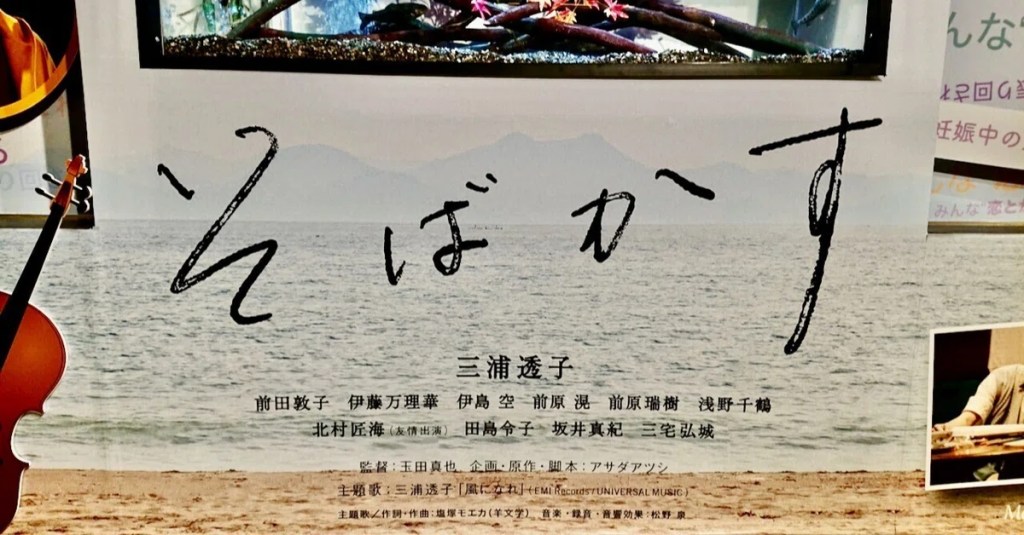
“Freckles.”
It had been a long time since I last saw a movie with a love theme at the cinema.

It’s not a typical romance movie where you wonder, will they fall in love? Or will they not? Or have they already fallen?
“Freckles” is the exact opposite. It’s a story about the protagonist gaining freedom by being liberated from the imposition of values on him, with love and sexuality as its themes.
The worldview of the work is bright, cheerful, and sometimes humorous. However, the protagonist’s conflict is vivid.
Tohko Miura’s acting, which makes it work, is also superb. Her acting in Drive My Car was also excellent, but this one was just as good.

I believe this is a work that anyone who has ever been tormented by someone else’s arbitrary common sense or preconceptions can enjoy, which means that a lot of people can enjoy it, so I would like to introduce it to you.
Synopsis of the movie “Freckles”

The main character’s name is Sobata Kasumi, or Freckles for short. It’s the title of the movie. She lives in a beautiful provincial city by the sea.
She’s a nice person who cares about her colleagues, but she has no friends. She has a blank look on her face and doesn’t smile much. She only gives a polite smile every now and then. She even seems to be deliberately suppressing her cheerfulness and sociability. This may be related to the fact that she chose a job as a customer service center operator, where she doesn’t meet people face-to-face.
Smoking alone suits her so well. The smoke she exhales while looking at the sky seems to be a mixture of relief and emptiness. It’s as if she has completely given up on getting to know others and being understood. It’s as if she finds comfort in giving up. This makes her appear “ennui”, “somewhat shadowy”, and “mysterious”, and she is the type of person who is misunderstood. That’s why she’s quite popular.
For example, when she’s called “Sohata-san”, instead of saying “Yes, what is it?”, she makes a gesture of lifting her eyebrows. The beauty of her eyes stands out, and they are surprisingly bright. The contrast with her expressionless face is sparkling. If she puts on a fake smile, it sparkles even more. It’s like the clouds are passing and the full moon is peeking through.
She doesn’t wear many vivid colored clothes, and she wears modest makeup. She even seems to avoid standing out and enjoying herself. And yet she is popular. She only smiles occasionally. She is even more popular. As a result, there is a good chance that men will show interest in you.
However, even people who easily attract the opposite sex have their own hells. This is especially true for our protagonist, Kasumi. That’s because she is aromantic asexual, meaning she has no romantic or sexual feelings for anyone. A moth to the light of love. And it’s not just annoying. Just when you think you’ve made a friend, they fall in love with you, and you have to apologize. It’s just that even though you care about someone, it doesn’t take the form of love or sexual love. It’s not hard to imagine how difficult life is for Kasumi. No wonder she avoids socializing with others.
She is 30 years old. One day, her mother pressures her to get married, and she is forced, or rather tricked, into going to an arranged marriage meeting. This is where the story begins.
Meeting and parting with various people brings about a turning point for Kasumi. There is a sad misunderstanding with an arranged marriage partner, a happy reunion with an old friend, and a new encounter that opens up the world. The most significant presence among these is Yonaga Maho, played by Maeda Atsuko. Maho, who has returned to her hometown from Tokyo, affirms Kasumi’s individuality and teaches her the joys of having friends. Before long, she naturally starts smiling more. After changing her occupation, she plans something with Maho, but…
To be happy as herself. To live with someone. And to have fun. What hope awaits Kasumi after overcoming her own challenges? This is the story.
A zombie virus called “common sense”. Just run away. There are sure to be people who can help you break through.

What I found unique about this film, and what gave me hope, is that it conveys the message that “it’s okay to run away. If there’s a challenge, it can lead to a breakthrough.”
For Kasumi’s family, co-workers, and other characters, love and marriage are “common sense. ” But “common sense” is often frightening. Once you are trapped, you may unconsciously force it on someone else. Because you are not aware of it, you may hurt someone without hesitation. Their ability to stop thinking and their aggressiveness are like a zombie virus. To me, the people around Kasumi seem to be infected with the love strain of the common sense virus. They appear unexpectedly at home, at work, or on the go, and launch a surprise attack saying, “Love and marriage are a given.” No matter how much you shake it off, they are common sense zombies that keep coming back.
However, even though Kasumi finds it difficult to live in such an environment, she doesn’t try to get those around her to change. She doesn’t loudly ask for people to “understand her.” She basically just bluffs and ignores what they say. She doesn’t increase her social circle. She even stops a plan with her friend Maho midway through.
There are no Marvel-style feats of transformation of anger into power to fight. She just keeps running away from confrontations with the common sense zombies.
Because everyone around her is good. You could say Kasumi is a good person because she is surrounded by caring people. Even if they are a little hopeless, they never have any ill intentions. In other words, Kasumi knows that there is nowhere for her to put her raised fist down. She can’t get angry. She can’t fight. She doesn’t want to be in conflict because they are not her enemy in the first place. I’m sure that many of the audience are people living in such a world. The earnestness of the story grabs hold of the viewer’s hearts and never lets go.
As the story progressed, I felt my empathy for Kasumi turn into a joint struggle. While fleeing from the common sense zombies, Kasumi changes her environment through her connections with friends and takes on the challenge of being herself. Her enemy is “common sense.” By trying to blow a hole in that, she begins to search for a way of life that is true to herself. The keywords are “job change,” “Cinderella,” and “living together.” Her days of flight turn into a breakthrough through the challenge.
And then, in the last scene, a small but powerful hope is found.
After struggling to break through the siege of the common sense zombies, she finds an emergency door. It could be said that this is the moment when her world opens up, as she realizes that “the door to happiness can be opened with a key other than love.” Surprising, dynamic, and refreshing. I felt invigorated after reading this book.
Is there anyone who hasn’t been attacked by a common sense zombie? I feel like I’m being bitten every day. Watching it made my heart ache. But even so, I don’t have the wisdom or courage to directly argue. In fact, I might have become a common sense zombie without even realizing it. I don’t even have the confidence to say, “I’m better.” For me, I don’t resist. But I don’t submit either. Escape and challenge go hand in hand. Kasumi’s down-to-earth challenge is truly real. It felt like the very embodiment of hope that one could wish for.
In addition, this work does not reject the value of love outright. It does not portray the characters as ridiculous. In that respect, I think it has an exquisite sense of balance. That is why it sharply raises the question of not questioning “common sense.”
The norms of the world, the norms at work, the norms at school.
Anyone who has ever been oppressed by “common sense” that has no reason for existence will recall a suffocating feeling similar to Kasumi’s. And I think there are probably many people like that.
Don’t let it lead to easy generalizations. Touko Miura’s acting ability

I’m sure there are many people like that. This is a work that does not make easy generalizations such as, “Not just in the form of love, but masculinity, femininity, skin color is so-and-so, young people are so-and-so, etc. If you substitute different words, everyone has the same pain.”
That’s because the words aromantic asexual are never used throughout the play. Kasumi is portrayed as she is, without being classified as anything. It is a personal story from start to finish.
Because being aromantic asexual is not the whole of who she is. It is a story about her grasping the key to finding happiness outside of romance and sexuality. Focusing on only one aspect, categorizing someone in an easy-to-understand way. This may also be because it has a thought-stopping structure similar to the common sense of romance, in that it disregards humanity.
That’s why. In order to make the audience feel the crudeness of categorizing someone, it is necessary to portray Kasumi as a person, involve her in joy, anger, sorrow, and happiness, and make them empathize with her. But Kasumi’s facial expressions and emotional expressions tend to be restrained. The powerful technique that overturns this dilemma is largely due to the acting ability of the lead actress, Toko Miura. I came to love her.
I feel like there has been an increase in controversy recently over whether it’s right or wrong for a non-participant to play a part of a gender or sexuality-themed work. So some viewers may think, “Isn’t this different from the reality of a person involved?” (According to the pamphlet, it was properly supervised by a person involved).
But Miura doesn’t state that he is either a person involved or not. I don’t think there’s any need to go out of his way to state that (so I haven’t searched or looked into it. Sorry if I’m wrong). In that respect, I would like to add that this film can be considered to have a structure that embodies the danger of fitting others into one’s own preconceptions in a meta-way.
Anyway, Drive My Car was amazing, but this one is also worth seeing. Although this film deals with Kasumi’s suffering and conflict, her antithesis to society, and aromantic asexuality, which is still not widely recognized, it is bright, cheerful, and sometimes humorous overall. This makes it a very easy-to-watch film. That’s why
the audience should feel hopeful at the end of the film. “Maybe I too can open the door with my own key. ” It’s as if Kasumi’s escape was actually a stepping stone to the future.
Thank you for reading to the end. Once again, this movie is a must-see.
 Musuta Kusaka's Everyday Journey with Diversity, Equity, and Inclusion in Japan
コメントを残す